

admissions season

Few black and Hispanic students admitted to top high schools, adding to calls for admissions rules changes

Few black and Hispanic students won seats in eight of the city’s specialized high schools this year, prompting Mayor Bill de Blasio to repeat a campaign trail declaration that the admissions process needs an overhaul.

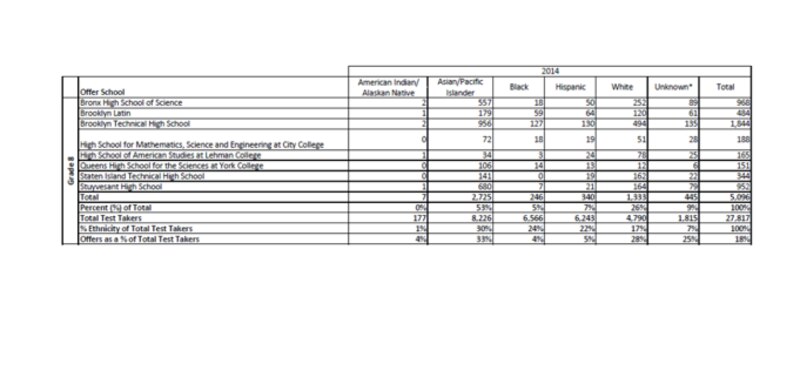
Just 11 percent of the offers to eight of the city’s top high schools went to black and Hispanic students, though they make up about 70 percent of the city’s eighth graders. That figure is similar to last year’s, though for some schools the number of offers to black and Hispanic students continued to fall. Just seven of 952 students accepted to Stuyvesant High School are black, and 21 are Hispanic. No black students were admitted to Staten Island Tech, down from five last year.

Students get those admissions offers based solely on their performance on the Specialized High School Admissions Test. Civil rights groups and de Blasio himself have said that process contributes to inequity, since lower-income families have less access to high-quality elementary and middle schools or external test preparation,

On Tuesday, the mayor and Chancellor Carmen Fariña signaled that they would be revisiting the admissions requirements—though their time frame isn’t soon enough for some.

“Over time we’re going to have a series of steps we take,” de Blasio said. “I think ultimately we need to reform the admissions system. That’s something we’d have to do with Albany.”

That’s partially true, since three of the eight specialized schools that use the exam have their admissions rules codified in state law. But the mayor could change admissions rules for the other five, including Staten Island Tech, to include other measures like student grades at any time.

Fariña said in a statement that the department will be looking into the admissions gap “in the coming months.”

Their statements represented an official shift from former Mayor Michael Bloomberg, who repeatedly said that the admissions process was an equitable one because all students were judged by the same criteria.

“You pass the test, you get the highest score, you get into the school — no matter what your ethnicity, no matter what your economic background is. That’s been the tradition in these schools since they were founded, and it’s going to continue to be,” Bloomberg said in 2012.

To Lazar Treschan, the director of youth policy at the Community Service Society of New York,  today’s numbers were just the latest confirmation that the admissions process needs to reflect more than a test.

“Zero [black students] at Staten Island Tech and three at Lehman? It’s not like there are no black students in Staten Island and the Bronx,” Treschan said, referring to the High School of American Studies at Lehman College, which is not required by law to use the Standardized High School Admissions Test for admission. “It’s academic apartheid.”

Treschan co-authored a report last year with the the NAACP Legal Defense Fund that laid out options for a “fairer and more effective” process for determining who gets the city’s most-coveted high school seats. The report points out that most of the nation’s highest performing, selective high schools already use more than one measure to determine admission.

The NAACP Legal Defense Fund also filed a civil rights complaint about the specialized high school admissions process in 2012. Lawyer Monique Lin-Luse, special counsel to the education group at the Legal Defense Fund, said the U.S. Department of Education Office of Civil Rights is still investigating that claim.

The civil rights complaint is one of three fronts on which the group is fighting to change the admissions policy, Lin-Luse said, including state legislation and lobbying City Hall to change the procedure for the five schools in their control as soon as possible.

“There is a sense of urgency that decisions need to be made so so that students can prepare,” Lin-Luse said. “We shouldn’t wait another year.”

The state legislation would allow city officials to determine the admissions criteria for Stuyvesant, Brooklyn Tech, and Bronx Science. State Assemblyman Karim Camara sponsored the bill in the Assembly, where it has stalled for the last two years. But Camara said today that he’s hopeful that de Blasio’s support could help push a more ambitious, amended version through the legislature.

“Over the next few weeks we will be announcing a very specific piece of legislation,” Camara said. “What we have now is a plan that we’re developing that would lay out the measures, from expanding the pool of applicants to having more notification to children of color.”

The Department of Education also announced the results of its regular high school admissions process today, and officials said that 45 percent of eighth graders who applied got into their first-choice school—down slightly from 47 percent last year. 73 percent of applicants got into one of their top three choices.

10 percent of the applicants didn’t receive a high school match and will need to go through round two, when they can rank schools that still have available seats and apply to a group of newly announced schools.
Screen Shot 2014-03-11 at 6.53.19 PM

Summer remix

Ten stories you may have missed this summer (and should read now as the new school year kicks in)

PHOTO: Caroline Bauman
Gabrielle Colburn, 7, adds her artistic flair to a mural in downtown Memphis in conjunction with the XQ Super Schools bus tour in June.

Labor Day used to signal the end of summer break and the return to school. That’s no longer the case in Tennessee, but the long holiday is a good time to catch up on all that happened over the summer. Here are 10 stories to get you up to speed on K-12 education in Tennessee and its largest school district.

TNReady is back — with a new test maker.

Last school year ended on a cliffhanger, with the State Department of Education canceling its end-of-year tests for grades 3-8 in the spring and firing testmaker Measurement Inc. after a series of missteps. In July, Commissioner Candice McQueen announced that Minnesota-based Questar will pick up where Measurement Inc. left off. She also outlined the state’s game plan for standardized tests in the coming year.

But fallout over the state’s failed TNReady test in 2015-16 will be felt for years.

The one-year void in standardized test scores has hit Tennessee at the heart of its accountability system, leaving the state digging for other ways to assess whether all of its students are improving.

Speaking of accountability, Tennessee also is updating that plan under a new federal education law.

The state Department of Education has been working with educators, policymakers and community members on new ways to evaluate schools in answer to the federal Every Student Succeeds Act, or ESSA, which requires states to judge schools by non-academic measures as well as test scores.

Meanwhile, issues of race and policing have educators talking about how to foster conversations about social justice in school.

In the wake of police-related killings that rocked the nation, five Memphis teachers talked about how they tackle difficult conversations about race all year long.

School closures made headlines again in Memphis — with more closings likely.

Closing schools has become an annual event as Tennessee’s largest district loses students and funding, and this year was no exception. The shuttering of Carver and Northside high schools brought the total number of district-run school closures to at least 21 since 2012. And more are likely. This month, Shelby County Schools is scheduled to release a facilities analysis that should set the stage for future closures. Superintendent Dorsey Hopson has said the district needs to shed as many as two dozen schools — and 27,000 seats — over the next four years. A Chalkbeat analysis identifies 25 schools at risk.

Exacerbating the challenges of shifting enrollment, families in Foote Homes scrambled to register their children for school as Memphis’ last public housing project prepared to close this month amid a delay in delivering housing vouchers to move elsewhere.

The new school year has officially begun, with the budget approved not a moment too soon for Shelby County Schools.

District leaders that began the budget season facing an $86 million shortfall eventually convinced county commissioners to significantly increase local funding, while also pulling some money from the school system’s reserve funds. The result is a $959 million budget that gives most of the district’s teachers a 3 percent raise and restores funding for positions deemed critical for continued academic progress.

The district also unveiled its first annual report on its growing sector of charter schools.

With charter schools now firmly entrenched in Memphis’ educational landscape, a Shelby County Schools analysis shows a mixed bag of performance, while calling on traditional and charter schools to learn from each other and promising better ways to track quality.

summer mix tape

Ten stories you might have missed over the summer (and should read now as a new school year begins)

PHOTO: Nicholas Garcia
Students work on an English assignment at M. Scott Carpenter.

There is no such thing as time off from covering education. While school doors were shuttered, plenty happened this summer on the Colorado education beat. Here, we’ve compiled stories that we hope prove useful as you ease back into your fall routines.

We’ve got your immunization data right here … 

For the second year, Chalkbeat tracked down immunization data for more than 1,200 schools in Colorado’s largest school districts. Our database revealed that Boulder remains a hotspot for the anti-vaccination movement, students in districts with racial and income diversity are more likely to get their shots and nearly half of schools in the database did a better job this year tracking students’ immunization records. Read our news story about the findings, check out these six charts that dig into the numbers and search for school-level data here.

Denver Superintendent Tom Boasberg reflects on his sabbatical (a break not everyone appreciated)

In June, Denver Public Schools’ longtime schools chief returned from a six-month unpaid sabbatical in South America with his family. “It made us appreciate the extraordinary resources we have here,” he said in an interview about his experience.

A milestone for Colorado charter schools on diversity, but not so much on integration

For the first time, Colorado’s charter schools educated a larger proportion of racial and ethnic minorities than district-run schools, a state report showed. We took a closer look and found that does not mean charter schools are more integrated.

Race, policing and education during a summer on edge

This summer sadly provided no shortage of violence and heartache over issues that sometimes feel like they’re tearing America apart at the seams. We sought to bring some local perspective (and wisdom) to the debate by talking to an ambitious Manual High School student who took up a bullhorn at Denver street protests and to Aurora Public Schools Superintendent Rico Munn.

A middle school’s last-ditch effort to save itself 

An Adams County middle school running out of time to improve has placed its bet on more challenging, more personal teaching — and zero test preparation. Watch Chalkbeat later this week for a report on whether these efforts paid off in the form of improved state test scores. (Hopefully … the data are set to be made public Thursday).

Guess which Colorado school district had a high proportion of teachers designated to lose tenure …

Compared with other large Colorado school districts, Denver Public Schools had a higher proportion of teachers set to lose tenure under a sweeping educator effectiveness law passed six years ago. We surveyed big districts about one of the consequences of Senate Bill 191.

Too darn hot to teach and learn 

As part of its big bond request of voters this fall, Denver Public Schools wants to try to cool off some of its hottest schools. We took a look at where the mercury soars the highest and found that in 12 of the 18 hottest buildings — some of which house more than one school — the number of students who qualify for free or reduced price lunch exceeds the district average.

But the University Club has a lovely lunch menu (and squash courts, too)…  

What if the State Board of Education held a not-so-public meeting with the education commissioner at a private club downtown to prioritize goals, but didn’t get much of anything accomplished? That happened.

What we know — and don’t know — about Colorado remediation rates

Colorado’s college remediation rates inched upward after years of steady decline, a disheartening development. On top of that, we’re not getting the full picture, either, because of incomplete school-level numbers and non-existent district-level data.

Diet Coke: Coming soon to a high school vending machine near you? 

Despite opposition from advocacy groups, Colorado appears headed toward lifting a seven-year ban on diet soda in high schools. The rule change would clear the way for diet soda to be sold in high school vending machines and school stores, though districts could decide not to stock the drinks. We covered the issue before and after the State Board of Education’s initial vote.