


Sign up for Chalkbeat’s free weekly newsletter to keep up with how education is changing across the U.S.
GRANADA, Colo. — The black-and-white photographs show neat rows of young men wearing old-fashioned football uniforms and leather helmets. As elementary students jostled around the museum display, Granada High senior Emersen Hernandez explained that the Amache Boys’ Club team only ever played one home game, against nearby Holly.
Amache won that game. But most other teams in the region did not want to play at Amache — or play against them at all.
“Why?” one boy interrupted.
Emersen paused before answering. But she didn’t shy away from the reason. “At the time, there were a lot of racists in the area, and they did not want anything to do with the Japanese Americans.”

The younger students, many in their purple Cheraw Wolverines T-shirts, had traveled an hour by yellow school bus for their October field trip to Amache. Located in southeast Colorado just outside the tiny town of Granada, it was one of 10 sites where the U.S. government imprisoned tens of thousands of its own citizens during World War II.
Under the leadership of teacher John Hopper, the site and its stories have for more than three decades had an unusual set of caretakers: Granada High School students like Emersen.
Students have sifted through dirt to find discarded children’s toys and broken glass bottles of lithium-laced Cheer Up soda. They’ve recorded firsthand stories from survivors and their families. They’ve mowed the grass and tended the cemetery.
Amache represents the kind of difficult American history that many teachers are wary of broaching in the classroom. Addressing it wasn’t popular back in the 1990s either, when Hopper first had his students send questionnaires to survivors.
“I had a lot of pushback from locals. ‘Leave it alone,’” Hopper recalled. “I was getting letters. I was getting phone calls. I was not very well-liked.”
Over time, Hopper’s Amache course became a sought-after elective at Granada High School, and the Amache Preservation Society became an elite club with its own letter jackets.


The work done by Hopper’s students helped lay the foundation for Amache officially becoming a national historic site in 2024. That put the federal government in charge of the site. Hopper ensured Granada students would keep control of the small independent museum they run out of a converted bank in town. At this de facto visitor center, they give tours to school groups and tourists filling their National Parks Passports.
This is sensitive work. Few people today believe this history should be ignored. But exactly how it should be told, and what lessons this episode holds for the current political moment, have divided people for decades.
The Granada students have always steered clear of partisan politics while sharing those stories. But the Trump administration’s push for schools and national parks and museums to present a positive view of America’s past has made politics more challenging for students to sidestep.
QR codes went up last summer at Amache and every National Park Service site advising visitors to report anything “negative about either past or living Americans.”
The National Park Service has since removed a slavery exhibit from a Philadelphia home where George Washington lived, though a federal judge ordered it restored. The Pride flag came down at Stonewall National Monument, though New Yorkers promptly raised it again. The park service has plans to remove signs at more than a dozen other sites.
Hopper is getting questions again, from both visitors and locals. “What are you going to do about your museum? It’s mostly DEI.”

Amache museum tells story of Japanese American internment
Today at Amache, you can find a reconstructed water tower, community center, barracks building, and watchtower. Sage and blue grama have reclaimed much of the site, though elms planted by those incarcerated here still dot the landscape.
But between 1942 and 1945, this site was the 10th largest city in Colorado. In total, roughly 10,000 people of Japanese descent, most of them U.S. citizens, lived here behind barbed wire and under constant military guard, in hastily constructed barracks that afforded little privacy or protection from the wind and dust and cold.
“It just scared the living daylights out of me when we went by it on the highway,” said Sandra Ellis, who grew up in a nearby town. “We assumed they were locked up because they were dangerous.”
Plans to round up people of Japanese descent in the event of a war had been laid years earlier. After the Empire of Japan attacked Pearl Harbor, President Franklin Roosevelt invoked the Alien Enemies Act to arrest non-citizen immigrants and community leaders.
Then on Feb. 19, 1942, Roosevelt signed Executive Order 9066, authorizing exclusion zones from which military authorities could order the removal of civilians. Military officials first imposed curfews only on Japanese Americans, then encouraged them to leave the West Coast voluntarily, and then ordered their removal and detention in the U.S. interior.
The Amache Museum tells this story. There are posters ordering people of Japanese ancestry to report for evacuation and suitcases into which they crammed what they could carry.
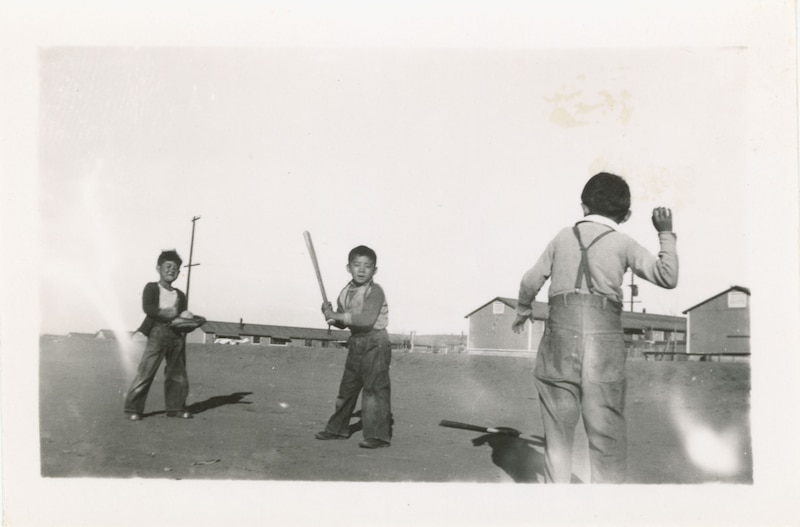
“Little kids, like you guys, they couldn’t bring their toys,” Emersen, her dark hair pulled back in small braids, told the Cheraw students. “They had to take things that their families needed, so extra sheets, extra jackets, sweaters.”
Faculty and graduate students from the Amache Community Archeology Project, based at the University of Denver, helped Granada students learn how to catalog artifacts and display them in meaningful ways.
There are kimonos and traditional Japanese instruments, cards produced by Amache’s silk screen shop, and a wedding cake topper that was used again and again. There are loyalty tests that marked some for transfer to harsher camps and passes that allowed those deemed low-risk to leave the camp for work.
These items shape students’ discussions with visitors. Emersen recalled one person who questioned whether people at Amache were truly incarcerated.
“I was explaining how they could leave with permission and get passes and IDs to go into town, so one man asked me, ‘If they can leave and go in and out, they’re not really prisoners, right?’”
“But if you have to get permission to leave and you have to come back,” Emersen said she told him, “you’re not free.”
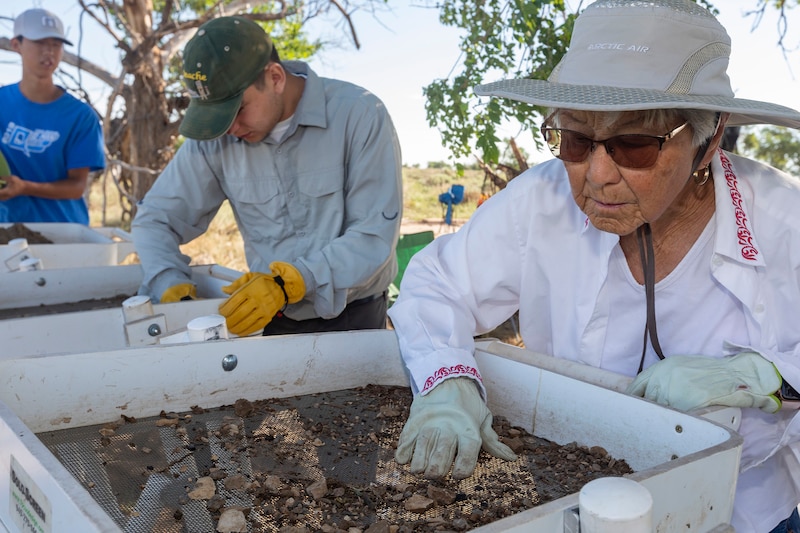
Students let Amache visitors make up their own minds
A large group had just left the museum last summer when the students found something alarming tacked up in a semi-private cubicle where survivors and their descendants leave handwritten remembrances.
Next to note cards describing how one person’s mother had to report for removal a week after giving birth, and how another’s parents met at Amache, were the words “WE HAVE LEARNED NOTHING” and articles and photos about “Alligator Alcatraz,” the immigrant detention center recently built in the Florida Everglades.
The students don’t know if someone from that group put up the Alligator Alcatraz display, or if any visitors saw it.
“The person probably thought, ‘Oh, the people who work here or the people who are coming to visit, they would agree with what we’re putting up,’” Emersen said. “But the museum is supposed to be about the Japanese Americans, and putting up stuff like that takes away from what people are trying to learn.”
Out at the camp, next to the QR code, another visitor left their sarcastic take on what a positive version of the incarceration story might look like.
“It was the Spring of 1942 and President Roosevelt decided to treat people of Japanese descent to a fabulous free vacation at one of ten fantastic luxury resorts built just for the occasion,” it began.
Students worried that visitors might take it at face value.
“When people go there, they don’t expect something sarcastic,” said Destiny Garcia, also a senior at Granada High School and a member of the Amache Preservation Society. “So some people might have taken it serious, and that’s misinformation being spread.”

Granada students don’t see their work as political. They also believe Amache has lessons for today. “This can happen again,” Emersen said. “The Constitution hasn’t changed. Everything you see here, it could happen to another person again.”
A former Japanese American incarceration site at Fort Bliss in Texas has been reopened as an immigrant detention site. Several states are using an obscure law, last used to identify Japanese immigrants for relocation, to bring criminal charges against unauthorized immigrants who fail to register.
Today a majority of Granada students are Hispanic. Destiny said she worries about people being questioned or detained based just on their appearance. But the goal of the Amache Preservation Society is to present historical facts, not tell people what to think.
“We leave political opinions for the visitors to conclude,” Destiny said.
Amache offers students the chance to be historians
Hopper knew about Amache back when very few people talked openly about it. He grew up about an hour away, and a friend of his parents had been interned there. And whether people talked about it or not, signs of that history were everywhere.
The town used portions of the Amache site as a landfill and a fairgrounds. The physical materials of Amache, auctioned off after it closed, were scattered around the region. The Amache hospital laundry became the school district’s bus barn. Some residents grew up eating out of Amache’s soup bowls.
Hopper, who sports a mustache, has a quality particular to the best teachers, who can command kids’ attention and get them to do things they didn’t think were within their reach. But when he was young and inexperienced, he was looking for ways to make history more engaging. He was also curious about Amache, so he put his students on the case.
Starting with just a few addresses, they sent questionnaires to survivors. These interviews expanded the historical record of what happened there and slowly built trust with people who had not always been welcomed back when they started making pilgrimages in the 1970s.

Working with the school’s math teacher, students built a scale model of Amache. They calculated the slope of the site and measured barracks’ foundations to get it right. Drawing on his graduate school archeology experience, Hopper taught the students how to build sifters and took them to look for artifacts.
Students loved the chance to be historians and not just read about history. They formed bonds with survivors and their descendants, who entrusted them with artifacts and sought their help in researching family stories.
“It’s not just state standards this, state standards that,” Hopper said. “It’s practical knowledge of how to do things and how to do it correctly and how to use critical thinking skills to figure it out.”
Hopper got a tip after a local rancher died that the camp’s old water tank was in a field some 20 miles away, where it had been used to water cattle. But the estate was tied up in probate, and things were getting ugly.
Hopper gave the job to a student because he knew it would be harder to say no to a kid.
“He had to call 43 different people from that family,” Hopper said. “He called cousin Eddie and cousin Betty. He called this person and that one to get to the right person. And that person said, ‘It’s yours, but you got to get down there now and get it off.’ So that’s what we did.”
The restored water tower is now one of the site’s defining features.
Ellis, who felt scared when she drove past as a child, can see it from her window. Now it fills her with awe.
“They got to have been very strong and courageous people to be plunked down in the middle of that prairie and do what they did,” she said. “And then to find out they were American citizens.”

Granada students’ work changed minds at home
When the Army ordered Japanese Americans to leave the West Coast, Mitch Homma’s grandfather Kyushiro Homma lost a thriving dental practice in Los Angeles that served Hollywood actors and University of Southern California football players. He died in Amache, most likely of a heart attack or stroke, at just 44 years old.
Homma’s father, Hisao, was 8 years old at the time.
Homma is now the president of the Amache Alliance, a California-based group that represents survivors and descendents. He didn’t learn much about his family’s story until his grandmother died in 2004, and he uncovered a trove of photographs — prewar family photos that church friends had saved and camp images his grandfather had taken with cameras smuggled in with his dental equipment.
Digital copies of those photographs — a rare find in a community forced to abandon family albums and restricted from taking new photos in camp — are now part of the Amache Museum’s collection. A panel tells the Homma-Wada family story.
Exploring that story wasn’t easy. Homma’s first trip to Amache with his father opened old wounds.
“When Dad got off the bus, and I saw the look on his face, I thought I was the worst son in the world,” Homma said. “You could see all the memories coming back. When I pushed and probed, he would remind me: ‘Amache took my father.’”
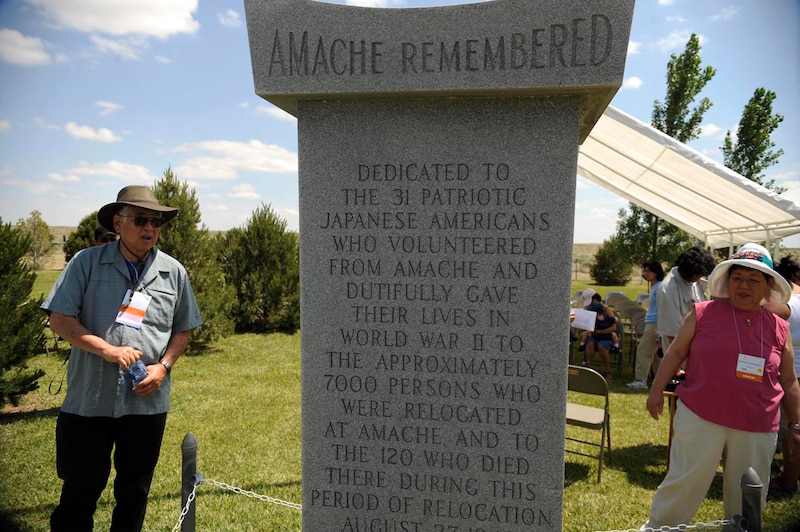
President Ronald Reagan apologized for Japanese American incarceration in 1988 — the result of decades of Japanese American activism that sometimes divided the community.
But anti-Japanese sentiment from the war years remained widespread when Hopper started this work.
Then-Granada mayor Alan Pfeiffer told the alternative weekly Westword in 2001 that he didn’t see much value in learning about Amache. Pfeiffer’s father had been at Pearl Harbor and “didn’t have a good taste for the Japanese up to the day he died,” he said.
At one point, Hopper said, a woman came all the way from Idaho to confront him while he was working with students at the cemetery. She demanded to see his curriculum. He told her it was public knowledge, and she was welcome to review it.
In the face of skepticism and hostility, Hopper urged his students to stick to the facts. Their presentations were backed by primary source documents and vetted by survivors. Everything they told people about Amache, they could explain how they knew it to be true.
Slowly, attitudes changed. When Amache became a national historic site, Granada Mayor Argie Thrall Jr. issued a statement of support.
“It was the kids who changed the minds of their parents and other people in their region,” Homma said. “I always refer to them as little educators.”
Amache story remains in the hands of students and descendants
So far, no changes have been made at any of the six Japanese American incarceration sites in the NPS system, according to both parks supporters and the Interior Department, which oversees the National Park Service.
An Interior Department spokesperson denied that changes underway at other sites involve diluting or rewriting history. In an email, the spokesperson said the National Park Service is doing routine reviews and maintenance “to ensure accuracy, honesty, and alignment with shared national values” to comply with President Donald Trump’s executive order on “Restoring Truth and Sanity to American History.”
Visitor comments in response to the QR code reviewed by Chalkbeat overwhelmingly supported telling the full history of Amache.
“I think our country is strong enough to understand the history of our nation in its totality, and I think that anything less than that makes us weak,” one person wrote.
Changes are coming for Amache, though. Existing signage includes a mix of materials put up by the Amache Preservation Society, Colorado Preservation Inc., and others over the years. Some signs are sun-bleached and hard to read.
Now that Amache is a national historic site, Japanese American organizations, academic experts, and others are working with the National Park Service on planned updates. Homma worries about the park service’s larger educational mission, but he said initial reviews of new material have gone well.
Advocates for Amache are choosing their language carefully. They don’t want to sanitize the story and risk people “thinking it was a YMCA summer camp,” Homma said. Nor do they want to “jab the government in the eye.”
“The site’s not there to make people feel horrible about what happened,” Homma said. “It should never happen again. I’m not trying to water that down. But there are great stories of resiliency.”

Those incarcerated at Amache coaxed vegetables from the soil with farming techniques brought from California. They published newspapers and formed dozens of clubs. Young men and women volunteered for military service at the highest rate of any camp.
That perseverance is a message Tanner Grasmick also hopes to impart on visitors. As a student, talking directly to people who were “uprooted from their home and had to move to the middle of nowhere and make the best of it” made a deep impression on him.
Inspired by Hopper, Grasmick became a teacher and returned to Granada. Hopper is officially retired, though he still works part-time, and Grasmick has taken over running the Amache Preservation Society. Students are already talking to him about wanting to join next year.
The museum remains in the control of the Amache Preservation Society, so the federal government won’t dictate the stories it tells. And as Grasmick steps up to guide students, Hopper said he’s playing the role of the superintendent who had his back when he was a young teacher. If there’s any heat to be taken, he’ll take it.
Grasmick said he feels supported by a community that once wanted Hopper to back off.
“We tell the story as it is, regardless of how uncomfortable it might be, regardless of anything,” Grasmick said. “If that’s the story that happened, we’re going to tell it how it was.”

Teaching Japanese American incarceration
Arrange a visit to the Amache Museum and Amache National Historic Site.
Visit other Japanese American incarceration sites in the National Park system.
Densho offers lesson plans and video interviews with former incarcerees. Densho preserves oral histories, images, and other historical documents related to Japanese American incarceration and promotes civil liberties.
Heart Mountain Japanese American Confinement Site offers classroom resources and in-person and virtual field trips. This Wyoming incarceration site is managed by a private foundation independent of the National Park Service.
Japanese American National Museum offers a summer teacher training program and virtual workshops about the Japanese American experience, including incarceration. JANM is a Smithsonian-affiliate museum in Los Angeles.
Erica Meltzer is Chalkbeat’s national editor covering education policy and politics. Contact Erica at emeltzer@chalkbeat.org.