

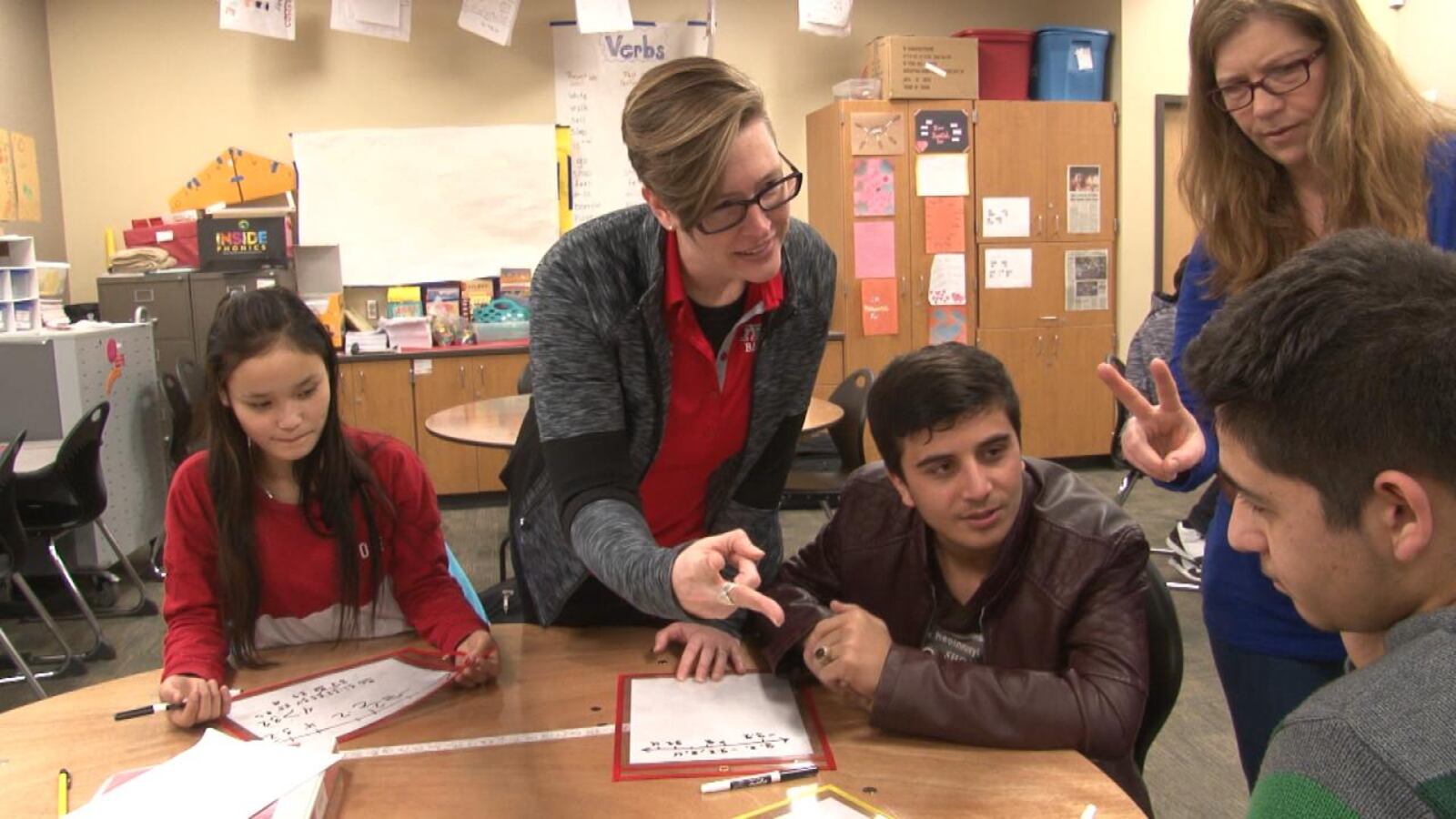
Four years ago, Mandy Manning realized she wanted to have an impact outside her classroom, where she spent her days teaching immigrant and refugee students how to navigate their new school and new lives.
To do that, though, she also realized that she would need more than just years of experience. She would need a platform.
This year, she got just that: Manning, who teaches in Spokane, Washington, was named the 2018 national teacher of year.
“People need to know how amazing these immigrant and refugee students are,” she told Chalkbeat.
It’s a message she feels more urgency to spread as the current presidential administration takes a harsh position toward immigrants and asylum-seekers. Manning said she spent several months responding to students asking her when they would have to leave the country.
But the core of Manning’s work is to teach immigrant and refugee students foundational language skills and help ease their transition to the U.S. The students, who come from across the school district, usually spend one semester with her at the Newcomer Center at Joel E. Ferris High School.
“I’m their ambassador. Hopefully I’m a good example of what we are as Americans,” she said.
This interview, part of Chalkbeat’s How I Teach series, has been edited and condensed for clarity.
Was there a moment when you decided to become a teacher?
Teaching really chose me, because I hadn’t intended to become a teacher. I finished my undergraduate degree, which was in filmmaking, and I really wasn’t interested in continuing in that line of work. A friend, who was a paraeducator — someone within a classroom who works one-on-one with students — suggested I become a paraeducator.
Then I taught in the Peace Corps, which really helped expand my worldview. Even after that, I wasn’t convinced I wanted to be a teacher. I moved to Texas and my aunt suggested I apply to teaching positions, even though I wasn’t certified or had a degree in education. It was almost as if teaching was pursuing me and I was just denying it.
How do you get to know your students?
I’m very welcoming to them. I think that’s so essential, because the very first day is where you set your climate and environment in the classroom. For me that means being very upbeat and excited and ensuring that I’m introducing myself to every student as they’re walking in and figuring out their name and where they’re from and what languages they speak.
I used to teach general education — film making, journalism, communications, English. With them I would just have conversations like, ‘You are an individual and I’m an individual and yes I am your teacher and you are my student but I’m still interested in who you are not just as a learner but as a person.’ With the newcomers, it’s a little more difficult because we’re starting with charades, essentially.
So slowly, every day, I learn something new about my kids and that’s my goal. As long as I learn something about one student each day, I’m moving forward.
Tell us about a favorite lesson to teach. Where did the idea come from?
It’s our “Out in the Community” lesson. It has to do with the foundational language we’re teaching — giving and receiving directions and the basic ability to navigate your community. The reason I love it so much is that we actually get to go out and explore the neighborhood of the school and sometimes the downtown area of Spokane — the actual community in which they live and they’re expected to function as community members.
It’s so fun to watch the kids and what things are of interest to them and how they draw their maps. They also make connections back to their home country when they’re talking about the differences between their neighborhoods or schools or communities.
What object would you be helpless without during the school day?
My whiteboard and markers. Personally, I need a paper clip, which is so dumb, but it helps me concentrate. I just play with it when I’m teaching and communicating with kids. But the thing I really need in my classroom all the time is the ability to write things down because it helps with that comprehensible input for my kids.
What’s something happening in the community that affects what goes on inside your class?
Right now, it’s the climate around immigrants and refugees. Spokane is pretty good, pretty neutral. There isn’t a whole lot of negative communication or messaging, but it does happen. It’s happened in our hallways at school where kids have been told to go back to Africa or horrible racist slurs have been called against Arabic kids or kids from African nations. It impacts how welcome and comfortable my students feel.
It also brings older students, who have gone beyond the Newcomer Center back to my classroom more often, because my room represents the first place they were comfortable and safe. They’re often returning to me and the bilingual specialist I work with just for the reassurance that they’re welcome and they’re safe here in our nation. That’s something we now have to navigate every single day.
Tell us about a memorable time — good or bad — when contact with a student’s family changed your perspective or approach.
The first year I started to do home visits — at that time I had families from Burma, Iraq, Afghanistan, and different nations in Africa. These home visits with all these different families showed me so much about individual differences between people of the same culture and between different cultures.
I got to see how they’re living, who they’re living with, the different type of homes — apartments, duplexes, single-family dwellings, or a house — and just how they interacted with each other. It broadened my perspective of family. there are so many different types of families within the students born within the United States, then to see it on a such a large scale with different cultures, it’s helped me to seek value in every single different type of family. And to understand that even though things operate differently in each home, that doesn’t diminish the beauty of that home.
What part of your job is most difficult?
The hardest part is the middle of the year, semester-end. Kids at the Newcomer Center come from all over the school district. Usually after a semester, they then go on to their neighborhood high school. We have several practices in place to help with transition, but that semester break, it’s really hard to say goodbye to the kids.
It’s harder than at the end of the year because at the end of the year, we’re all taking a break. That semester, some of my kids are leaving and I’m not going to see them on a regular basis. And we’ve bonded with one another so much that it’s really hard, and I always end crying for the whole day because I’m going to miss them so much.
What was your biggest misconception that you initially brought to teaching?
I didn’t know what I was doing at all when I had my first classroom. I didn’t even know how to read a teacher’s edition of a textbook. I sort of jumped in with both feet. I guess I assumed I needed to understand how to build a lesson exactly and that would be a hard hurdle for me, but I soon found out it doesn’t matter how beautifully you structure your lesson plan, because teaching is really about monitoring and adjusting for whatever the needs are of the kids at the time. You might have the most beautiful lesson but chances are it will shift and change in the first 10 minutes.
What’s the best advice you’ve received about teaching?
Focus on your kids and everything else will fall into place.
Want more interviews with teachers? Sign up for Chalkbeat’s How I Teach newsletter.