

Sign up for Chalkbeat Indiana’s free daily newsletter to keep up with Indianapolis Public Schools, Marion County’s township districts, and statewide education news.
As they left their fourth period classes last week for an anti-ICE walkout, several Southport High School students said they noticed a school employee near the front door. The students decided to go through a side door instead, where they climbed over a bank of snow to reach the parking lot.
“I wanted to say something about what I believe is injustice in the country right now,” said junior Derek Stanley. “But I was nervous. I didn’t know how it was going to work out, what door we were going through, if anyone would stop us, if we would get repercussions.”

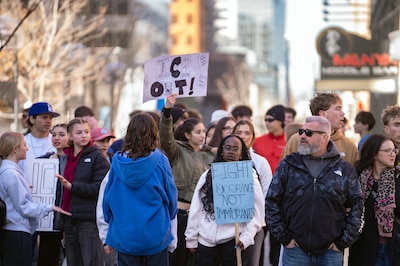
The group of more than 100 students walked to Madison Avenue holding signs and chanting, “no justice, no peace.” Some students brought signs or carried flags from their home countries. A police officer from the school also trailed the group in a car for safety.
Across Marion County and central Indiana, thousands of students walked out of school last week to speak out against heightened presence of federal immigration agents across the country, including agents who killed two people in Minneapolis last month.
The walkouts left schools to strike a balance between allowing for student expression and maintaining safety, both in and out of the classroom. Some districts sent preemptive emails to families and worked with students to ensure the walkouts would be safe. Districts also referred to student handbooks for attendance policies, stopping short of saying the specific repercussions. But in at least one case, at Southport, that meant suspensions.
While the district declined to say how students were disciplined at Southport, the student handbook does say students can be suspended for causing disruptions to learning.
“One of the greatest things about America is we have a right to speak out and protest. I wanted to take a stand for what I believed in, ” said Ava Miller, a Southport junior who was suspended for the walkout. “Seeing what the world is like right now, I want to act on behalf of everyone being silenced.”

Protests can’t cause ‘substantial disruption’
The landmark 1969 Supreme Court case Tinker v. Des Moines established that public school students do not “shed their constitutional rights to freedom of speech or expression at the schoolhouse gate.” Students have the right to express their opinions as long as it doesn’t cause a “substantial disruption” to the educational environment, according to the ACLU.
However, student walkouts are not protected under the First Amendment, and schools must be consistent in discipline and not punish a student more harshly based on the specific message of their protest.
Generally, student protests against immigration enforcement have been tolerated more in blue states. In Denver, roughly 400 students walked out of a suburban district and didn’t face consequences. Yet in Texas, the state education agency warned school districts they might face state takeovers if they “encourage” student protests. And Texas Attorney General Ken Paxton launched an investigation into student walkouts in Austin. Students also face discipline in Florida and Arizona.
Here in Indiana, the department of education sent an email to school superintendents early last week acknowledging that students were walking out “in political protest.” The department said it didn’t support student walkouts, and stressed that districts should enforce student conduct, attendance, and discipline policies, including having parent permission to leave the school building.
“Above all, student safety and parental authority must remain paramount,” the department wrote to school leaders.
Schools work with student organizers, prioritize safety
Several Marion County districts also sent messages ahead of student protests to share expectations around attendance and the schools’ response. And while some districts stressed it would be business as usual and school employees would remain neutral, other schools reached out to student planners to ensure safety.
Warren Central High School principal Masimba Taylor said her staff caught wind of the planned protest earlier in the week when students started sharing ideas on social media.
She said the team talked to students about why they wanted to walk out and worked with them on suggesting a safer route to take in a march near their school. On the day of the walkout, Taylor said it was all hands on deck for administrators to be present and provide supervision so educators could continue teaching inside the high school.


The school also informed parents in advance of the walkout, and some attended to offer an additional layer of help. Justin Beattey was one of those parents and said he saw staff and administrators present, taking a neutral tone and focusing on keeping kids safe.
“I thought they did a really good job of maintaining objectivity and just making sure no one was hurt,” Beattey said.
Similarly, students at Shortridge High School said they went through rounds of negotiations with administration about their demonstration last week — originally planned as a 2-mile walk down Meridian Street to Herron High School.
Student organizers later changed their plan to protest on school grounds after talking to administration about concerns for student safety. They were not worried about potential disciplinary actions stemming from the protest.
At Crispus Attucks High School, an email to students and families encouraged students to advocate for their beliefs without leaving school grounds.
“While we respect our students’ desire to engage with the world around them and to make their voices heard, we are also responsible for their safety during school hours,” the email said.

Southport students face one-day suspensions
Per student handbooks and attendance policies, students who participated in walkouts could face a range of discipline. For example, at Lawrence Central and North high schools, the district said any disciplinary action against students is due to an unexcused absence — not for the student protest.
That discipline could include an attendance agreement, parental notification, or detention depending on the student’s overall attendance, the district said.
At Southport, students said they received emails from the principal on the night of the protest saying the walkout had created an unsafe environment.
“Beyond school discipline, these actions shook the sense of safety for many of your peers and their families. For many, Southport is a sanctuary, and that sanctuary was disrupted,” the email said.
The Southport handbook does not specify disciplinary action for protesting, but says students may face suspension or expulsion for a list of behavior incidents, such as “disruptions to the educational process or to the orderly atmosphere for learning.”
Southport students said that when they returned to school Tuesday, counselors and administrators began to call them down to dole out one-day out-of-school suspensions.
For Stanley, the junior, he said the prospect of his first-ever suspension from school initially made him nervous, but he was ultimately fine with the result.
“I’ve seen both in person and online people saying how scared they are. I wanted to speak about it,” Stanley said. “I’m glad I prioritized speaking out what I believe is right over three hours of school. Looking back, I would’ve regretted not doing it.”
Miller’s mom, Kelly, said the unexcused absence was a fair consequence. But the school could have warned students in advance about what other discipline they could face, especially when it became clear that students across the state were holding walkouts. Ultimately, she said her daughter had their support to walk out.
“She’s living out her values and principles … We trust her and her instincts and we want to support her,” she said. “What more could we do than hope to develop that heart for social justice and the courage to stand up for what she believes in?”
Reporters Amelia Pak-Harvey, Erica Meltzer, and MJ Slaby of Chalkbeat and Zak Cassel of WFYI contributed to this article.
Aleksandra Appleton covers Indiana education policy and writes about K-12 schools across the state. Contact her at aappleton@chalkbeat.org.
Mirror Indy reporter Carley Lanich covers early childhood and K-12 education. Contact her at carley.lanich@mirrorindy.org or follow her on X @carleylanich.