

Sign up for Chalkbeat New York’s free daily newsletter to get essential news about NYC’s public schools delivered to your inbox.
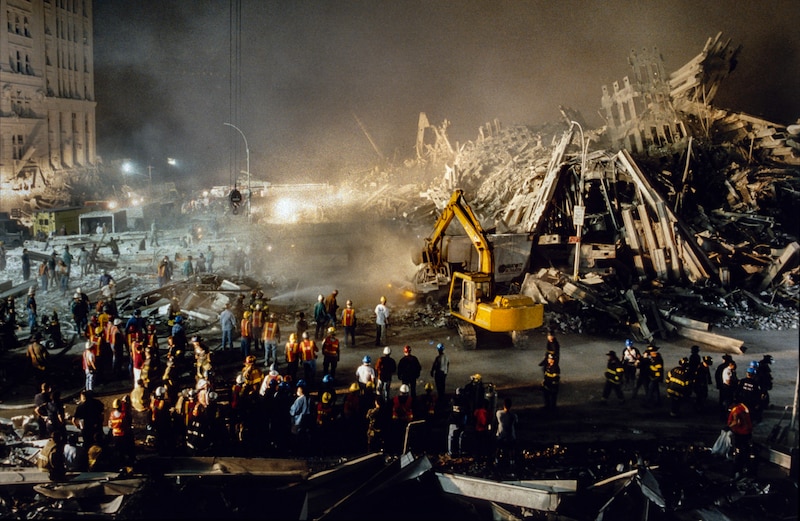
Twenty-five years ago, about 1 million New York City children were in school on the morning of Sept. 11, 2001, when hijackers flew planes into the World Trade Center, the Pentagon, and a Pennsylvania field.
Today, some teachers as well as parents of children in the city’s public schools weren’t even born when the terrorist attacks occurred.
But city and state officials are trying to ensure the day is remembered: The City Council recently announced $1 million for the 9/11 Memorial & Museum to provide free field trips to New York City students, with a focus on eighth graders. The museum also offers lessons for educators and also on-site and virtual visits for students in grades 3-12. The Education Department offers an instructional guide with links to books, lesson plans, archival materials, and more.
With the anniversary this year falling on the second day of school, it might be trickier to talk about the attacks — which killed nearly 3,000 people in Lower Manhattan — as educators are still building their classroom communities. But many city schools still plan to commemorate 9/11 in some way, whether with a classroom discussion, or at minimum, a moment of silence, as required under state law.
At least 40 states require students to learn about 9/11 in some form, but these lessons are much more personal in New York. Chalkbeat talked to three teachers about what they remember about that day 25 years ago and how they plan to teach about 9/11 to their students this year.
These interviews have been lightly edited for length and clarity.
Miriam Sicherman, fourth grade teacher at the Children’s Workshop School in Manhattan’s East Village
I still teach in the same classroom. It was my second year of teaching and I had a combined second/third grade class. I teach on East 12th Street — so, not very far from the World Trade Center. One student was picked up by his babysitter at about 9 a.m., which I thought was strange, and shortly afterwards, another teacher came to my daughter and whispered to me what had happened (simply that planes had crashed into the towers, nothing more). Soon more parents came for their kids, and all the kids began wondering what was going on.
I ultimately told them that planes had crashed into the Twin Towers, and some families felt more comfortable having their kids with them, while others felt more comfortable having the kids at school. I had no source of information about what was going on, other than what parents would tell me when they came to my door (some of which turned out to be accurate and some didn’t). One parent came back and forth several times and eventually took her kid. As the numbers dwindled, I gave the kids choice time and they used blocks to build towers.
The students I will have this year were born in 2017, and most of them are aware of 9/11 in a sort of vague way. Many of their parents were still kids in 2001. Nowadays, I do teach about 9/11, but not in a very in-depth way, as the kids are only about 9 years old and not ready for complex geopolitics. I often read “The Man Who Walked Between the Towers” about Philippe Petit’s tightrope walk. And we talk a little bit about what happened, and I answer their questions.
I don’t get into the wars in Afghanistan and Iraq, or the killing of Osama bin Laden, unless the kids specifically ask. I have never taught anywhere but here, so I don’t know what it’s like elsewhere, although I can imagine it may not be taught in elementary school at all since it’s scary and complicated.
Nancy Re, fifth and sixth grade English teacher, St. Francis de Sales Catholic Academy, in Belle Harbor, Queens
I remember the personal fear and horror because my brother-in-law was in the towers. He died. He was a partner at Cantor Fitzgerald. It was hard to maintain the class when my personal life and my cellphone were exploding.
9/11 can never be forgotten. It does not matter what subject you teach, every teacher must address it, because that gives a strong message of its importance and how we can never forget.
We start the year studying 9/11. We read several books on the subject. Most importantly we read “ Message on a Wing,” “The Little Trinity Church,” “Sadako and the Thousand Paper Cranes,” and we study Mychal Judge (a Catholic priest and chaplain for the New York City Fire Department, who was killed by falling debris and was designated as the first recorded casualty of the terrorist attacks). Then we read about the survivor tree and we go outside where a piece of the survivor tree is actually on our street. I teach in Rockaway Beach, and part of the survivor tree was given to our school after Hurricane Sandy.
After doing all the readings, we discuss, share out, and start a poetry unit. I have a huge bulletin board set up with spaces for them to each add one poem. They are taught haiku, across it, and Free Verse. Many do more than one. On 9/11, our entire school has a prayer service in the prayer garden outside. Our neighborhood of Rockaway Beach was extremely affected. Many families of fallen firefighters attend our prayer service. Then, all the names of people from the Rockaway Peninsula are read aloud.
Jen Chapin, 10th grade Global History 2 teacher at Brooklyn Prospect High School in Downtown Brooklyn
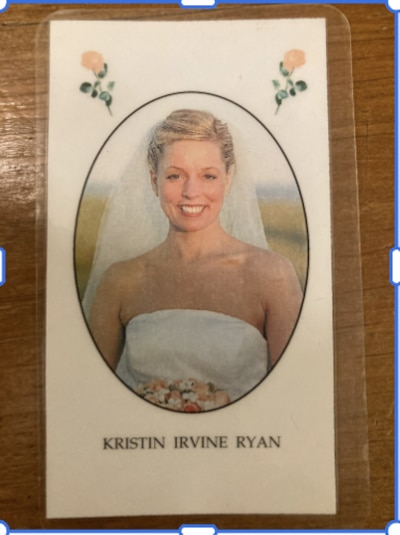
I was working as a singer-songwriter at the time and not yet a history teacher. I saw the second tower fall from my rooftop and lost my childhood friend Kristy Irvine Ryan that day.
I try to contextualize 9/11 in our first unit of the year (Industrial Revolution) and our course emphasis on critical thinking and historical context. Why did this event occur/what are the historical circumstances that led to 9/11? We analyze Osama bin Laden’s statement from several weeks after the attack to identify and analyze his references to historical events (fall of Ottoman Empire, atomic bombing of Japan) cited as rationale for the attacks, and discuss how 9/11 was motivated at least in part by a historical awareness and sense in the Arab/Muslim world of having been left behind and wronged by Western powers, which can be connected to the Ottoman Empire’s lag in industrialization compared to the West.
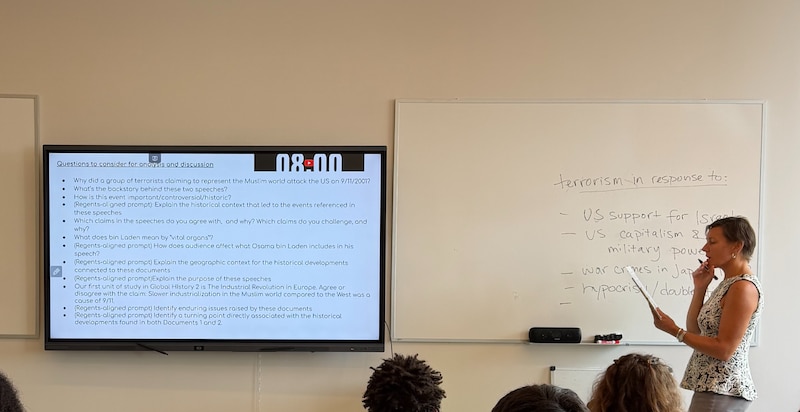
It is notable that in the first 10-15 years after 9/11, so many New Yorkers seemed to be resistant to any evidence-based analysis of the event, given the heightened emotions and the jingoism of the time. Even when I started at my school nine years ago, my former co-teacher was resistant to us even mentioning it, given the lingering notion that to try to understand terrorist motives is to steer dangerously close to justifying it. Today we have the opportunity to bring more big-picture critical thinking and myriad topical connections to our teaching of this event. I think history teachers have a responsibility to teach the historical context of 9/11. If we can’t try to understand the why of 9/11 with our students, why are we even teaching history?
Amy Zimmer is the bureau chief for Chalkbeat New York. Contact Amy at azimmer@chalkbeat.org.