
survey says

Support for boosting teacher pay is at a 10-year high, new survey finds

After a year of teacher protests, an increasing number of Americans think teachers should be paid more, according to a new national survey.

Sixty-seven percent of respondents said that teacher salaries should increase, up from 61 percent last year, according to a survey conducted by the research magazine Education Next. The poll is notable for its close tracking of parents and teachers’ opinions on contested education issues, in addition to those of the broader public.

The 67 percent figure is the highest support for increasing teacher pay has been since 2008, just before the financial crisis. Support rose this year among members of all political parties, and was especially high among those from states with recent teacher protests, like West Virginia and Arizona.

Support for increasing teacher pay is slightly lower when respondents are told the average annual salary for teachers — 49 percent say we should increase it — though that number has risen 13 points since last year.

What’s behind this rise in support? The researchers offered two possible explanations: one, that those teacher walkouts and protests have bolstered support, and two, that people are more receptive to the idea of salaries rising when the economy is in good shape and wages across the economy are increasing, as they are now.

“These two explanations may in fact work together,” said Marty West, a Harvard professor and the magazine’s editor in chief.

Here are five other things we learned from the survey:

Agency fees are unpopular. In June, the Supreme Court said public unions — including teachers unions — cannot charge mandatory fees to non-union members. The decision is in line with public opinion: 56 percent of respondents oppose requiring teachers to pay agency fees, according to the survey.

A large gap exists between members of different political parties, with 56 percent of Republicans opposing the fees compared to 35 percent of Democrats. Notably, the survey was conducted before the Janus Supreme Court decision, so the researchers are unsure whether pro-union or anti-union campaigns since then have changed public opinion.

When people are given the arguments for and against agency fees, support increases by several points.

Support for charter schools has rebounded a bit. Last year’s survey included a 12 point drop in support of charter schools, one of the largest changes in public opinion in the survey’s 12-year history. This year, opposition to charter schools held steady (36 percent in 2017 to 35 percent in 2018), but support for charter schools increased 5 points, to 44 percent. The increase was concentrated among Republicans, widening the partisan divide on the issue.

Americans don’t like using race or income to assign students to schools. The survey finds that the majority of the public opposes taking race into account in school assignment decisions, with 57 percent opposed and only 18 percent supportive. Black and Hispanic respondents were also generally against the idea, though somewhat less so than white respondents.

Income-based affirmative action policies are equally unpopular, though opposition to both income and race-based policies has fallen slightly since the poll last asked the question in 2008.

In July, the U.S. Department of Education withdrew several Obama-era documents that had offered advice about how public schools could legally consider race to assign students to K-12 schools.

Support for school vouchers has increased. Opinions on sending public money to private schools in the form of vouchers are famously difficult to poll, because the results vary drastically based on how the question is worded. Here, 54 percent of the public backed a program described as giving families a “wider choice” in school; that’s up 9 points since last year. That’s surprising, since Education Secretary Betsy DeVos has championed the policy and is widely unpopular, according to previous polling.

In the Education Next poll, support is 10 points lower if the word “voucher” is introduced — which is likely why private school choice advocates often avoid the term. And a 2017 poll from another organization found that only 39 percent of respondents backed “allowing students and parents to choose a private school to attend at public expense.”

Teachers really oppose charter schools, vouchers, and merit pay. On those issues, teachers’ views diverge from the general public’s.

Fifty-five percent of teachers oppose charter schools, compared to 35 percent of the public. For vouchers, 58 percent of teachers oppose them, while 31 percent of the public does. And a full 73 percent of teachers oppose merit pay, compared to 36 percent of the public.

on the money

The salary slide: as other professionals see growth, teachers’ pay stagnates, new report finds

PHOTO: Melanie Asmar/Chalkbeat
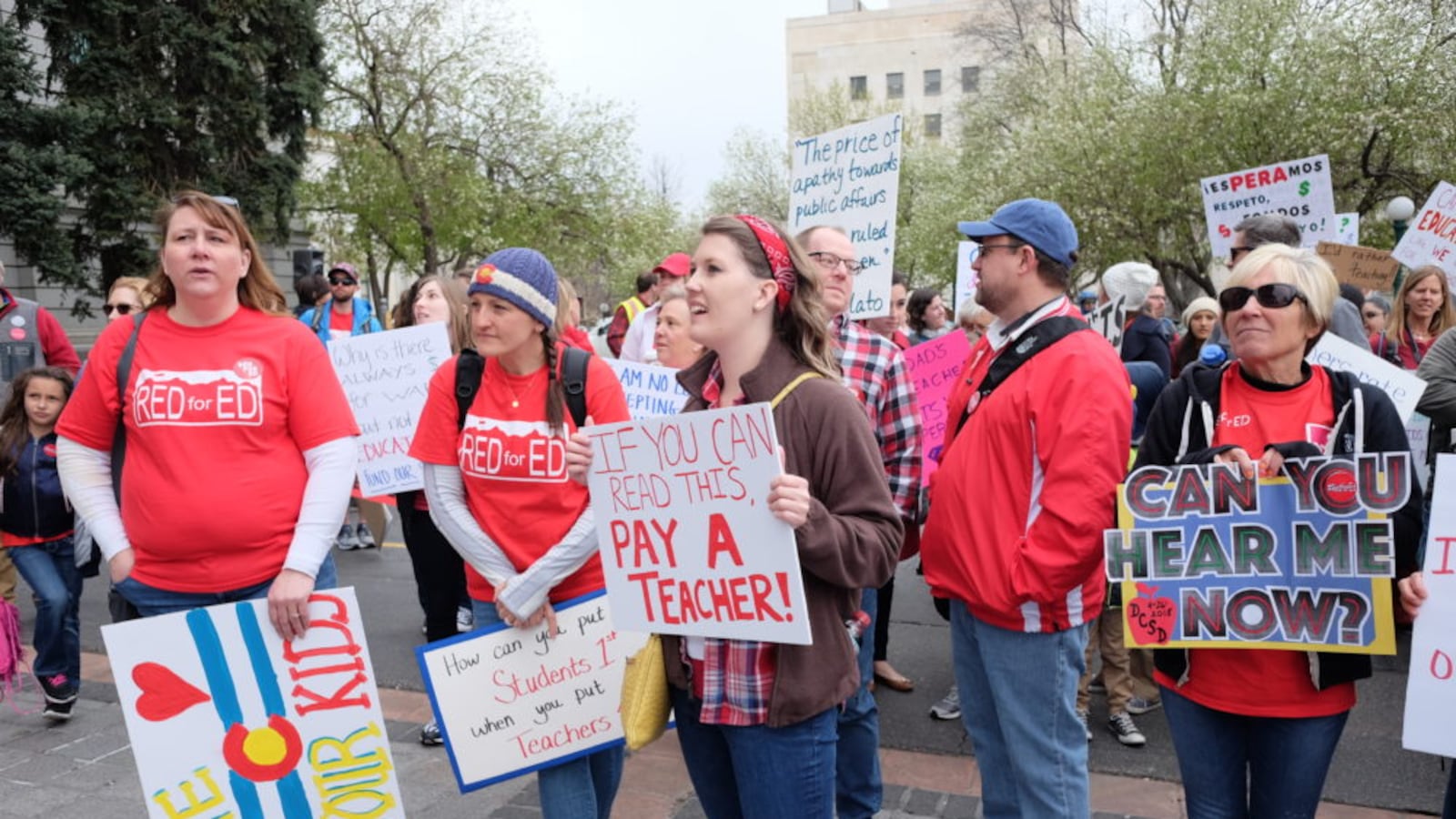
Colorado teachers rallied for more education funding on April 27, 2018.

Newly minted college graduates considering the teaching profession probably don’t expect lucrative salaries. But they might not realize how big a financial hit they face: Teachers now earn about 20 percent less than other college-educated workers, according to a new report by the Economic Policy Institute, a union-backed think tank.

This teacher pay penalty has persisted and even grown modestly in recent years, the latest numbers show. It may be one reason why a majority of parents for the first time say they don’t want their children to become teachers, according to a recent poll. Low pay is also one of the chief drivers of recent teacher protests across the country.

The analysis bolsters those teachers’ arguments, though it shows that some of the salary gap is made up for by better healthcare and retirement benefits. But even accounting for benefits, there remains a 11 percent pay penalty for teachers.

“As we have shown in our more than a decade and a half of work on the topic, relative teacher pay has been eroding for over a half a century,” write EPI researchers Sylvia Allegretto and Lawrence Mishel.

They find that, compared to other college graduates, teachers are paid nearly $350 less per week in salary, or 23 percent less. They also use a more sophisticated approach that controls for demographics, including age and level of education. This shows similar results: an 18.7 percent pay gap.

Accounting for benefits, the gap is slightly larger than it was in 2015 and substantially larger than in 1994, when teachers were paid on par with similarly educated professionals.

“The wage penalty [is] on its own critically important as it is only earnings that families can put toward making ends meet,” the EPI authors note. “It’s only earnings that can pay for expenses such as rent, food, and student loan payments.”

Arizona’s teachers face the largest salary penalty, at 36 percent. That state has also been roiled by waves of teacher activism, including an effort to put a pay hike on the November ballot. (That was recently nixed by the State Supreme Court over a wording issue.) North Carolina, Oklahoma, and Colorado are next on the list.

The EPI study is just the latest of many attempts by researchers to determine whether teachers are really “underpaid.” That’s challenging to determine about any job, because compensation depends on a complicated web of factors like working conditions and job security, which can be hard to measure.

Critics of the EPI approach have argued that it doesn’t account for teachers’ greater job security thanks to tenure or fully capture the value of state-backed pensions. (In recent years, though, tenure and job protections have been weakened in a number of states, and other research suggests this deterred college graduates from entering teaching. A handful of states have also moved away from traditional pensions.)

Mishel of EPI counters that other factors, like not being able to take vacation when you want and the rigors of working with children, may make teaching less attractive. “You could point to a lot of factors that would make teachers need to get paid more,” he said.

The EPI report doesn’t distinguish between different groups of teachers, like those in high-poverty schools, who are much more likely to leave their schools than those in more affluent schools.

A separate study using a different approach finds that while high school teachers are substantially underpaid relative to similar workers, elementary and middle school teachers actually earn more money than they would in other jobs.

“It’s a mistake to treat teachers and teacher pay as a generic phenomenon,” said Dan Goldhaber, a professor at the University of Washington. “While it may be right that teacher pay is falling behind the pay levels of other professionals, the magnitudes really depend on what kind of teachers are being compared to what kinds of professionals.”

Another way to look at pay is to consider to what extent schools are experiencing teacher shortages. A 2017 report by the federal government showed that every state reported shortages in certain areas; some researchers argue that the real trouble is in states with particularly low pay and in areas like math, science, and special education.

Of course, the debate around teacher pay isn’t only focused on economic principles or debates about recruitment — it includes questions about basic fairness and economic justice.

“I can’t remember the last time I had a day off,” one Michigan teacher, who also works part time at a clothing store, told Vox. “I always had this understanding that I would never be rich as a teacher, but I never thought it would be this difficult to live on a teacher’s salary.” (Less than one in five teachers work a second job, though that’s higher than other workers.)

Another question is one of priorities: One school choice advocacy group points out that the number of teachers per student has risen between 1992 and 2015, as has the number of non-teaching staff in schools — even as teacher pay has flatlined.

What’s clear is that teachers’ salaries have been stagnant as other professionals’ wages have grown. Research suggests that pay affects who enters and who stays in teaching, which in turn affects student learning.

“The basic trend that teachers are losing ground relative to other college educated workers is pretty damning,” said Diane Whitmore Schanzenbach, an education economist at Northwest University. “It’s got to impact selection into the profession, and that’s the piece that worries me the most.”

sold

An initiative that helps teachers buy a home is expanding to 15 Colorado districts

PHOTO: Denver Post file

Carissa Travis is an early bird. She’s usually at school by 6 a.m., two hours before her second-graders arrive, because she does her best work when the hallways of Denver’s Steele Elementary are quiet. She spends seven hours on her feet teaching and then sometimes several more after school in training sessions or PTA meetings.

When she gets home from what can be a 12-hour day, Travis needs some space. It’s one reason the 29-year-old was eager to buy her own home. She also wanted to leave behind the revolving roommates and rising rent that caused her to move four times in five years.

But she found her teacher’s salary didn’t go far in a gentrifying city where the median home price is now more than a half-million dollars. It’s a familiar problem that’s especially acute in Colorado, which a recent study ranked dead last among states for the competitiveness of its teacher salaries. The average Denver teacher earned $57,753 last year, according to the district.

Just as Travis was ready to give up, she got an email about a novel program that helps teachers buy homes in the communities where they work. In June, she became the first Denver teacher to seal a deal through it when she closed on a remodeled one-bedroom condo just a five-minute drive from her school. Hers was not the highest offer, but the previous owners liked her story.

PHOTO: Courtesy Carissa Travis
Carissa Travis teaches a lesson at Steele Elementary.

“They were excited to sell to a teacher,” Travis said.

The program that helped her is called Landed. Using philanthropic dollars, it pays for part of an educator’s down payment with the understanding that the educator will pay that amount back, plus a percentage of the increase in the home’s value.

The most common scenario is that the educator puts down 10 percent of the home price and Landed kicks in 10 percent to get to a down payment of 20 percent, said Paula Davis, a former teacher who helped bring the program to Colorado and is the company’s representative here. But the bar to qualify is lower: Educators have to put down just 5 percent and Landed will pick up the rest, up to $70,000 in Colorado.

Landed pays for its portion with more than $15 million in donations from foundations including the Chan Zuckerberg Initiative, funded by Facebook creator Mark Zuckerberg and his wife Priscilla Chan; and the Zoma Foundation, funded by Walmart heir Ben Walton and his wife Lucy Ana. (Chalkbeat also receives funding from the Chan Zuckerberg Initiative and the Waltons.)

Landed is not a non-profit but rather a mission-driven for-profit that reinvests the money teachers pay it back into the down payment fund, and makes its money by taking a fee from the realtors’ commissions. It was founded in San Francisco in 2015, and expanded to the Redondo Beach Unified School District near Los Angeles and Denver Public Schools earlier this year.

Landed is working with employees of these Colorado school districts:
    Denver
    Jeffco
    Aurora
    Adams 14
    Westminster
    Adams 12 Five Star
    Sheridan
    Englewood
    Mapleton
    27J in Brighton
    Cherry Creek
    Littleton
    Douglas County
    Boulder Valley
    St. Vrain Valley

Last week, Landed grew its reach in Colorado even further by making its services available to employees of 14 additional school districts, including Aurora Public Schools, Jeffco Public Schools, Westminster Public Schools, and the Adams 14 district in Commerce City.

Employees – including teachers, principals, bus drivers, custodians, and others – must have worked for the district for at least two years, and must agree to stay for two more. Part of Landed’s mission is to help districts recruit and retain teachers, Davis said.

Educators who leave the profession voluntarily before then have up to a year to pay Landed back. Educators who fulfill the two-year commitment must pay Landed back when they refinance or sell their home, or earlier if they want.

The idea differs from most others aimed at helping Colorado teachers find affordable housing in that it focuses on buying rather than renting. Some small, rural districts own housing units that they rent to teachers on the cheap. The school district in pricey Aspen does the same. Denver briefly considered converting a vacant elementary school into teacher housing, but pushback from the neighborhood caused the district to shelve the idea.

Thus far, Landed has helped more than 90 educators with their down payment, Davis said. That includes the first three to buy homes in Denver: a longtime teacher with grown children who owned a house in Aurora but wanted to move closer to where she works in the Green Valley Ranch neighborhood, a young couple who bought their first home near Stapleton, and Travis, who bought a condo in Capitol Hill. The home prices ranged from mid-$200,000 to mid-$500,000, Davis said.

“What we hoped it would be is a tool that would empower people to do what they wanted to do,” Davis said. “It’s nice to see we’re meeting people where they are.”

For Travis, who is single and loves to travel, that meant buying a small place in good shape that she could lock up and leave over the summer with few worries. During her second weekend of house-hunting with the realtor Landed recommended, she found it in a fifth-floor one-bedroom with air conditioning, hardwood floors, and a view of the gold Capitol dome.

She began her sixth year at Steele Elementary a homeowner. The daughter and granddaughter of teachers, Travis said she enjoys having a job she feels is important, and she relishes getting to know each of her students and watching them grasp a new concept or learn a new skill. Despite the relatively low pay, she hopes to be in the profession for the long haul.

“The stress of modern teaching keeps increasing,” Travis said. “If some of the stress around pay and living situations could go down, it would make it a much more tenable profession.”