
This is part one of a two-part series. Sign up for Chalkbeat New York’s free email newsletter to be the first to know when the next story is published.
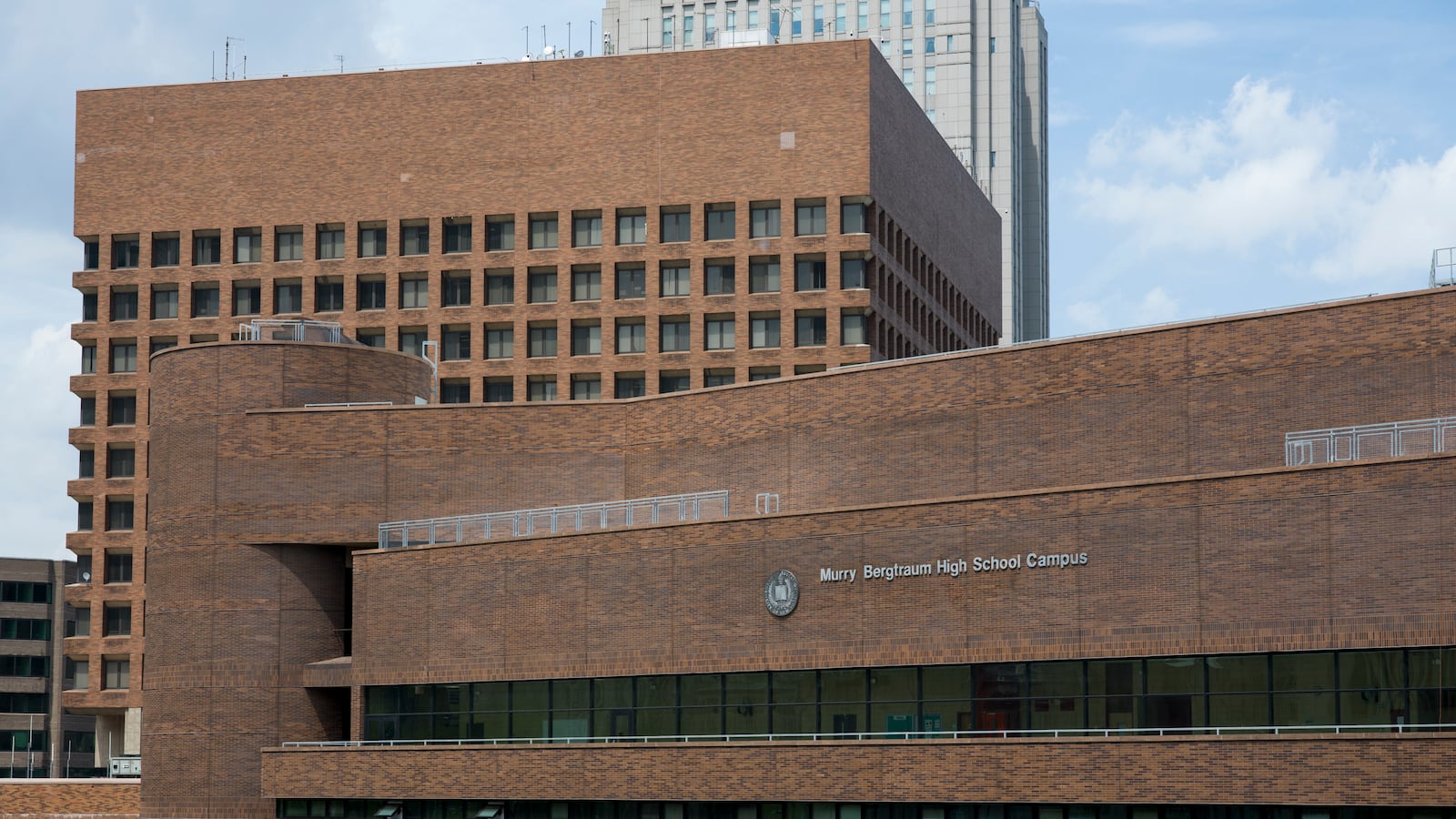
On the fourth floor of a fortress-like building in lower Manhattan housing four public high schools, more than 500 students cram into classes such as calculus and agriculture. They operate 3-D printers and tend herbs in a hydroponic farm.
In the basement, about 500 students at another high school prepare for emergency medicine careers with a new ambulance simulator. They can graduate with associate degrees and participate in activities that include cursive club and lip sync battles.
Meanwhile, the campus’s original school, Murry Bergtraum High School for Business Careers, sits largely empty on the ground floor.
With about 90 students, it is New York City’s smallest traditional high school. The school advertises no extracurricular activities outside of the sports it shares with the other schools on campus. Its lone math teacher cannot teach every class that students need each semester, forcing some to attend night school on other campuses. That’s despite receiving more than $46,000 per student last year, roughly twice the citywide average.
“When you look at the other schools, it’s mad people, mad opportunities,” said Christopher Vasquez, who recently finished his senior year at Murry Bergtraum after making up a math class at night. “But when you come to our school, really nothing.”
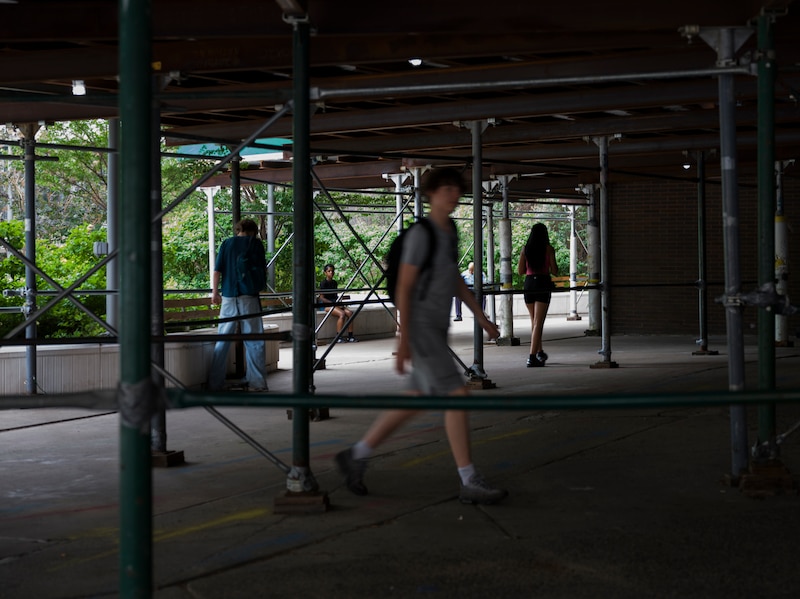
For the past two decades, Murry Bergtraum has been locked in a downward spiral. The school, which once enrolled 3,000 students and was an academic standout, is now in the bottom 1% of city high schools in four-year graduation rates and attendance. Yet city officials have made no meaningful efforts to turn the school around. Instead, they have allowed it to remain open despite repeated acknowledgements from high-ranking leaders that the school should be closed, a Chalkbeat investigation found.
Vivian Orlen, the former superintendent of Manhattan high schools, who oversaw Murry Bergtraum between 2018 and 2022, said she raised the idea of closing or merging the school every year with Education Department leaders, but there was “no appetite” for the proposal.
“What we all know about what kids deserve is not happening there,” Orlen said.
Murry Bergtraum is in a growing club of schools too small to function well: Citywide, 33 high schools now have fewer than 150 students, and 113 have fewer than 250, an eightfold increase from 25 years ago, Chalkbeat found.
The Education Department declined to answer specific questions about Murry Bergtraum, as did the school principal. Schools Chancellor Kamar Samuels has acknowledged that the city has too many small schools and has started conversations about underenrollment in some districts. But the Mamdani administration has not announced a citywide plan to address the issue — or to improve the situation at Murry Bergtraum.
A school of last resort: the decades-long decline of Murry Bergtraum
Murry Bergtraum, which was named after a former president of the city’s Board of Education, opened in 1975 near City Hall as the nation’s first high school to focus on business careers.
For decades, it was one of the city’s most in-demand high schools, attracting mostly Black and Latino students who were interested in business. Its alumni include Bronx Borough President Vanessa Gibson and actors John Leguizamo and Damon Wayans.
Chalkbeat spoke to more than a dozen students, current and former staff, administrators, and district officials familiar with Murry Bergtraum to understand how the once-thriving school diminished to its current state.
Murry Bergtraum’s fall began during Mayor Michael Bloomberg’s push in the early 2000s to shutter large, troubled high schools and replace them with scores of smaller ones. City officials kept Murry Bergtraum open, but it became a school of last resort for students who were displaced by the closures and didn’t seek out or find seats in the new, smaller high schools. Multiple teachers said the changes brought new academic and behavioral challenges.
John Elfrank-Dana, a former social studies teacher and chapter leader of the United Federation of Teachers who worked at Murry Bergtraum for 25 years, compared the upheaval to an influx of patients at a hospital’s intensive care unit.
“Imagine a hospital being required to take on four times as many ICU patients, but with no additional supports,” he said.
Those challenges were compounded by a revolving door of new principals and a series of embarrassing scandals that repeatedly landed the school in the New York Post between 2010 and 2014. One article called Murry Bergtraum “the shame of the city education system.”
As the school’s reputation and academic outcomes plummeted, so too did its enrollment: By 2014, it had fallen under 1,000 students. Dozens of teachers left, and the deteriorating conditions made it harder to recruit new ones. Programs, classes, and activities disappeared.
Aristotle Galanis, a 22-year-veteran physical education teacher and the school’s current chapter leader, said workloads grew for the teachers who remained.
“We’re a skeleton crew,” he said.
Eight years, three mayors, no plan: The policy vacuum keeping a declining school open
As Murry Bergtraum floundered, the Education Department did not create a plan to attract more students or bring in new resources. District officials instead opened competing schools in the same building.
In 2013, the Urban Assembly Early College High School for Emergency Medicine moved into the basement. A year later, Urban Assembly Maker Academy moved onto the fourth floor, and Manhattan Early College High School for Advertising took over the third floor.
As those schools grew, so did their course offerings. Last year, they each offered between 42 and 52 different courses, according to city data. Murry Bergtraum offered 23.
The increased competition, coupled with falling enrollment citywide, has made it nearly impossible for Murry Bergtraum to recover.
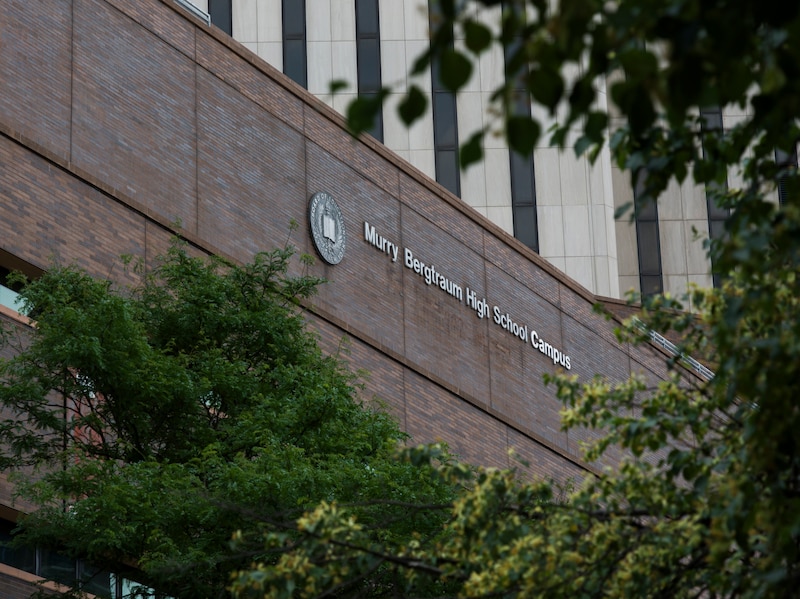
When Orlen took over as superintendent in 2018, the school had about 180 students. She began lobbying Education Department leaders to close the school and hired the current principal with the stated goal of shutting it down, she said.
Multiple factors got in the way of closing the school, said Karin Goldmark, a former deputy chancellor under former Mayor Bill de Blasio who oversaw school closures and mergers. A new chancellor, Richard Carranza, took over in 2018. Two years later, the COVID pandemic started and the next couple years were focused on when and how to reopen schools.
But she acknowledged it’s ultimately the responsibility of the city to take action.
“There’s always some crisis that makes it convenient to do this hard work another day,” Goldmark said. “It’s almost impossible for a school that size to serve students well.”
Under former Mayor Eric Adams, Murry Bergtraum repeatedly came up in discussions about chronically underenrolled schools, according to a former Education Department official who requested anonymity in order to speak about internal conversations.
But the Adams administration focused on opening new schools to draw students back to the system, leaving decisions about closures and mergers largely to district superintendents. Orlen’s successor, Gary Beidleman, who has overseen Murry Bergtraum since 2022, did not respond to a request for comment.
Eight years after Orlen began her push to close it, she’s dismayed Murry Bergtraum remains open.
“It is institutional failure,” she said.
High spending, low enrollment: What it’s like inside an empty school
Murry Bergtraum’s $46,000 per student budget — driven by high administrative costs, a high-need demographic, and city policies propping up underenrolled schools — dwarfs the $19,000 per student the basement school received for serving a similar student population. Yet, Murry Bergtraum can feel like a ghost town — one that few students seem to want to be in.
Last year, 39 eighth graders applied. Some students transferred in after running into disciplinary issues elsewhere. Some said they enrolled by accident because they confused it with the other schools in the building.
Though class sizes average 15 students, many students don’t come to school regularly. Three-quarters of Murry Bergtraum students missed at least 18 days of the 2024-25 school year, according to the most recent data.
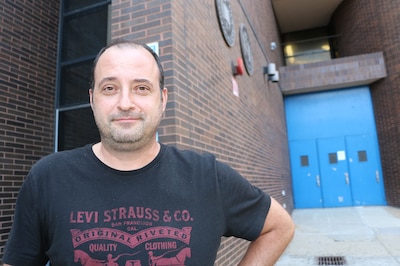
Galanis, the P.E. teacher, argued that the school’s attendance and graduation rate aren’t a fair measure of its quality because in such a small school, a few students disengaging can have an outsized effect on outcomes.
Murry Bergtraum, like many other small high schools, disproportionately enrolls the most vulnerable students. Nine in 10 students at the school live in poverty, and 20% were homeless last year. (The city also runs transfer high schools designed specifically for at-risk older students, several of which are even smaller than Murry Bergtraum.)
Despite the difficult circumstances, the small staff works hard to create “good stories,” like a student who recently transferred into the school and became valedictorian, Galanis said.
Some students appreciate the school’s smaller size. Madison Vernon, a senior who transferred to Murry Bergtraum after getting in a fight at her last school, said the atmosphere feels like “a little family.”
Other students, though, say the school’s size is limiting.
“Having such a small community, you’re not getting open to the same knowledge or experiences you could if you have more students in your school,” said Jada Thomas, a senior.
Some students see the differences between their school and others in the building and feel shortchanged. While several Murry Bergtraum students said they get perks like AirPods Max headphones, the school still fails to offer essential classes.
“We’re a last line type of school,” said a student named Saany, who declined to share his last name. “They give all the necessities to the other schools. I feel like they just left ours.”
Kae Petrin contributed data analysis.
Michael Elsen-Rooney is a reporter for Chalkbeat New York, covering NYC public schools. Contact Michael at melsen-rooney@chalkbeat.org.