This is part two of a three-part series. Here’s the first story. And sign up for Chalkbeat New York’s free email newsletter to be the first to know when the next story is published.
As a parent leader for more than a decade, Johanna Bjorken has heard plenty of stories about New York City schools struggling with low enrollment.
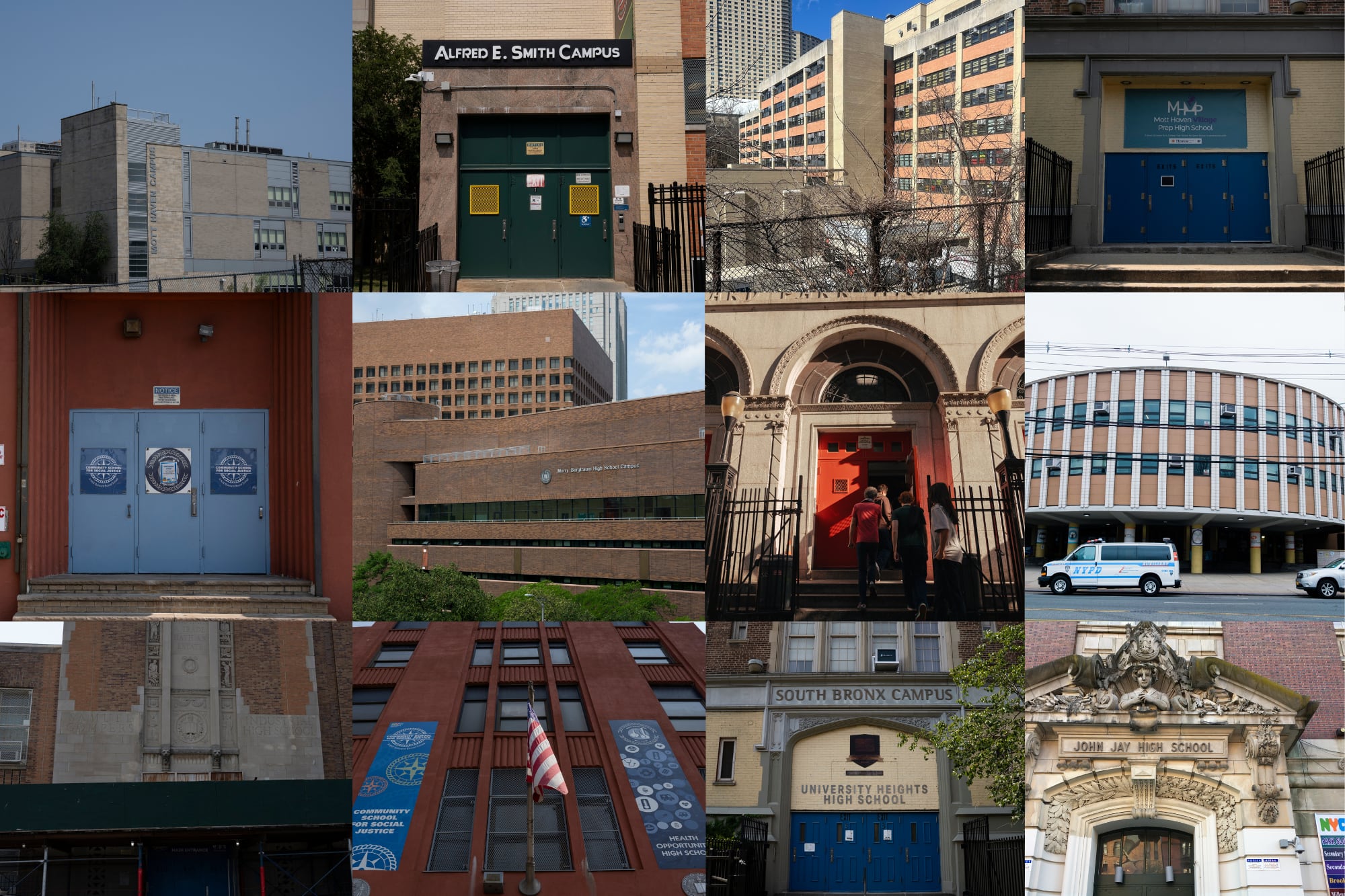
But Chalkbeat’s investigation last month into the decline of Murry Bergtraum High School for Business Careers — the city’s smallest traditional high school with roughly 90 students — struck a nerve.
Bjorken’s son goes to school just two floors above Murry Bergtraum in a shared building in lower Manhattan where the students play on joint sports teams. Yet the schools feel worlds apart. While Bjorken’s son takes Advanced Placement Calculus, students at Murry Bergtraum last year had only one math teacher and two math courses, Algebra I and II. Despite having a per-student budget nearly twice the city average, Murry Bergtraum’s limited academic offerings force some students to attend night school to graduate.
“I was shocked to hear that students, some of whom may very well play volleyball or soccer with my child, have to go to night school for basic graduation requirements, and moreover, that the school’s situation has been known for many years with no action,” Bjorken wrote in a September letter to city officials.
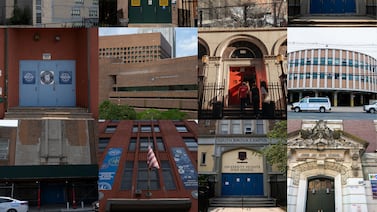
Like school districts across the country, New York City is struggling with a small schools crisis after years of enrollment declines. What makes the city’s situation unique, however, is how many of its small high schools share buildings with each other: 72 of the city’s high schools with fewer than 250 students are on shared campuses, a Chalkbeat analysis found.
Ten months into his tenure, pressure is mounting on New York City schools Chancellor Kamar Samuels to address the increasing number of small schools, which cluster the most vulnerable students in schools with the fewest academic opportunities. School leaders and experts say that long term, the city will need to close and merge underenrolled schools — a process that can be slow and politically unpopular. But many principals feel they can’t afford to wait for that process to play out and feel a sense of urgency to ensure their current students have access to high-quality programs and advanced courses. Now, a growing chorus is urging Samuels to help small schools on shared campuses pool their resources.
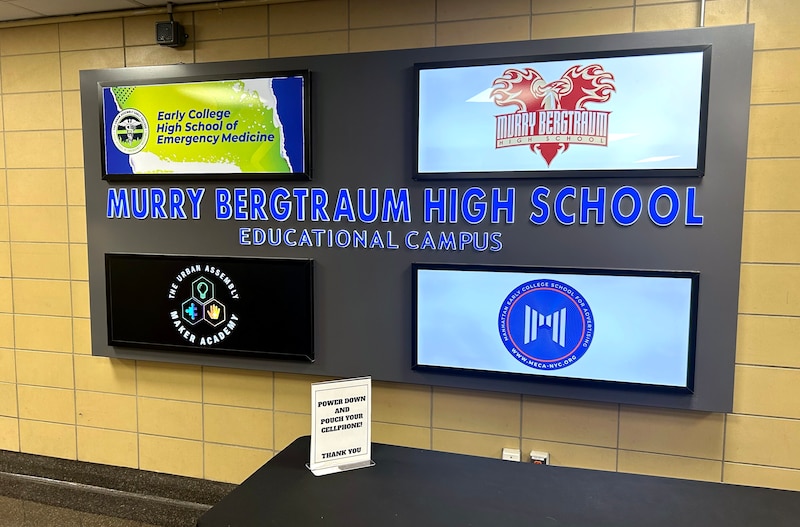
“On shared campuses like ours the system accidentally pits us against each other — right when we need to share resources the most,” said Amy Piller, the principal of Urban Assembly Maker Academy, the school Bjorken’s son attends on the Murry Bergtraum campus.
Samuels indicated at a town hall last week that he’s not crafting a citywide plan and instead is asking five working groups to devise blueprints for underenrolled schools in their districts. None of those working groups includes high schools, but Samuels told parent leaders this week that the Education Department is looking at creating “campus working groups” for high schools. City officials have not shared a timeline for this work. An Education Department spokesperson did not respond to questions about how, or whether, the city is helping schools in the same building share resources.
In the meantime, some principals on shared campuses have pooled course offerings, while others have not — but are looking for guidance and support from the Education Department as they’ve seen their rosters shrink.
“They kind of leave principals up to their own devices,” said Mike Sill, the secretary of the United Federation of Teachers.
Inside the push to reimagine NYC’s shared high schools
About two decades ago, the Bloomberg administration made a big bet that small schools would better serve vulnerable students by providing them with more individual attention and ensuring they didn’t slip through the cracks. The city shuttered dozens of troubled large high schools and opened scores of small new ones in their buildings.
Small schools boosted graduation rates and college enrollment, but they couldn’t provide the same variety of extracurricular or academic options as larger schools.
As enrollment declined, some schools banded together in an attempt to provide students with more opportunities. At the Theodore Roosevelt campus in the Bronx, the principals of its six co-located schools decided a decade ago to open advanced courses like calculus and statistics to the entire campus since none of the schools had enough students to fill the courses on their own.
“It’s challenging with scheduling,” said Michael Barakat, the principal of Bronx HIgh School for Law and Community Service. “But what’s the alternative? Kids don’t have calculus? That’s crazy.”
At the Lehman High School campus in the Bronx, the principals of six small high schools in a sprawling building agreed in 2016 to align their bell schedules so they could open courses to everyone on the campus.
“We sat down and figured it out,” recalled John Powers, the former principal of Lehman High School, who retired in 2023. “It was something we all felt compelled to do.”
Some education leaders said the city can be more ambitious in helping small schools pool resources than just sharing courses.
With nearly half the city’s high school buildings sitting “underutilized,” it’s worth trying to figure out how to use the empty space for new programs or academies to benefit all the students in their building, said Kristin Kearns Jordan, the former CEO of Urban Assembly, a nonprofit that helps run roughly two dozen small New York City public high schools.
The city recently built STEAM centers in Brooklyn and the Bronx where nearby high schools can send students to get hands-on experiences in math and science. Those centers offer a model of what the city could build on shared campuses.
“The possibilities are endless,” Kearns Jordan said.
Several of the schools on the Murry Bergtraum campus are already thinking about those possibilities. In a letter to families last month, Piller, the Maker Academy principal, said her school is a finalist for a grant to transform an unused locker room on the campus’s top floor into a shared academic space for all of the schools on the campus.
“As enrollment patterns change across New York City, large shared campuses like ours have an opportunity to rethink what sharing a building can mean,” she wrote. Chalkbeat’s story on Murry Bergtram “names a problem. I want us to be part of designing what comes next.”
Schedule clashes and fragmented leadership complicate resource-sharing on campuses
Pooling resources, however, is not without complications.
Besides having schools with different bell schedules, they may also have different grading policies. Some, for example, might focus on classwork and prioritize essays and projects, while others assign more homework and exams. Principals have to figure out how to split the costs of teachers covering shared classrooms. Further complicating matters, on many campuses, including Murry Bergtraum, schools in the same building report to different superintendents, meaning there’s no single leader responsible for the whole building.
Some education leaders hope a new position Samuels created — a supervising official overseeing all 11 high school superintendents — will help streamline decision-making for shared campuses.
Shael Polakow-Suransky, the president of Bank Street College of Education and a former deputy chancellor under Bloomberg, said sharing courses can work for advanced classes and electives, but it’s harder for core academic subjects where different schools may have specific — and clashing — approaches to instruction, behavior, or grading.
“The key is how much does that shared instructional work impede on the autonomy of each school on the campus to do its model effectively?” he said.
Sharing resources often only benefits a portion of students, too, such as those who seek out advanced courses. That’s part of why it can feel more like a “Band-Aid” than a systemic solution to the small schools problem, said Vivian Orlen, the former superintendent of Manhattan high schools.
Barakat, the Bronx principal, agreed that merging schools is the “logical next step.” But for now, he said, “I would hope that there are principals all over the place who are taking advantage of the opportunity to work with colleagues.”
Michael Elsen-Rooney is a reporter for Chalkbeat New York, covering NYC public schools. Contact Michael at melsen-rooney@chalkbeat.org.