Sign up for Chalkbeat Indiana’s free daily newsletter to keep up with Indianapolis Public Schools, Marion County’s township districts, and statewide education news.
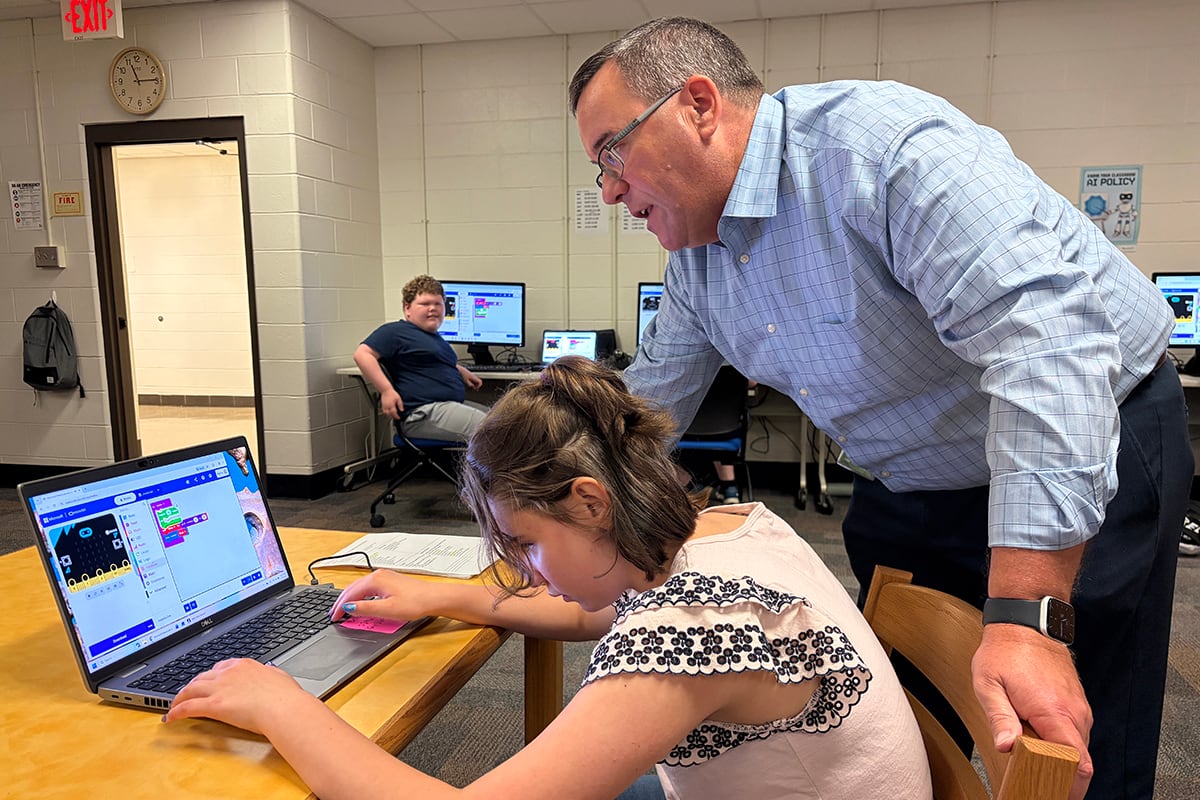
Arabella Zink softly touches the keys of her laptop, leaning forward to listen to the voice coming from the computer speakers.
The seventh grader is building code, dragging and dropping elements on a screen to turn the educational technology known as micro:bit into a die. The small piece of educational technology, which connects to the computer in the shape of a chip, encourages students to learn to block code — a highly visual activity.
Arabella, however, does it without vision.
She’s one of seven students at the Indiana School for the Blind and Visually Impaired who helped develop a new accessibility feature for the micro:bit, expanding coding to blind and visually impaired students.
The accessibility initiative began last year, after the Micro:bit Educational Foundation reached out to the school’s media specialist, Shawn Humphrey. The foundation was seeking blind students who could read Braille to give input on screen reader compatibility and the accuracy of Braille instructions for visually impaired students, Humphrey said.
Arabella and her peers got to work, editing Braille materials and testing whether the screen reader could read what the computer was showing in a way they could understand within the Microsoft MakeCode program.
The project — developed with the foundation and the educational open source coding tools Microsoft MakeCode and Blockly — makes the micro:bit compatible with computer screen readers that tell students what is on their screen.
The micro:bit tool is used in 85 countries to bring coding to the classroom, with lessons that include how to program the tool to play games like rock, paper, scissors, or clap to turn on its lights. And now, with input from ISBVI students, coding is accessible not only to visually impaired students who use the Microsoft MakeCode platform, but all other coding programs built on Blockly’s software.
On a recent September afternoon, Arabella was learning how to make the micro:bit tool into a die that would light up with a number ranging from one to six when shaken. Students could identify which number it landed on by the number of beeps the micro:bit emitted after a shake.
Humphrey recalls seeing Arabella light up when she was told that she was one of the first students in the world to try a particular coding lesson using the accessible version of micro:bit.
“It’s one of the coolest things I’ve ever heard in education, having our students have that opportunity,” he said. “It has opened up coding for visually impaired students.”
Maddilyn Peters, a seventh grader with a penchant for horror stories who also helped develop the accessibility feature, has an interest in coding in order to make robots. Specifically, she said, she’d like to make animatronics like the ones in the horror film “Five Nights at Freddy’s” come to life.
“But not hostile,” she clarified. “I’m just going to make them not attack people.”
Amelia Pak-Harvey covers schools for Chalkbeat Indiana. Contact Amelia at apak-harvey@chalkbeat.org.