Sign up for Chalkbeat Tennessee’s free newsletter to keep up with statewide education policy and Memphis-Shelby County Schools.
Tennessee Republicans continue to advance legislation that would require public schools track and report the immigration status of their students despite heated pushback from local educators.
House Bill 793 would require schools to start tracking and reporting anonymized data on students’ immigration status as early as next school year.
But an amendment filed Wednesday indicates a controversial 2025 effort to either block undocumented students from enrolling in K-12 schools or charge their families tuition is dead for the year.
Bill sponsors previously wanted to use the legislation as a vehicle to challenge the U.S. Supreme Court ruling in Plyler v. Doe that protects access to public education for undocumented students.
Senate Republicans passed Senate Bill 836, the bill to charge tuition, last spring (Tennessee has two-year legislative sessions). But its House companion bill stalled amid bipartisan concerns that it could have jeopardized more than $1 billion in federal education funding.
House Majority Leader William Lamberth, a Republican from Portland who sponsors the HB 793, has repeatedly said he was in discussions with the U.S. Department of Education for further guidance on the bill, including a guarantee it wouldn’t jeopardize Tennessee’s federal funding.
That guidance has not materialized, even after Republican leadership said it had worked closely with the Trump White House to develop a hardline immigration package this year.
Lamberth has instead dialed back the bill to a documentation bill at odds with the Senate version.
“We’ve sent several questions to them to try to get answers to a very straightforward question: Would the bill in the previous form endanger $1.1 billion? We have not been given a guarantee that it would not,” Lamberth said.
HB 793 passed out of a House finance subcommittee on Wednesday and is now headed for a hearing in the full committee next week.
The new House bill requires Tennessee public schools to collect documentation on either a student’s citizenship or immigration status. Schools would then be required to report that anonymized data to the Tennessee Department of Education, legislative leaders, and the Tennessee Immigration Enforcement office. That sparked concerns from some immigration advocates about data privacy.
It’s not yet clear if Senate Republicans would agree to changes to the bill. But even dialing back the legislation to a documentation effort could lead to a legal challenge to Plyer.
In 2012, a federal appeals court ruled a similar Alabama law requiring schools to check students’ immigration status when they enrolled was unconstitutional.
Tennessee educators have criticized the legislation, decrying it as both unfair to children and an impractical logistical burden to place on schools whose resources are already stretched thin.
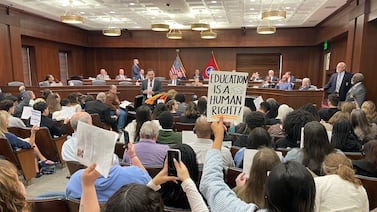
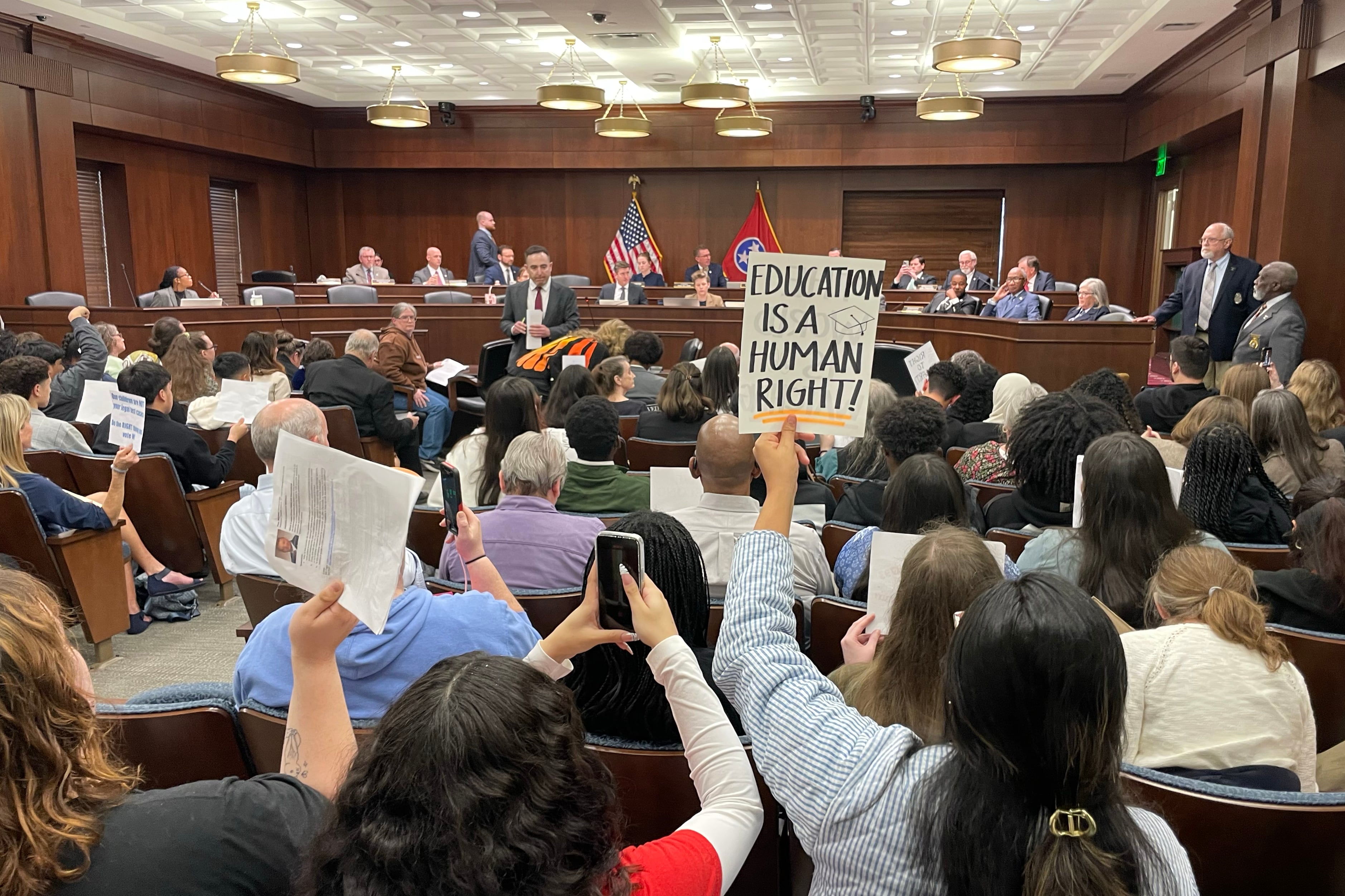
The bipartisan Knox County Board of Education late last year voted to formally oppose immigration documentation requirements. On Wednesday, Knox County Board Member Katherine Bike testified against the legislation in a committee room packed with protesters.
Bike cited a report released this week by the Immigration Research Initiative that estimated requiring Tennessee schools to verify and track the status of 963,000 students could cost the state up to $55 million and require hundreds of new school employees. The legislature’s fiscal analysis has not determined an estimated cost to local districts.
However, the state’s documentation requirements for its recently implemented voucher program, which does not accept undocumented immigrants, show verifying special immigration status such as specialized visa documentation can be complex.
“Where are we going to come up with this money? Is that our special education services that are going to be cut ? Is that our Student Support department, our security budget?” Bike asked. “Where is it going to come from? We always make do but don’t make us do this. I urge you to vote no on this harmful bill.”
Meanwhile, a separate bill that could also require student tracking is progressing through the General Assembly. House Bill 1711 is set up as a trigger bill, meaning it would not be enforced unless the Supreme Court’s Plyler v. Doe ruling is overturned.
A Wednesday committee vote on HB 1711 was delayed until next week.
Melissa Brown is the bureau chief for Chalkbeat Tennessee. Contact Melissa at mbrown@chalkbeat.org.