Chicago is getting an elected school board. What questions do you have?

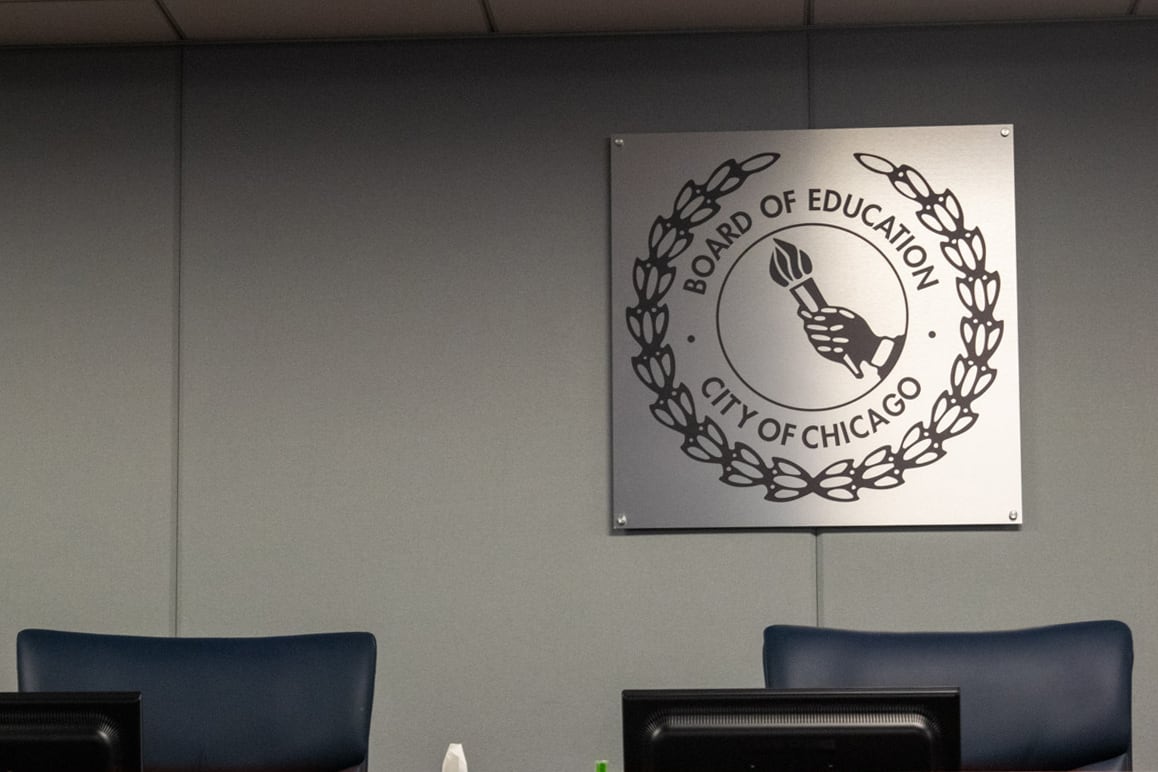
A photo of two empty seats for Chicago’s school board members on shared dais. In front of the seats is the table part of the dais. Behind the seats is a gray, matte, and square sign. In the middle of the sign is a circle with a hand holding a torch inside. Above the circle is the words “Board of Education,” curved around the circle. Below is the circle is the words “City of Chicago,” also curved. Wrapping around the words in a half circle is a laurel.
The Chicago Board of Education seal, taken in June 2023. (Max Lubbers / Chalkbeat)

Sign up for Chalkbeat Chicago’s free daily newsletter to keep up with the latest education news.

Less than a year from now, Chicago Public Schools will swear in its first elected school board members.

But even with a firm swearing-in date of Jan. 15, 2025, many unanswered questions still remain about the election on Nov. 5 that would usher in those new board members — and how the board will function once in place. State law says 10 members will be elected this year, but lawmakers are debating whether to elect all 21 now. (Mayor Brandon Johnson recently asked the legislature to ensure that just half are elected this year, the Sun-Times reported.)

The state legislature must also finalize district boundaries for school board members. Lawmakers appear to have agreed on a third draft of the map last November.

Once members are sworn in next January, what’s next? How will the board work in comparison to the appointed board it will replace?

Chalkbeat Chicago wants to hear your questions about the upcoming school board elections and the elected school board. We’ll aim to answer your questions through our reporting as we follow campaigns and elections this year.

Answer the survey here or fill it out below. We will not use your name in our reporting without your permission.

Reema Amin is a reporter covering Chicago Public Schools. Contact Reema at ramin@chalkbeat.org.

The Latest

The ILEA’s recommendations are heading to lawmakers, who see the potential to replicate many of them throughout the state but could be skeptical of giving mayors more power.

The facilities proposal includes a plan to close three to five schools per year. Five schools have already been recommended for closure in 2026.

A major fight over religious charter schools could be brewing in Tennessee amid a national push to declare religious charter bans unconstitutional.

In private emails, a leading advocacy group fretted about the move and secured a meeting with the Labor Secretary, who will oversee a key charter program.

The 8-1 vote on the recommendations came amid increasing public pressure to retain the power of the elected school board over district buildings and transportation.

The Minority Teachers of Illinois Scholarship was a 33-year-old initiative funded by the state to diversify the teacher workforce. After the program was challenged in 2024, lawmakers decided to erase all language related to race and ethnicity and change eligibility requirements.