Sign up for Chalkbeat Chicago’s free daily newsletter to keep up with the latest news on Chicago Public Schools.
Roughly half of the 45 candidates running for the Chicago school board have signed a pledge to adopt a three-year ban on artificial intelligence use by CPS students and educators.
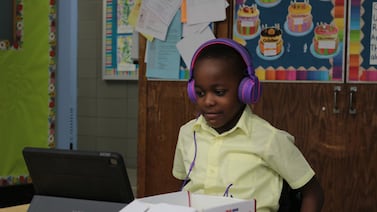
Crafted by a local nonprofit, the pledge also calls for eliminating school screen time before third grade and limiting it in later grades. It demands that the district hire a chief privacy officer and ban the collection of student biometric data, such as voice recordings captured by literacy software.
“The risks of AI are absolutely outweighing the benefits right now,” said Cassie Creswell, the head of Illinois Families for Public Schools, a parent advocacy group that has lobbied for more student privacy protections. “It’s perfectly possible to have a low-tech education and learn everything you need to know.”
The nonprofit wanted to leverage the city’s first races to elect all 21 members of the school board to exact commitments from candidates, Creswell said, though last week she also called on the current, partly elected board to consider AI restrictions this fall. So far, 23 candidates have signed the pledge.
The local push comes amid a national parent backlash against education technology, including AI-powered software. But some Chicago school board candidates, district officials, and others said the pledge goes too far, denying educators useful tools and limiting their ability to help students thoughtfully and safely navigate an ubiquitous technology.
“I think an outright ban is unproductive, and it really negates our responsibility, which is to come up with better solutions so our kids can both access this stuff, but also so that we don’t do irreparable harm to them,” said Janice Jackson, a former CPS CEO who is now leads the Education and Society Program at the nonpartisan think tank the Aspen Institute.
In a statement, Chicago Public Schools said it remains “steadfast in its deliberate, responsible approach to artificial intelligence.” It noted that the Illinois State Board of Education’s recently released AI guidelines for school districts references CPS’ AI guidebook as a model.
Creswell points to a recent move by CPS to shelve a plan to give high school students access to Gemini — Google’s AI chatbot — as an early win for the effort, though CPS officials said they only briefly weighed that plan and nixed it last spring.
The district said officials considered “an aspirational plan” to enable Gemini access on its high schoolers’ Google Classroom accounts after a small group of educators tested the tool without letting students access it. But the plan was put on hold last May based on input from teachers “to prioritize individual school readiness and educator training.”
“CPS embraces AI’s potential to enhance learning while remaining fully committed to safeguarding critical thinking and student data privacy,” the district’s statement said.
The district said a group of high school students spent the summer designing a new Student Voice AI Council and drafting a Student AI Playbook.
Board member Debby Pope, an appointee and retired educator running to represent district 2b, who signed the pledge, worries about AI’s potential to undermine students’ ability to think creatively, write, and ferret out misinformation.
“It’s extremely important to take an approach of caution and care so we raise a generation that has critical thinking abilities and understands the importance of using multiple sources of information,” she said.
But she said she is concerned that an outright ban might hamper the district’s ability to teach kids already widely using the technology how AI works and how to navigate its pitfalls.
Ellen Rosenfeld, who is running to represent district 4b unopposed, didn’t sign the pledge. She shares many of the concerns in the pledge and supports taking a more critical look at tech use in CPS.
“I am concerned that on AI, we are building the plane while we’re flying it,” she said.
But she said she was uncomfortable signing a sweeping document with a yearslong commitment. She said she is unsure how much jurisdiction the board has to impose such a policy.
Some momentum for technology restrictions is building nationally. Earlier this year, Illinois joined a majority of states in adopting a new law restricting student cell phone use in schools that will go into effect next year.
But the state’s AI guidance is nonbinding, imposing no requirements on how districts regulate the technology’s use. Earlier this summer, the school board in Los Angeles — whose superintendent resigned amid a federal probe into a costly failed AI chatbot contract — passed a policy banning screen time before the second grade. This week, New York City is releasing a new policy that would restrict student AI use in the elementary and middle grades and set screen time limits though it stops short of a full moratorium.
Creswell, of Illinois Families for Public Schools, said the nonprofit’s Pledge to Protect Human-Centered Education was also inspired by a recent Brookings report suggesting that AI’s potential harms to students exceed the possible benefits. She said tech use in CPS and its cost to the district have expanded without enough evidence these tools are improving learning or vendors are safeguarding student privacy. The nonprofit is taking particular aim at Amira, an AI-powered tool for struggling readers that CPS says has shown promising results in supplementing more traditional instruction.
Jackson, the former CPS CEO, said school districts need to be more discerning in selecting education technology tools. A lot of them are “junk,” she said, and she does worry about how companies are collecting and using student data.
At the same time, she said teachers are embracing helpful AI-powered tools, for example using AI to more efficiently plan lessons geared to diverse student needs. Failing to teach smart, responsible use of a technology that has come to permeate daily life can leave students at a disadvantage compared with peers at better resourced districts.
“I don’t think we get rid of technology and educate a bunch of kids who don’t know how to use these tools efficiently, because that doesn’t set them up for success,” she said. “But I do think it’s a moment to take a step back and make sure there are guardrails in place.”
This story has been updated to include information on a newly released New York City policy on student use of AI.
Mila Koumpilova is Chalkbeat Chicago’s senior reporter covering Chicago Public Schools. Contact Mila at mkoumpilova@chalkbeat.org.