Sign up for Chalkbeat Indiana’s free daily newsletter to keep up with Indianapolis Public Schools, Marion County’s township districts, and statewide education news.
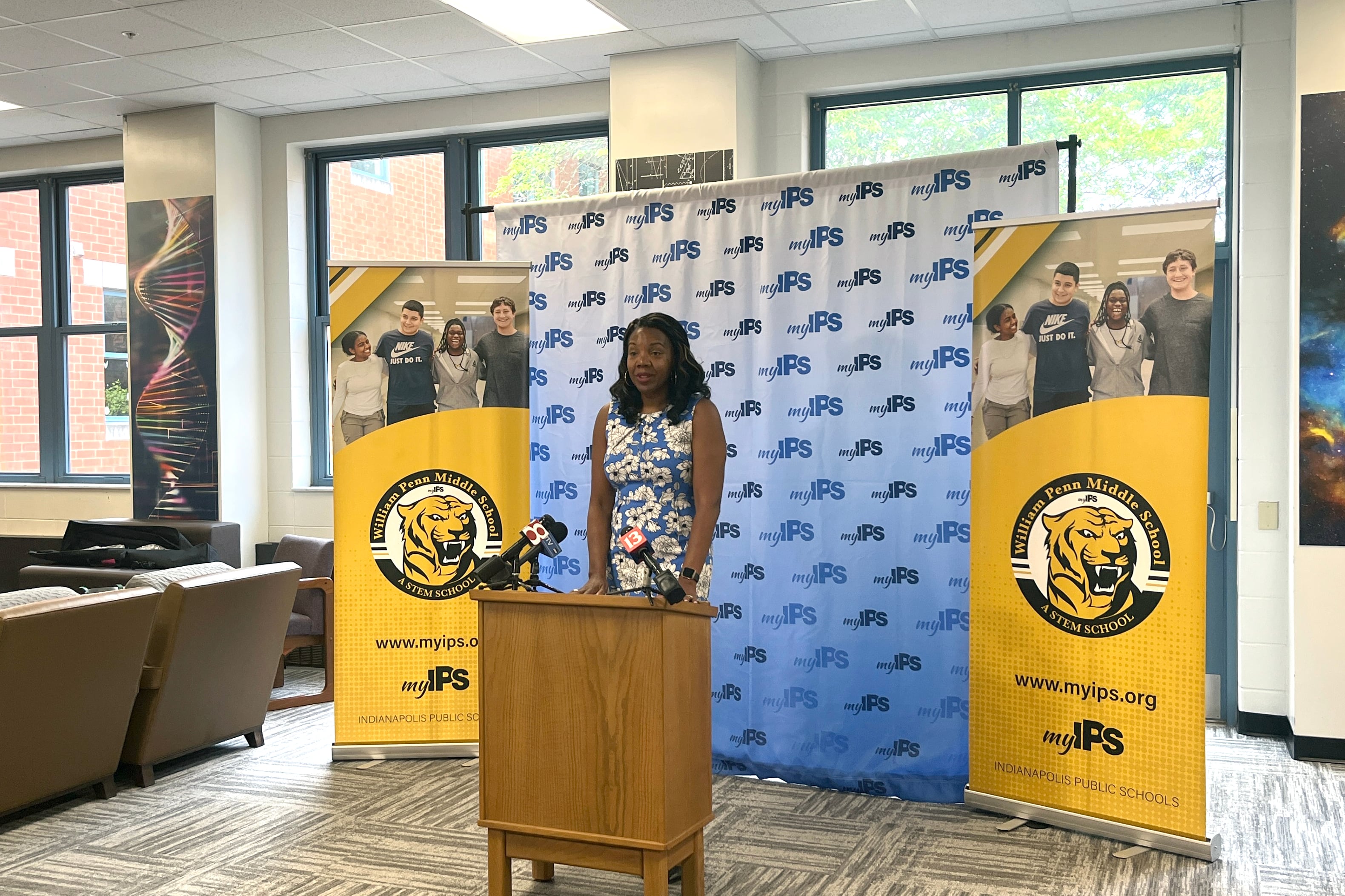
Indianapolis Public Schools will launch a multimillion-dollar initiative to boost access to STEM fields — science, technology, engineering, and math — in middle and high schools through the graduating class of 2032.
The Destination 2032 initiative — powered by a $5.5 million grant that’s the largest donation the IPS Foundation has received from the Eli Lilly and Company Foundation — will fund STEM coursework and STEM future centers at William Penn Middle School and Arlington Middle School, the district’s two STEM middle schools. (The Lilly Foundation also supports Chalkbeat. Learn more about our funding here.)
It will also create a STEM-focused fellowship at Arsenal Technical High School that will offer hands-on experience in the field, similar to the district’s Indiana University Health fellowship at Crispus Attucks High School.
The announcement at William Penn Middle School on Tuesday marks a significant boost to the district’s STEM programming that it has sought to expand through its reorganization plan known as Rebuilding Stronger. The plan, which included closing schools amid enrollment decline, rebranded schools based on a number of themes — such as STEM and performing arts — while expanding its popular Montessori and International Baccalaureate programming districtwide.
The funding also comes as some IPS schools work to achieve STEM certification from the Indiana Department of Education.
“This work matters significantly,” Superintendent Aleesia Johnson said. “This is about equity and this is about opportunity intervening at the exact time when our students, particularly our students of color and from low-income communities, are deciding what is possible for their futures.”
The initiative begins in January at William Penn Middle School, where the STEM Scholars program will give students “enhanced” STEM coursework and hands-on projects, according to the district. The scholar program will expand to Arlington Middle School by 2027-28.
Both schools will also launch STEM Future Centers, which are designated areas with staff who will assist students with academic support, arrange hands-on opportunities, and help them plan a STEM-based career.
In two to three years, the district will launch a STEM fellowship at Arsenal Tech that officials hope existing STEM middle school students will pursue in high school. The fellowship will include a cohort of students who will be exposed to STEM careers through internships, externships, or apprenticeships, said Austin Dodd, the district’s director of high school academies and pathways.
The grant funding will last through the next five years.
Amelia Pak-Harvey covers Indianapolis and Lawrence Township schools for Chalkbeat Indiana. Contact Amelia at apak-harvey@chalkbeat.org.