Sign up for Chalkbeat Indiana’s free daily newsletter to keep up with Indianapolis Public Schools, Marion County’s township districts, and statewide education news.
The Indianapolis Public Schools board adopted a new policy on student privacy Wednesday in response to a lawsuit from the state attorney general claiming the district unlawfully impeded federal immigration enforcement.
The new policy on student access, safety, and privacy seeks to ensure there is a “uniform administrative protocol” that ensures all district actions are “within the bounds of applicable law,” the board said in a resolution passed 6-0 along with the policy.
But Attorney General Todd Rokita’s office is still pursuing the lawsuit.
Since the lawsuit, the district has removed resources for undocumented students on its website, a move that highlights the growing impact the Trump administration’s approach to immigration enforcement is having on schools. In Indiana, lawmakers are seeking to require greater cooperation between local governments — including school districts — and federal immigration authorities.
Rokita’s November lawsuit took issue with a resolution the board passed in 2017 that reminded employees not to assist immigration enforcement efforts “unless legally required and authorized to do so by the Superintendent.” It also challenged IPS guidance for staff and principals on what to do if immigration enforcement shows up on school grounds.
Both documents, Rokita’s office argued in its lawsuit, violated a state law that prohibits governmental entities from restricting enforcement of immigration laws.
The fight will likely continue through a Marion County Superior Court case that will weigh the rights of students against a state law restricting school districts from restricting immigration enforcement.
The board last month rescinded the 2017 resolution as it floated the new student safety policy for consideration. But Rokita’s office said in a court filing on Monday that “IPS in no way repudiated the policies described” in the 2017 resolution when the board voted to rescind it.
The new IPS policy directs the superintendent to develop guidelines on how staff should coordinate with legal counsel when external agencies seek information or access to students. The superintendent will also develop protocols for the protection of student records.
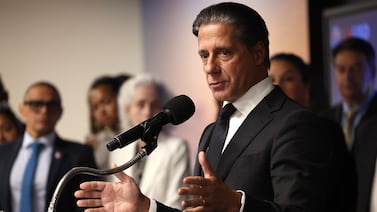
In a statement before the vote, board President Hope Duke Star said the policy was neither a symbolic gesture nor a political statement, but rather “a governance instrument designed to bring clarity, uniformity, and accountability” on how to administer safety districtwide.
“Indianapolis Public Schools serves students from many backgrounds and life circumstances. The district does not adjudicate these circumstances,” Star said. “Our fundamental charge is narrowed and more concrete: to operate schools that are orderly, predictable, and compliant with the law, therefore allowing teaching and learning to occur without undue disruption.”
Attorney general says IPS hindered deportation attempt
The lawsuit alleges that IPS policies hindered the deportation of a “Honduran national” who opted to voluntarily leave the country in January 2025 with his son, an IPS student.
On the day of the scheduled flight, the student went to school despite his father’s wish for them to depart the country together, the complaint states.
The child’s father sent a family friend to meet the student at the school to be reunited with his father, according to an affidavit of a contracted school resource officer that Rokita’s office filed earlier this month. IPS staff refused to turn over the child, who like his father was an undocumented immigrant, to the family friend, according to the affidavit.
In its response to the lawsuit, the district said that the person who claimed to be a federal immigration officer — whom district staff spoke to by phone that day — did not produce any legal documentation to support the request to take custody of the student. IPS denied the allegation from Rokita’s office that the father missed his deportation flight because of the district.
A district staff member allowed the student to go home with an immigration attorney in violation of district policy, according to district responses to the attorney general’s interrogation filed in court. But the district said Immigration and Customs Enforcement never came to the school, and staff never spoke with the student’s father that day.
The new policy adopted Wednesday maintains that the district will continue to provide “equal access to public education” regardless of immigration status while complying with local, state, and federal laws.
State law forbids a governmental body from adopting a resolution or policy that restricts cooperation with federal officials when it comes to sharing information on a person’s citizenship or immigration status. Government entities may also not restrict federal immigration enforcement “to less than the full extent permitted by federal law.”
At the same time, the federal Families and Educational Rights Privacy Act, known as FERPA, restricts the ability of schools to provide student information to outside parties. And the Supreme Court’s 1982 ruling in Plyler v. Doe affirmed undocumented students’ right to a free public education.
The next hearing in the case involving Rokita’s lawsuit against IPS is set for March 5.
Amelia Pak-Harvey covers Indianapolis and Lawrence Township schools for Chalkbeat Indiana. Contact Amelia at apak-harvey@chalkbeat.org.