Sign up for Chalkbeat New York’s free daily newsletter to get essential news about NYC’s public schools delivered to your inbox.
In a letter to Education Department staff on Monday, New York City schools Chancellor Kamar Samuels began sketching out some of his priorities, including school integration and lessons that reflect the system’s diversity.
“I believe that every student — starting in early childhood and continuing through graduation — deserves a school that is academically rigorous, safe, and truly integrated,” Samuels wrote in the letter obtained by Chalkbeat.
Families, he added, “should be able to expect that our system reflects New York City’s rich multiculturalism, both through the diversity of our schools and through culturally responsive curriculum and practice.”
Mayor Zohran Mamdani did not campaign on a detailed education agenda, but he cited school integration as one of his goals — an issue former Mayor Eric Adams largely sidestepped. It remains to be seen how Samuels may approach diversifying one of the nation’s most segregated school systems. As a local superintendent, he pursued mergers and admissions policy changes with an eye toward integration.
In recent years, city officials have rolled out lessons that focus on historically marginalized groups — from the global African diaspora to LGBTQ communities. Samuels’ letter suggests he is interested in building on that work.
When Samuels led Brooklyn’s District 13, he worked with school communities to phase out gifted and talented programs and led an effort to bring the International Baccalaureate curriculum to schools across the district. Mamdani has also pledged to scale back gifted programming for the city’s youngest students.
In his Monday letter to school staffers, Samuels emphasized the importance of having “high expectations” and “high-quality learning,” while also noting the importance of foundational literacy skills and “class sizes that allow educators to meet students’ needs.”
Samuels indicated he will take community input seriously. On the campaign trail, Mamdani promised to end mayoral control of the city’s schools, arguing the system has not been responsive enough to community voices. He reversed that position last week, though the mayor has promised to come up with new ways to strengthen community input.
“I also believe deeply in transparency, accountability, and meaningful engagement,” Samuels wrote. “Our work will be strongest when educators, families, and students know their voices are heard — not symbolically, but in practice.”
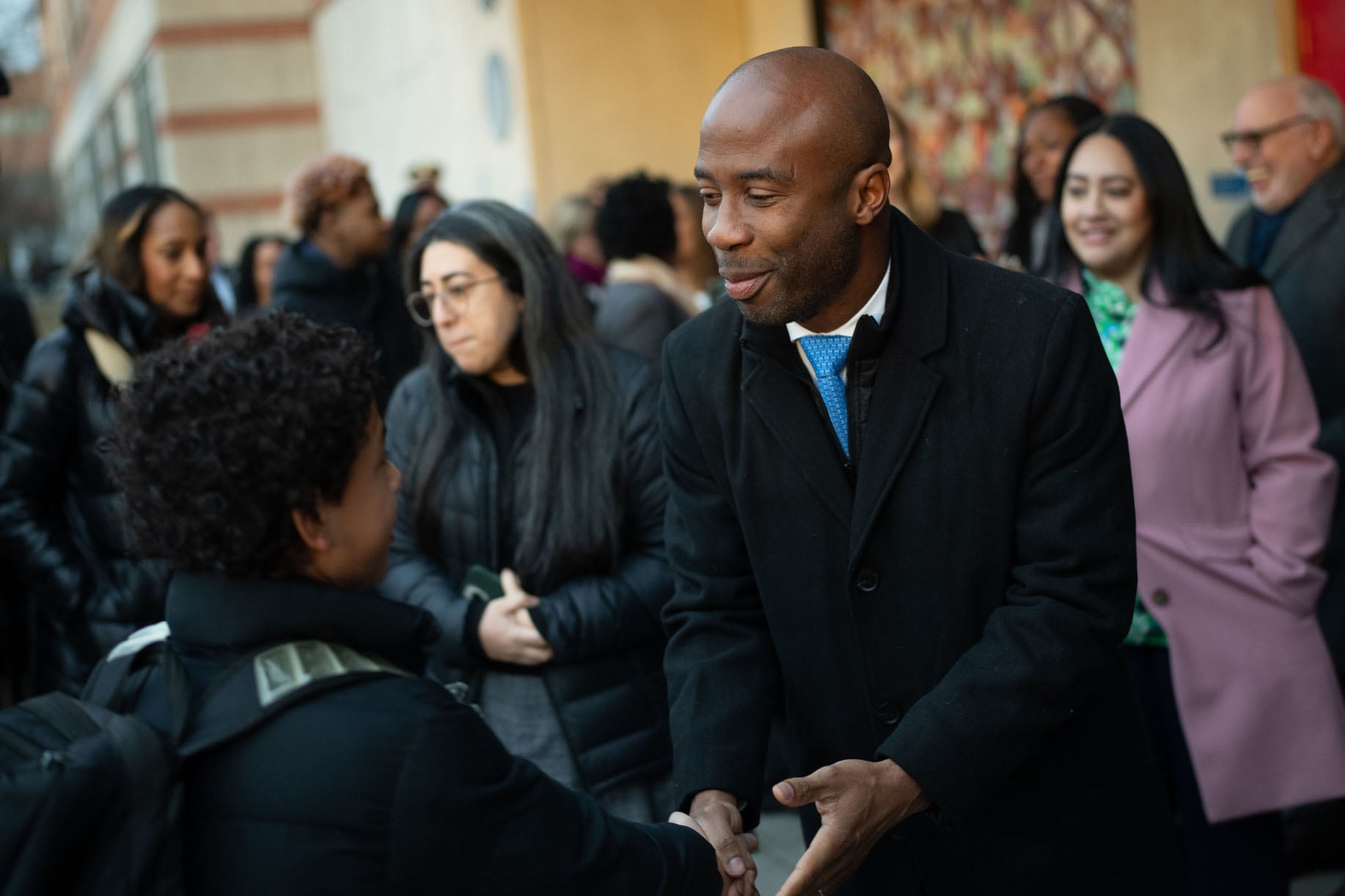
The new schools chancellor began his first official school day at P.S./M.S. 194 in the Bronx, the campus where he got his start in the city’s school system in 2001 as a sixth grade math teacher. He met with educators, students, and parent leaders, according to an Education Department spokesperson. (The visit was not open to the press.)
Samuels also emphasized in his letter that he has a personal stake in the system. Two of his children — a first grader and an 11th grader — are New York City public school students, while his youngest is not yet school-age.
Alex Zimmerman is a reporter for Chalkbeat New York, covering NYC public schools. Contact Alex at azimmerman@chalkbeat.org.