Sign up for Chalkbeat New York’s free daily newsletter to get essential news about NYC’s public schools delivered to your inbox.
After an Upper West Side parent’s racist comments were caught on a hot mic at a public meeting, Black parent leaders and elected officials say they want to see both accountability for her actions and a broader reckoning from the nation’s largest school system.
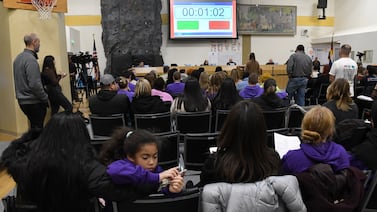
A student from the Community Action School was testifying in person against a plan to close the middle school at a Feb. 10 local education council meeting when Allyson Friedman, a parent at another local public school, began speaking on Zoom.
“They’re too dumb to know they’re in a bad school,” said Friedman, who is a professor at Hunter College.
She then appeared to misattribute and misquote Black historian Carter G. Woodson. “Apparently Martin Luther King said it: If you train a Black person well enough, they’ll know to use the back. You don’t have to tell them anymore,” Friedman said.
District 3 Interim Acting Superintendent Reginald Higgins cited Woodson earlier in the meeting as part of his reflections on Black History Month. In the 1933 book, “The Mis-Education of the Negro,” Woodson described how racism in schools can perpetuate inequities. “If you make a man think that he is justly an outcast, you do not have to order him to the back door,” Woodson wrote.
Friedman’s comments exploded into public view after a recording was posted online and drew rebukes from an array of elected officials and parent leaders. Mayor Zohran Mamdani on Tuesday called the remarks “reprehensible” and “indicative of the exact kind of language that makes students feel as if they don’t belong in our public school system.” A City Hall spokesperson said officials are discussing the incident with CUNY, which oversees Hunter College.
Several Black parent leaders held a press conference Tuesday to condemn Friedman and call on education officials to take action to address inequities in the system. They urged the city’s Education Department to better promote its Black Studies curriculum, deploy the materials more widely, and offer more support for parent leaders grappling with anti-Black racism.
“We are still fighting to be seen as human,” said Tanesha Grant, the executive director of Parents Supporting Parents NY, which organized the press conference. “Our children are still fighting to be seen as human and we will not allow or tolerate anti-Blackness in our school communities.”
Several parents and elected officials said Friedman, a professor in the biological sciences department at Hunter College, should be fired. A Hunter spokesperson said the school is reviewing whether Friedman’s comments violate their policies.
Friedman said in an email that she inadvertently unmuted herself on Zoom and did not intend to share her comments publicly. “As a parent, I was trying to explain the concept of systemic racism by referencing a historical example,” she wrote. “My remarks were not directed at the student speaker, and they do not reflect my beliefs or values. Regardless of context, my words were wrong and caused real harm.”
Comments come at a tricky time for new chancellor
The episode comes at a delicate moment for schools Chancellor Kamar Samuels, who was most recently superintendent of District 3. He built a reputation for listening to parent feedback and for his focus on integrating schools in one of the nation’s most segregated systems.
Samuels helped launch the process of closing three middle school programs in the district, including Community Action School, partly due to anemic enrollment. District officials are considering moving The Center School, where Friedman is a parent, to a new building more than a mile away.
The Center School, which is majority white, would share a building with P.S. 191, which is largely Black and Latino and would lose its middle school grades. Separately, the Community Action School, which predominantly enrolls students of color from low-income families, would be closed entirely.
Those proposals have all generated considerable pushback, and Friedman’s comments reopened longstanding questions about equity and access in a stratified school district.
Parent leaders at the Center School distanced themselves from the incident. “We want to be absolutely clear: this parent’s statement does not represent the values of the Center School community,” the school’s PTA wrote in a statement posted to its website. “Yet their words remind us that racism is not distant – it exists in our broader community, and it is our collective responsibility to confront it.”
For his part, Samuels vowed to support students who were affected. “I know that district quite intimately, and we will be really leaning in and working with the school communities to make sure that we repair any harm that was done to our students,” Samuels told reporters Tuesday.
Education Department spokesperson Dominique Ellison did not elaborate on what actions the city plans to take but noted that Friedman is not a department employee or parent council member.
Community Action School parent Nicki Holtzman said the school has done an “incredible job” responding to the incident. “To my understanding, the kids were not told, and they’ve been protected,” she said. (The student who Friedman interrupted may not have heard the comment because they were testifying in person and Friedman was on Zoom.) Still, Holtzman worries the episode will distract from the school community’s push to keep its doors open.
Several parent leaders indicated Tuesday that their frustration is much broader than Friedman’s comments. They pointed to repeated instances of systemic racism and anti-Black attitudes, including from other parent leaders.
“I’ve watched people employ every archaic, toxic, stereotypical red herring they can to try to slow us down and to try to justify why it is okay to underserve a Black child,” said Erika Kendall, the Community Education Council president in Brooklyn’s District 17. “But also why it is okay to ignore and dismiss the concerns of a Black parent.”
NeQuan McLean, the president of the Community Education Council in Bedford-Stuyvesant, proposed one idea for giving parent leaders considerably more power. He said local councils should have the power to sign off on mergers and closures, which usually affect schools that are struggling with enrollment and tend to have a higher proportion of Black and Latino children.
On the campaign trail, Mamdani vowed to end mayoral control of schools — which gives City Hall much of the power over those decisions — but later backtracked.
The councils “are community school boards that have been stripped of their power, and we need that power back,” McLean said.
Alex Zimmerman is a reporter for Chalkbeat New York, covering NYC public schools. Contact Alex at azimmerman@chalkbeat.org.