Sign up for Chalkbeat Philadelphia’s free newsletter to keep up with the city’s public school system.
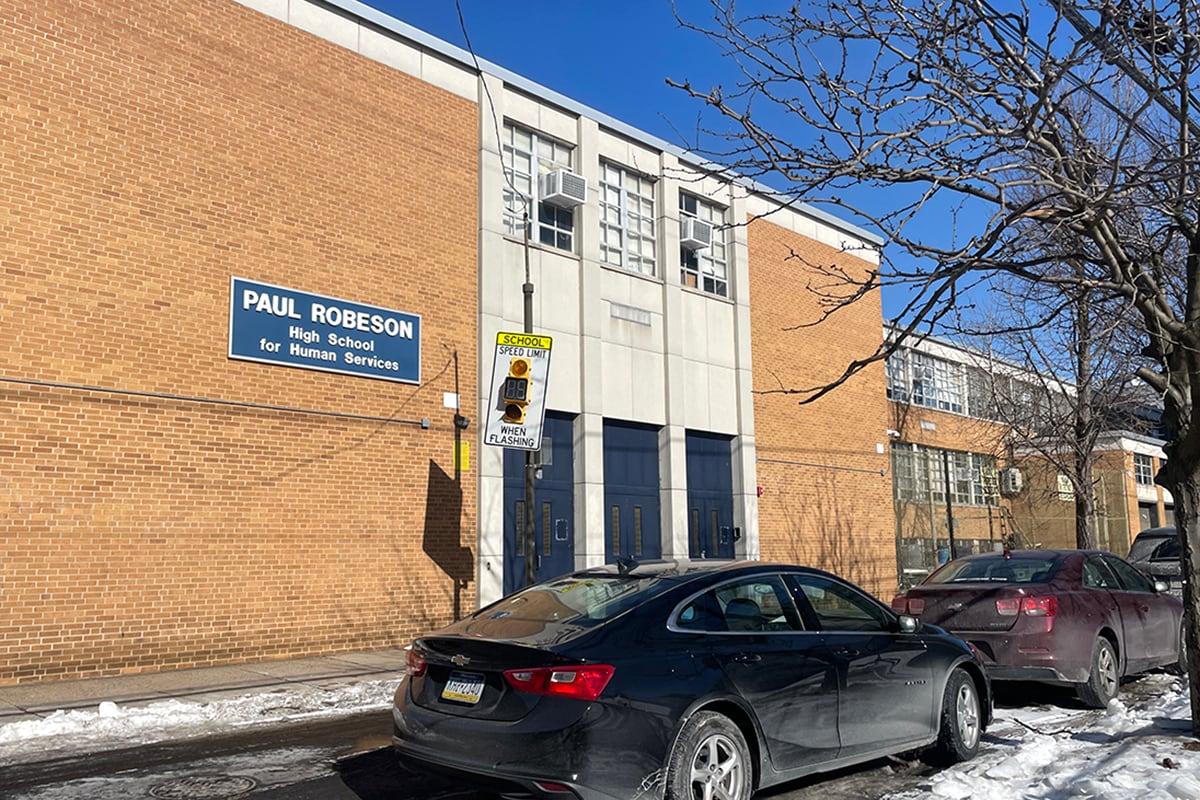
For Philadelphia parent Samatha Bromfield, the choice to send her kids to Paul Robeson High School was deeply thought-out.
Bromfield said she spoke to her children and saw what they needed: “They needed something small. They needed a family.” That’s what she found at Robeson, which has around 300 students and where the teachers all know her children’s names.
But now, the school’s future is in doubt. Robeson is one of the 20 schools the district wants to shutter in an effort to address declining enrollment and move students out of dilapidated buildings. Five are criteria-based magnet high schools or citywide admissions high schools with low enrollment.
Many of those schools would be absorbed into neighborhood high schools as honors programs. But their buildings would fully close in 2027, and the district has not made clear exactly what options current students will have then. Students who recently accepted an offer to schools on the chopping block have been told their only other option is their neighborhood school.
All together, those moves amount to a shrinking number of choices for some students and families, who have come to count on the idea that they have a real say in where they go to high school in Philadelphia.
Philadelphia’s high school selection process is a rigorous and often confusing one. It requires middle school-aged students to explore dozens of options and rank their top picks for a lottery system.
The choices are meant to help students find schools that “nurture their passions,” Superintendent Tony Watlington has previously said. For decades, the district has promoted these options to attract families.
Now as the district moves to close some of those schools and reduce the number of choices, families say they feel betrayed. If the plan moves forward, officials will be faced with the challenge of enticing families back to neighborhood schools.
Already, many say they will not go.
“I choose to decide where my children go,” Bromfield said. “If you decide — you, as in the board members — decide to close Paul Robeson, I have a choice to pull my children out of the public school system.”
Why attracting families to neighborhood high schools is so difficult
Watlington will present the plan to the Board of Education, which will ultimately decide which schools close, later this month.
Until then, district officials have told students at closing schools and those who recently accepted offers to attend them that they should stay enrolled. If they want to switch schools, their only option is attending their neighborhood school.
Watlington has stressed that the district plans to create a transition team to support all families impacted by the closure plan. The district’s goal, he has said, is to keep all students within district schools.
“We are laser focused on doing everything we can to not contribute to more out-migration of students,” he said during a recent radio interview.
The plan would provide students more access to desirable opportunities, like AP classes and career and technical education programs. It includes investments in some neighborhood high school buildings.
But attracting families to neighborhood high schools will likely be a tall order. For decades, school leaders have pushed small high schools as an answer to parents’ concerns about neighborhood high schools, which often have a reputation for being more chaotic and violent than smaller magnets.
In the meantime, these small schools are also trying to convince incoming families to stay enrolled, even with the threat of closures looming.
Successive district leaders in Philadelphia have championed different versions of specialized schools. In the early 2000s, for example, then-chief of schools Paul Vallas opened two dozen new small high schools. He divided some schools in half and turned others over to charter organizations under the promise that students’ experiences and outcomes would improve.
The idea was that at small schools, there would be more opportunities and better academic achievement. Increasing the number of available schools would also reduce overcrowding and give families the sense of choice. And magnet programs could offer the promise of a more intimate and often more rigorous education than a neighborhood high school.
In some cases, it works. Several longstanding magnet schools, like Julia R. Masterman and Central High School, are top-ranked in the state with families desperate to get in.
But not every small school is equally desirable. Over the past decade, the district has lost around 17,000 students, largely because of declining birth rates and more students attending cyber charter schools. Some magnet and citywide admissions schools now have hundreds of empty seats.
In the meantime, some neighborhood high schools have also struggled. Several have low academic achievement and, in some cases, reputations for in-school violence. Many are also in old buildings that families say would not represent an improvement for their children.
Watlington and other officials have promised to boost those schools. But so far, families say they’re not convinced.
“The neighborhood schools are unacceptable for me as a parent,” said Janae Crawley, a parent of a student at Parkway Northwest, during a meeting at the school about the closures. The district wants to close Parkway Northwest and turn it into an honors program at Martin Luther King High School, which has around 600 students — more than double the size of Parkway Northwest.
Crawley, like other parents, said the high school selection process was lengthy. After a “very important and very big conversation” with her child, they decided on Parkway Northwest.
Closing the school would be “almost catastrophic,” she said.
District plan would expand capacity at some popular magnets
The district’s proposal isn’t just about funneling more resources to neighborhood high schools. District officials acknowledge that many families want choices in high school selection, and are frustrated that many of the city’s top magnets are exceedingly hard to get into.
By closing some schools and colocating and relocating others, the district would be able to increase capacity at five top magnet schools, Watlington has said. That includes expanding enrollment at Central and Masterman and adding selective middle schools at the Arts Academy at Benjamin Rush and Palumbo Middle School.
Watlington also wants to open a new, specialized year-round high school that any family could apply to. It’s unclear how students would be chosen for admission or when the school would open.
Still, enrolling more students at neighborhood high schools remains a core promise of the plan. Many students at the schools slated for closure say that’s exactly what they don’t want.
“If I wanted to go to a neighborhood school, I would have applied there,” said Leille Lane, an 11th grader at Motivation High School, which the district wants to turn into an honors program at Bartram High School. Bartram is nearly four times the size of Motivation, and has a much lower graduation and attendance rate.
“If I wanted to attend Bartram or any other school, I would have put that school on my list,” Lane said.
Carly Sitrin and Sammy Caiola contributed to this story.
Rebecca Redelmeier is a reporter at Chalkbeat Philadelphia. She writes about public schools, early childhood education, and issues that affect students, families, and educators across Philadelphia. Contact Rebecca at rredelmeier@chalkbeat.org.