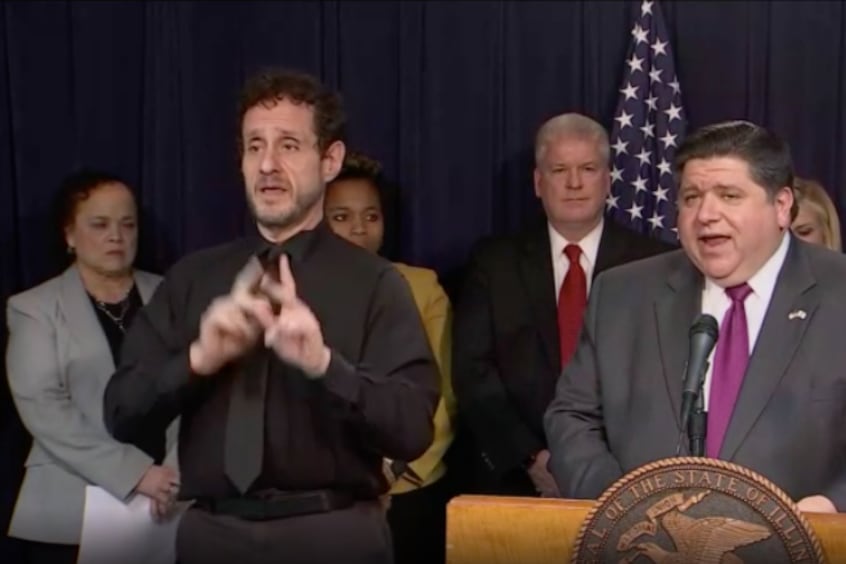
Gov. J.B. Pritzker said Tuesday that he will spend $108.5 million in additional federal relief funds on additional efforts to close the state’s digital divide in K-12 and on bolstering universities and community colleges.
The money comes from a discretionary fund for governors that was part of the first federal coronavirus relief bill. The governor had not said how he would spend his portion until now.
“Despite the challenges of COVID-19, I remain committed to a fundamental principle about education: Every student, no matter where they live or the color of their skin or what their income level is, deserves a high-quality education from cradle to career,” said Pritzker in a release.
Pritzker also said that using the funding to bridge the digital divide, provide professional development for educators, and create resources for student’s social-emotional health will advance his vision for equity in education.
The largest share of the money — $49 million — will go to colleges to help recruit and retain students. Another $40 million is earmarked for more spending on technology and broadband access for K-12 districts, signaling the depth and breadth of the state’s digital divide despite efforts to quickly bridge it when schools closed in March.
Some $10 million will go to fund early childhood mental health programs, professional development, and a text messaging campaign to help spur learning at home for the state’s youngest children.
For K-12 schools, about $50 million will go to closing the digital divide, training for educators and parents, and social emotional support for students. School districts will receive $32.5 million to purchase devices and $7.5 million to purchase WiFi hotspots. Another $7.5 million will be dedicated to training educators and families to help them use new technology.
A small set-aside of $2.5 million will go to create the state’s first “Student Care” department focused on student safety and well-being. Families have had to deal with the stress of economic instability, and losing loved ones to the coronavirus. With school buildings reopening in the fall, experts have said education leaders must grapple with how to transition students and teachers back into the classroom.
“This funding will help us keep students on track and address children’s needs holistically, no matter what the upcoming school year brings. These investments in technology and training will benefit our schools for years to come,” said Carmen Ayala, state superintendent of education.
Illinois’ overall school budget this year is flat. In addition to the governor’s discretionary fund,
the state anticipates receiving $569 million in federal emergency funding for schools, $512 million dedicated for districts.
Illinois school buildings closed in March amid the coronavirus pandemic, and districts have scrambled since to try to roll out remote learning plans to reach their scattered students. In May, a Chalkbeat Chicago and Better Government Association analysis showed that the bulk of the spending so far in five of the state’s largest districts went to computer devices and broadband access.
As districts weigh how to reopen safely in the fall, district leaders have warned that the long lists of health and safety procedures — and the additional expenses of meeting students’ needs after a long period of disrupted learning — will cost more than they’ve budgeted.
Many school districts across the nation are facing alarming budget cuts due to the coronavirus pandemic. Currently, education leaders are waiting for another federal relief bill to be approved by the Senate which includes about $58 billion for K-12 schools.