Mapmaker, mapmaker, make me an elected school board map for Chicago.
That’s what state lawmakers are asking the public to do using a new online mapmaking portal. The invite comes ahead of a July 1 deadline for drawing up districts for Chicago’s soon-to-be-elected school board.
Starting with the November 2024 election, Chicago will begin the transition to having the country’s largest elected school board. Initially, 10 members will be elected and 11 will be appointed by the mayor. In November 2026, the appointed members will be elected. By January 2027, all 21 members will be elected, with a school board president voted on by all Chicagoans and 20 chosen by district.
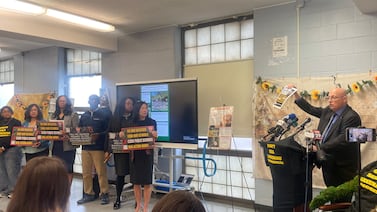
According to senate Democrats, the maps submitted by the public through the portal will become public record. Also, a newly-convened Special Committee on the Chicago Elected Representative School Board will hold hearings to gather input from parents, education advocates, and community groups.
“Transitioning the Chicago Board of Education from an appointed to an elected body is about empowering families with the ability to decide what is best for their children, especially Black, Latinx and minority students who are too often left behind,” Senate Majority Leader Kimberly A. Lightford said in a statement. Lightford will also serve as chair of the special committee.
Chicago Public Schools is the nation’s fourth largest school district and serves roughly 322,000 students, most of them Black and Latino. It has faced more than a decade of declining enrollment that has left several schools struggling to provide a full academic experience to students. The district has subsidized those programs, but a partially elected school board will have to contend with whether to continue operating them when a moratorium on school closures ends in 2025, the same year elected members will be seated.
Chicago Public Schools currently has a $9.5 billion budget, but faces a fiscal cliff as federal COVID recovery money runs out. In recent years, the mayor and City Council have also shifted some costs to the school district. A report released last fall outlined a series of other financial entanglements it could unknot as the elected school board takes over.
The move toward an elected school board will end nearly four decades of mayoral control, which began in 1995.
The end of mayoral control has become a key issue in the current April 4 runoff election between former Chicago Public Schools CEO Paul Vallas and Chicago Teachers Union organizer Brandon Johnson. Vallas was the district’s first CEO, serving from 1995 to 2001. Johnson became a middle school teacher in the district in 2007 and lobbied for the elected school board legislation.
Both support an elected school board, with Vallas pledging to run candidates in line with his vision for public education and Johnson supporting a board that represents the city’s diverse communities.
Clarification: This story was updated to clarify when and how Chicago’s school board will become fully elected.
Becky Vevea is the bureau chief for Chalkbeat Chicago. Contact Becky at bvevea@chalkbeat.org.