Sign up for Chalkbeat Chicago’s free daily newsletter to keep up with the latest news on Chicago Public Schools.
Chicago Public Schools will begin transitioning students from two ASPIRA charter high schools to other schools after months of financial turbulence at the network and deep uncertainty for its families and staff.
In a letter to the district this week, ASPIRA leaders insisted they will keep the campuses — ASPIRA Business and Finance and ASPIRA Early College high schools — open through the end of this school year. But district officials say the charter has not spelled out a clear plan to pull that off, even after the district steered millions of dollars in cash advances to it this winter.
CPS told the charter network in a letter dated Thursday that it will start the transition process this week and expected ASPIRA to assist with providing student records. The district noted it is not moving to close ASPIRA but did not provide more details about what moving students to other schools will look like.
ASPIRA’s two high school campuses together serve about 700 students, who are predominantly low-income and Latino. The district said a third ASPIRA campus, an alternative high school on the Northwest Side operated in tandem with the charter network Youth Connections Charter School, is not facing closure.
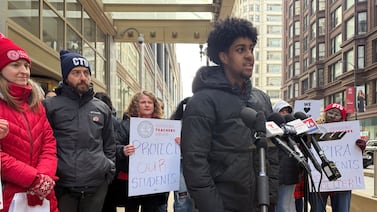
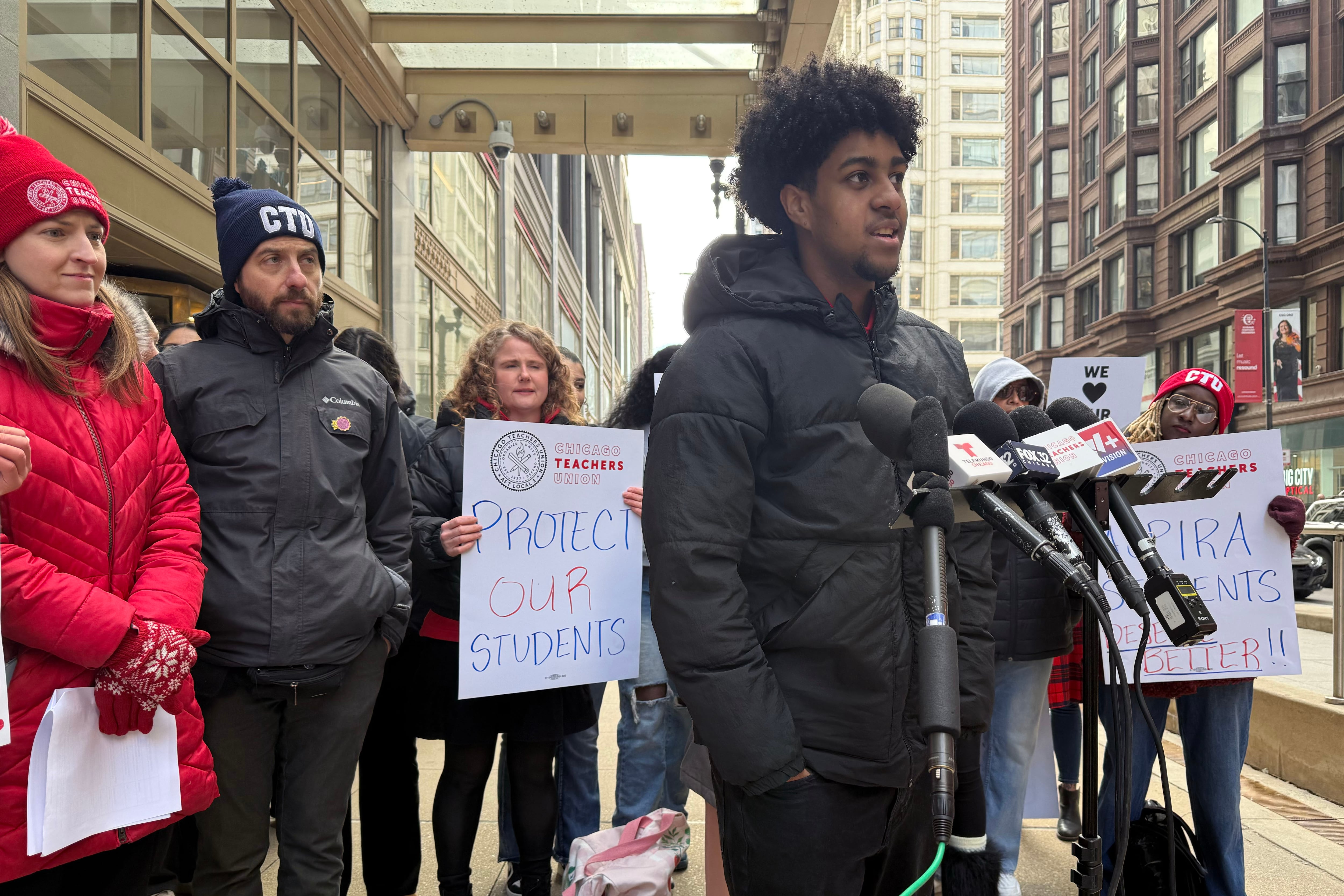
The Chicago Teachers Union, which represents staff at ASPIRA, held a rally with ASPIRA teachers, students, and parents outside of the Chicago Board of Education headquarters Thursday ahead of a board meeting. They called for CPS to help families find new schools now that would “keep students and staff together.”
Lavelle Turner, a senior from ASPIRA Business and Finance High School, told reporters he’s “very concerned about my future” and that closing the school will impact many of his fellow seniors.
“Will my credits be transferred if I change schools? Will this affect my college applications? I would like CPS to answer these questions,” Turner said, adding that he’d like to attend a school with his peers so he can be around familiar faces.
Griselda Hermosillo, parent of a freshman at ASPIRA Early College High School, told reporters in Spanish that she is worried about what happens to student credits and their individualized education programs, or IEPs, which spell out legally required services for students with disabilities, if the school closes midyear. She said Edgar Lopez, president and CEO of ASPIRA, has left her in constant doubt about the school’s future.
“If this has been a false hope, we would hope CPS will give us the actual plan,” Hermosillo said.
The move comes months after the district said ASPIRA had failed to responsibly manage its finances and was struggling to make payroll. CPS said it has already provided $2.5 million in advance payments to ASPIRA, which faces a $2.9 million deficit, and has reached a state-imposed legal limit for how much it can steer to a charter school.
CPS had asked ASPIRA to provide multiple documents by Wednesday, including proof that it could obtain funding from a third party and a plan showing how it would make it through the rest of the school year. ASPIRA provided neither, according to the district.
Instead, in its letter to the district, ASPIRA asked CPS to provide the network with the legal maximum amount of funding for the last four school years to reduce or eliminate its deficit. By state law, the district must provide charter schools with per pupil funding that’s equivalent to 97% to 103% of funding at district schools; ASPIRA is requesting 103%.
The network also said it was working on other funding fixes, including obtaining a bridge loan, raising money from alumni, and crowdfunding. But in its response, the district said it cannot provide funding for previous fiscal years retroactively, and it will start transitioning students out in light of “the emergency situation created by ASPIRA’s failure to demonstrate financial sustainability, which places the education of ASPIRA’s students at risk.”
ASPIRA President Lopez did not respond to requests for comment this week.
ASPIRA is latest in string of charter troubles
The ASPIRA turmoil is playing out against the backdrop of larger turbulence and uncertainty in the city’s charter and contract sector — schools that are publicly funded and overseen by the district, but operated by private entities.
Last year, the Chicago Board of Education voted to absorb five campuses of the charter network Acero into the district to prevent their closure. It also moved to chip in so the South Sides’ EPIC Academy High School could finish out the year before closing and take over the Chicago High School for the Arts, or ChiArts, a West Side contract school. This week, the district held a meeting with ChiArts families concerned that the school would lose its conservatory model, in which professional artists work with students during an extended school day.
District officials and charter leaders have said the larger upheaval is due to declining enrollment across the city and tight finances, including a district move to withhold thousands of dollars per pupil from charters to chip in for its massive pension and debt costs.
But charter critics say schools such as ASPIRA have also made major fiscal missteps and should have been monitored more closely by CPS. The district has taken ASPIRA to task for budgeting based on wildly unrealistic enrollment projections and for withholding key financial information from CPS.
In addition to the documents CPS requested, ASPIRA has not yet submitted a required financial audit or the monthly cash flow reports the district requires of charters such as ASPIRA that it has placed under financial remediation.
In a Wednesday interview with Chalkbeat, Conrad Timbers-Ausar, the district’s acting chief portfolio officer, who oversees charters, said CPS will strive to work closely with families to find high-performing schools where students can transfer this spring.
“It has to be a process that is first and foremost student-centered and family-centered to provide as many options as possible,” he said. “We have to stay very engaged every step of the way with those families.”
The district expects it will have conversations with the Chicago Teachers Union about the possibility of finding other roles for them, Timbers-Ausar said.
Reema Amin is a reporter covering Chicago Public Schools. Contact Reema at ramin@chalkbeat.org.
Mila Koumpilova is Chalkbeat Chicago’s senior reporter covering Chicago Public Schools. Contact Mila at mkoumpilova@chalkbeat.org.