Sign up for Chalkbeat Detroit’s free newsletter to keep up with the city’s public school system and Michigan education policy.
The Detroit Federation of Teachers plans to ask for more support for teachers whose students are impacted by immigration enforcement in its new contract.
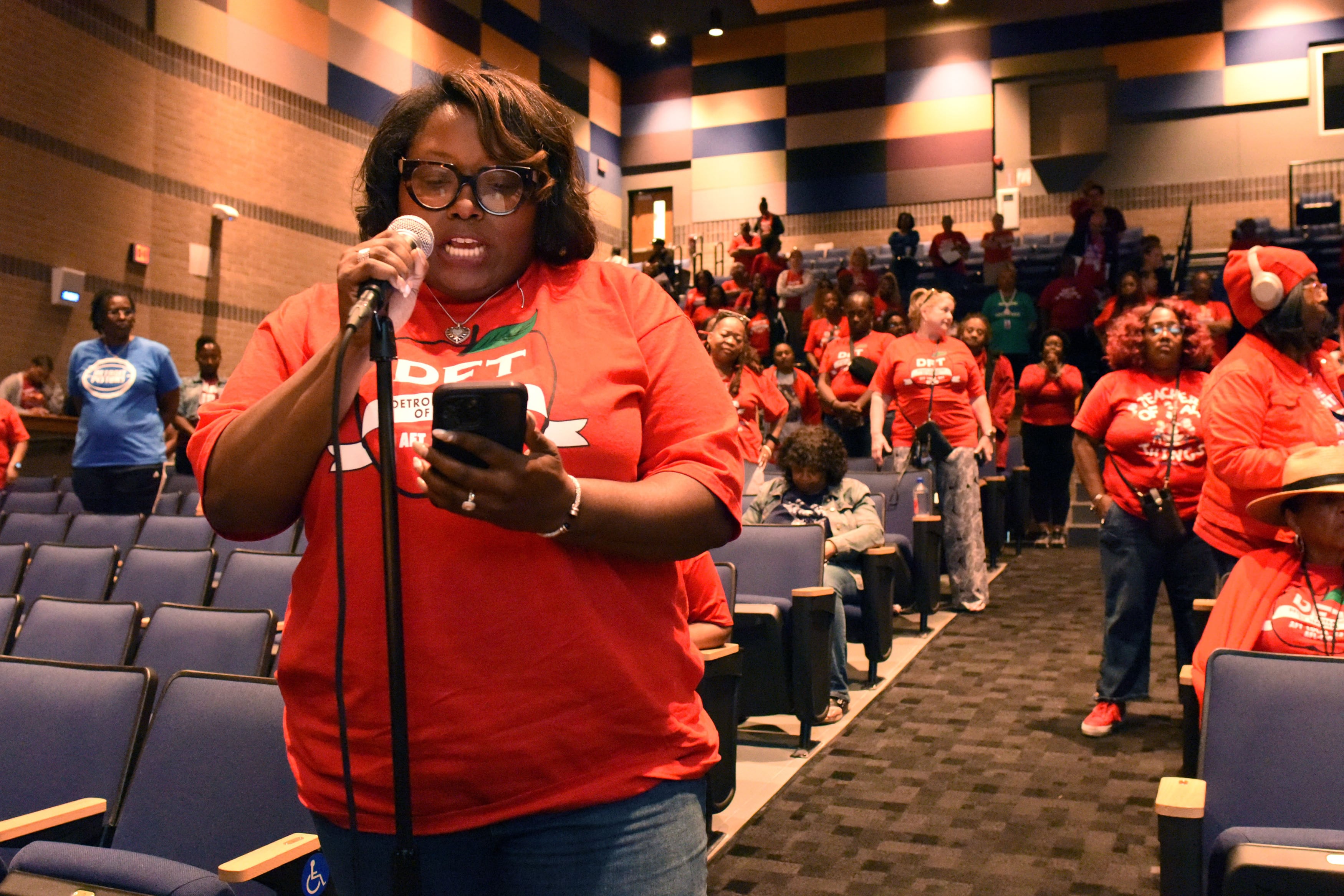
The district’s current agreement with the teachers union will end June 30 and discussions around the new contract will begin in the coming weeks, said Detroit Federation of Teachers President Lakia Wilson-Lumpkins.
The request will come after months of unmet teacher and community pleas to the Detroit Public Schools Community District and its board to provide more training around dealing with federal immigration enforcement. Educators have repeatedly asked the board to do more to protect newcomers and their families as at least five students in the school system have been detained in the months since federal immigration enforcement has ramped up in the second Trump administration.
While the district has provided some training to certain staff, Wilson-Lumpkins told Chalkbeat it can “do a much better job.”
“Parents are still afraid,” she said. “If you go into some of those neighborhoods, where you would normally see hundreds of parents walking their kids to school, you don’t see those parents. That has truly hurt our classrooms.”
The DFT will also seek contract language that reinforces the school system’s commitment to being a sanctuary district, said Wilson-Lumpkins.
Kristen Schoettle, an English as a second language teacher at Western International High School and DFT member, said she wants the contract to include mandatory training for all district staff as a baseline.
Schoettle said the contract should have protections for immigrant workers, as other unions in large urban districts have achieved.
“There are quite a lot of employees with varying immigration statuses,” she said. “They are not represented at all in the contract. There are no special protections for them.”
At last week’s board meeting, Superintendent Nikolai Vitti said he recently met with community leaders in Southwest Detroit, where a large portion of the district’s immigrant students and English learners attend school, to discuss strategies to support kids.
Vitti said it is clear enrollment is down and chronic absenteeism has increased in Southwest schools due to fears of ICE.
“We are actively working with Southwest leaders to proactively anticipate increases in ICE presence in Detroit,” said Vitti. “We’re doing this through individual leaders, community organizers, and groups. School staff and central office staff are working with those leaders to provide additional resources to immigrant families that have lost family members or are fearful of the ICE presence.”
The DFT’s bargaining priorities
The teachers union will fight for more competitive wages and better benefits so the district can better attract and retain staff, said Wilson-Lumpkins.
“Stability in our workforce directly impacts student achievement,” she said.
Vitti told Chalkbeat in an email the district and the DFT share the goal of “aggressively increasing teacher salaries to continue our improvement in recruiting and retaining the best teachers to serve our students.”
“A persistent challenge in providing our teachers with what they deserve — which is to be the highest paid teachers in the nation — is unequal and inequitable state/local funding,” he said.
The DFT’s bargaining priorities also include paid maternity leave.
The district provides protected maternity and paternity leave for up to 16 weeks, but it goes unpaid. Another four weeks may be allowed for those who qualify for family and medical leave. Some employees may also use paid sick or vacation time for their leave.
Most states don’t guarantee paid paternity leave, a recent study found, and just one-third of teachers reported access to any paid parental leave in a 2024 survey.
The union is also seeking more resources for students with autism spectrum disorder, saying that working conditions for teachers in special education and autism spectrum disorder or mild cognitive impairment classrooms are leading to burnout, said Wilson-Lumpkins.
This school year, the district revamped its special education department and restructured classrooms to be at centralized hubs. It also hired more staff to keep up with the growing demand for students’ special education service evaluations.
Even with the additional staff, Wilson-Lumpkins said members say the timeline for completing evaluations is unrealistic and causing staff to leave their jobs.
“The last contract scratched the surface,” Wilson-Lumpkins said at a recent board meeting. “This contract must be progressive, creative and innovative, so that there is no question about this district and this union’s expectations about what we have as a union and a district.”
The board went into its first closed session to discuss negotiations for this cycle of negotiations on Tuesday night.
Hannah Dellinger covers Detroit schools for Chalkbeat Detroit. You can reach her at hdellinger@chalkbeat.org.