Sign up for Chalkbeat Detroit’s free newsletter to keep up with the city’s public school system and Michigan education policy.
A state judge has ruled against the Detroit school district in its fight with the Michigan Department of Treasury over collecting operating tax revenue.
That means the Detroit Public Schools Community District will have to ask voters to allow it to collect a local operating millage, which has been collected by Detroit Public Schools. DPSCD also will lose some state funding.
Judge Christopher P. Yates, who issued a summary judgment last month in favor of the Treasury Department, said state law will not allow Detroit Public Schools to continue to collect operating revenue to pay off its capital debt ahead of schedule, as proposed by DPSCD.
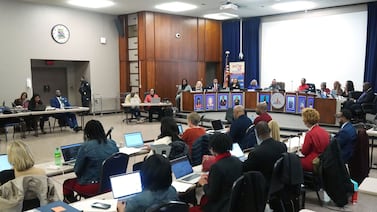
Superintendent Nikolai Vitti said last week at a board committee meeting that DPSCD must now get voter approval to collect the operating millage by July 1, 2027.
“If we don’t, then by that summer, as we roll into the next school year, we would have a $120 million deficit,” he said.
Vitti said the district will also appeal the Court of Claims’ decision.
Use of tax dollars sparks dispute between DPSCD and the state
In 2016, lawmakers created a new district to resolve a debt crisis in DPS. The new district, DPSCD, took over day-to-day school operations, while DPS remained only to collect tax revenue to pay off its existing $3.2 billion debt.
Since DPSCD would not receive local property tax revenue, the state then filled the gap with money from the 1998 Tobacco Settlement Fund.
In late 2024, nearly nine years after the legislative deal, DPSCD ran into a disagreement with the Treasury Department, as higher property values in the city accelerated a $150 million emergency loan repayment.
District officials wanted to use operating revenue to speed up its payment of the remaining $1.3 billion in capital debt and $355 million in debt to the state’s School Loan Revolving Fund.
A separate debt millage had been paying off the capital and revolving fund debts, but DPSCD officials said the move would allow the debt to be paid off years earlier, saving taxpayers about $326 million in interest costs.
But the Treasury Department said state law does not allow operating millage to be used for non-operating debt. The department’s position was that DPS could no longer collect the operating millage once the emergency loan was paid off.
Because the two could not agree and proposed legislation that would have changed the law failed, DPSCD sued the state.
(In February 2025, the court denied the district’s request for a preliminary injunction to require the state to continue making payments to DPSCD and allow DPS to keep collecting the operating millage as the case continued.)
Though the court recognized the potential benefit to taxpayers if DPS were allowed to pay off the remaining debts faster, Yates sided with the state, saying there was no way to allow the district’s request based on existing law.
“It may be wise to read a provision authorizing DPS to use the operating levy to repay all outstanding debt,” the judgment reads.
But “courts cannot insert a provision simply because it would have been wise of the Legislature to do so to effect the statute’s purpose,” the judge added, citing a 2021 Michigan appellate court decision.
The final order also said DPS will remain intact to continue to collect debt millages to pay off the remaining loans by around 2040.
The district’s next steps
As the district waits for a decision in its appeal, Vitti advised the school board to put an item on the ballot for the May election asking voters to authorize DPSCD to collect the operating millage.
If that ballot measure fails, Vitti said it could be added to the November ballot. If it does not pass then, the district may have to pay between $1 million and $2 million to the city to hold a special election in May 2027.
The board is also considering a $1.4 million contract with a public affairs firm to educate voters about the operating millage.
Vitti said he is optimistic voters will pass the measure, but the main challenge will be communicating to Detroiters that they will not have to pay additional taxes. The only thing changing will be that DPSCD will collect the money instead of DPS.
In November 2024, voters overwhelmingly approved Proposal S, which allowed DPS to levy the full 18 mills on non-homestead property.
Hannah Dellinger covers Detroit schools for Chalkbeat Detroit. You can reach her at hdellinger@chalkbeat.org.