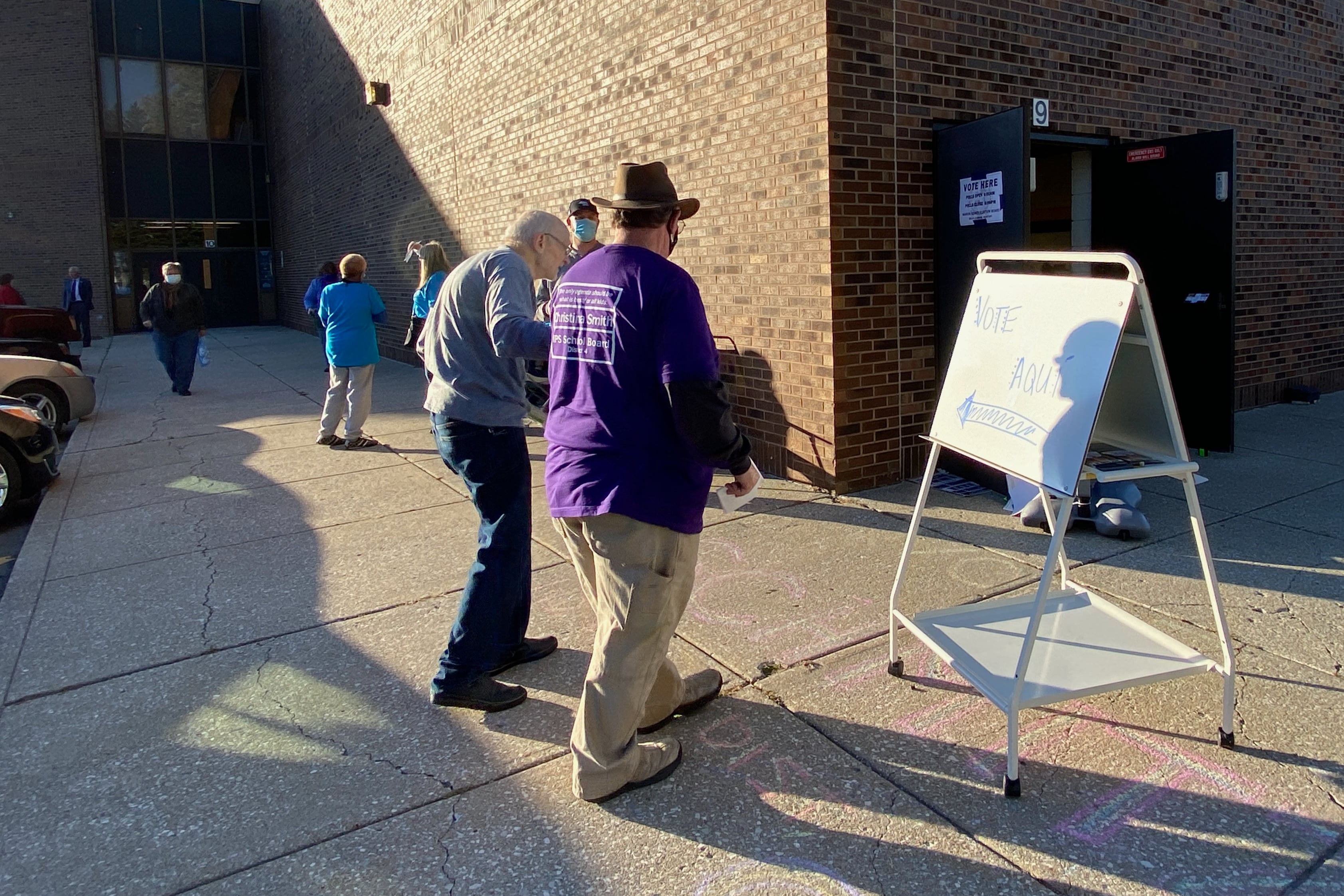
A bill to turn Indiana school board elections partisan drew unanimous public opposition in its first legislative hearing Tuesday, despite lawmakers’ contentions that it would improve transparency.
House Bill 1182, authored by Rep. J.D. Prescott, a Union City Republican, would require school board candidates to add their political party affiliation to the ballot, or identify as independent. The races are currently nonpartisan.
Opponents said the proposal would inject partisanship into school districts’ everyday decisions, like how to feed and transport students.
“The school board should be focusing on policy,” said Rep. Tonya Pfaff, a Terre Haute Democrat. “There are no Democrat or Republican schools.”
But Prescott said he had heard constituent support for greater transparency in school board elections. He said a candidate’s declaration of their stance on national issues indicated how they would handle smaller local issues.
“I think you can tell the difference between financial responsibility and moral character,” Prescott said. “Having that on the ballot will help tell voters a little bit more about the candidate.”
In down-ballot races where voters know little about individual candidates, they would at least know their political party, lawmakers said.
“I think politics are already in our schools, we just don’t know where our school board members are on the political spectrum,” Prescott said.
Under the proposal, candidates would have to have voted in the two most recent primary elections held by the party of their choice in order to claim the affiliation. If they hadn’t, they would need to seek written permission from the county party chairperson to claim party affiliation.
During public comment, dozens of school board members and their legal representatives spoke in opposition to the proposal, saying it would further fracture boards that have recently seen politically motivated furor over COVID-19 protocols and race discussions in schools.
“Inviting politics into the boardroom through partisan school board links could have the consequence of fueling conflict,” said Terry Spradlin, executive director of the Indiana School Boards Association. “What we witnessed as an unusual season will become the norm.”
Spradlin also said the proposal would prohibit federal employees from running for school boards under the Hatch Act, and leave out candidates who serve in the military as well as those employed by the departments of defense and corrections, and the Postal Service.
Spradlin said the school boards association — composed of 1,700 school board members across all 290 Indiana school districts — opposed the bill. But if it moves forward, he suggested adding an amendment that would allow local bodies to decide if their school board elections would be partisan, as Tennessee recently allowed.
Most other states hold nonpartisan school board elections.
Other speakers warned that the bill would make it harder to find quality candidates willing to serve on the school board, and, because the primary role of the board is to hire a superintendent, would politicize that position as well.
One person pointed out that the Indiana General Assembly had recently made the superintendent of public instruction an appointed position rather than an elected one, with the aim to depoliticize public education. Lawmakers said the office charged with appointing the superintendent — the governor — was still a partisan position.
No public speakers spoke in support of the bill.
The House Elections and Apportionment Committee did not vote on the bill Tuesday.