Alexis Fernung was ready to taxi the airplane from the runway to the hangar. Following the guidance of the signalman and staying in the lines on the runway, she did her best to move the airplane.
“I got this,” she said as the plane started moving.
Just a few minutes earlier, Lillian Green was examining a robot arm used for industrial painting. Up on a ladder, she searched for leaks and inspected the machine.
“Don’t fall off the ladder!” teased Ben Waterman, the teen coordinator at the Boys & Girls Club of Tipton County.
“It’s not real Ben, chill,” Lillian responded.
But it felt real.
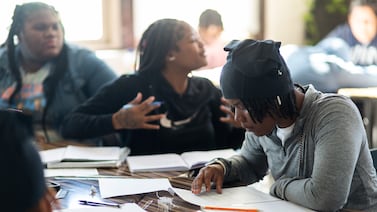
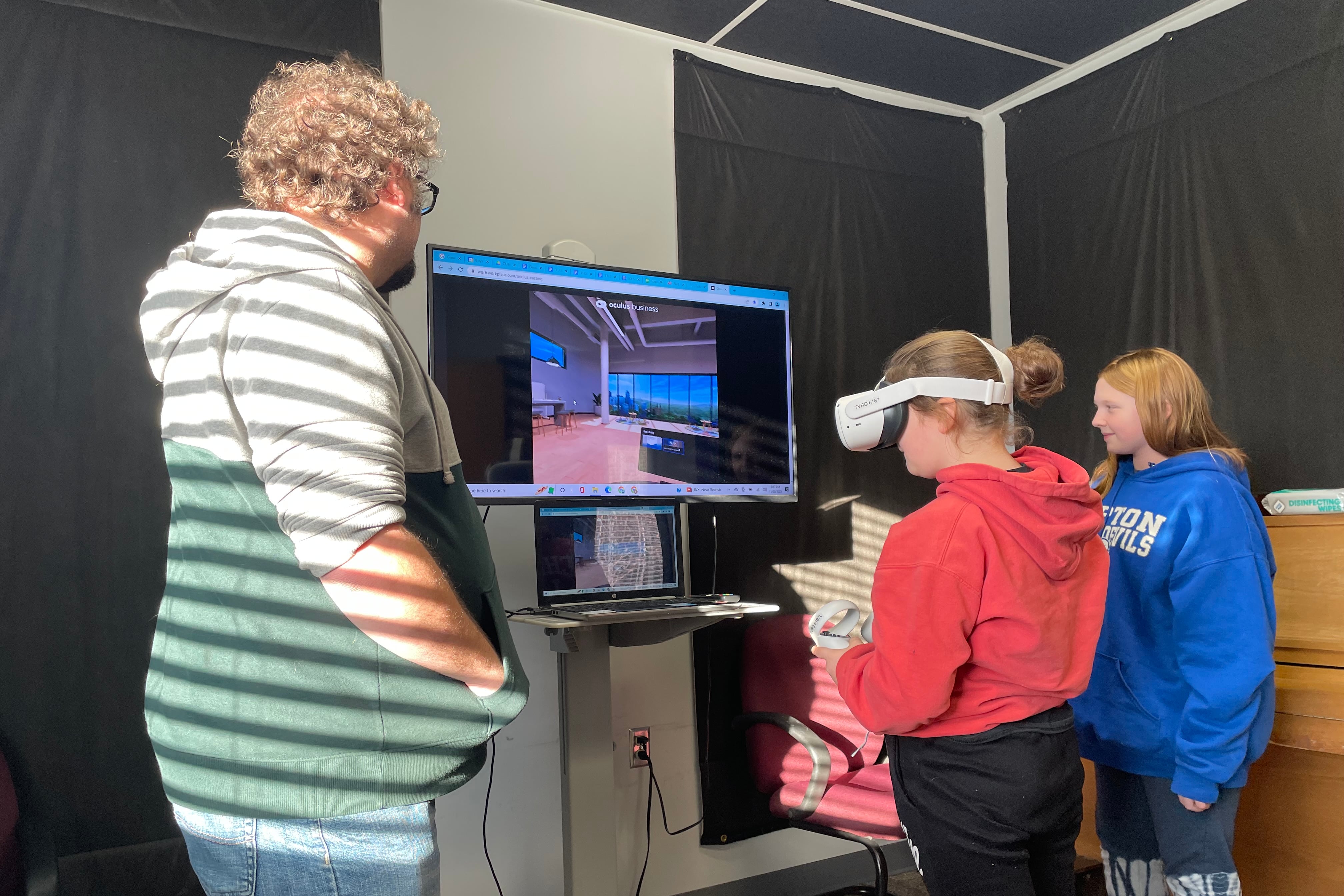
Alexis and Lillian are in sixth and fifth grade, respectively. They weren’t on the job site, but rather in the Tipton Boys & Girls Club’s music room where, once a week, it’s transformed into a “hands-on” jobsite using Oculus headsets.
The Indiana Alliance of Boys & Girls Clubs partnered with Transfr, a company that creates immersive virtual reality simulations for workforce development, training, and education, to bring oculus headsets loaded with VR simulations to help students explore potential careers to clubs across the state.
Tipton, about an hour north of Indianapolis, was one of 10 clubs that got the headsets in the summer and the program has recently expanded to include nearly two dozen more clubs.
“It’s opened up some of those types of conversations,” Waterman said of VR’s impact on his talks with students about careers. “Kids will gravitate toward careers that they see in their lives like teaching, nursing, or youth pastor.”
Listing jobs they’ve never seen means nothing to them, but with this, you can tell them that the skill they did in the simulation is important for one or more jobs, he said
“It’s a much more concrete way to talk about it,” Waterman said.
Multiple ‘hands-on’ career experiences in one place
Students come to the Boys & Girls Club looking for something different after the school day, said Lana Taylor, executive director for the Indiana Alliance of Boys & Girls Clubs.
“They don’t want to do math and reading, they want to do something fun and engaging,” she said. And the virtual reality experience, she said, “is fun and engaging.”
It’s also part of a shift from career exploration to workforce development, Taylor said. It’s the difference between hearing about a career and trying it. Plus, she said it’s another way to supplement what students are learning about career choices in school and at home.
Hearing adults talk about a career isn’t always the best way to give students an understanding of it, she said.
So the Boys & Girls Club wanted to offer more hands-on experiences. One way was for students to work as junior staff at the clubs and learn what it’s like to be a staffer. But not all students want to work at a Boys & Girls Club, Taylor said.
So the club started more partnerships with companies, such as Old Navy, and the one with Transfr is perfect, Taylor said. It allows students to explore multiple industries without leaving the Boys & Girls Club.
The simulations build a path from classroom to career and “help young people understand the full range of options available to them in today’s fast-changing economy and workplace,” Bharani Rajakumar, founder and CEO of Transfr, said in a statement.
After the VR experience, students know if a career is“that’s what we thought it was” or “that’s not what I wanted to do,” Taylor added.
Students try multiple careers and find new ideas
Back in Tipton, the music and art rooms at the Boys & Girls Club transform into job sites on Wednesdays.
Students in fifth grade and older can use the headset programs, which include an option for students to level up and build skills in a specific field.
For fifth and sixth graders, the ideas of going to college and having a career can feel pretty abstract, Waterman said. But he said he knows how important it is to try out different things.
Before coming to the Boys & Girls Club, Waterman worked in student life at Grand Canyon University, where he said he saw students come to college with one major in mind, start taking classes and experiencing life on campus, and then change majors.
He tells the students he works with to be prepared to change their minds once they learn something new.
And that’s exactly what the simulations from Transfr offer: Be a pilot, be an engineer, work in construction or tourism — try it all out.
As the students are exploring, Transfr is collecting data about which simulations are popular and adding options like health care. Waterman said that information helps him think about which guest speakers and field trips the students would want.
Both Alexis and Lillian said the airplane experiences were their favorites, and Lillian liked the robots too.
The girls said they want to be teachers someday. But they also expressed interest in engineering, math, and STEM — all subjects that are covered in the VR simulations.
“That’s what happens. Kids find other options that they hadn’t thought of before,” Taylor said. “The more exposure they get, the more they think about it.”
MJ Slaby is the bureau chief for Chalkbeat Indiana. Contact MJ at mslaby@chalkbeat.org.