
Sign up for Chalkbeat’s free monthly newsletter How I Teach to get inspiration, news, and advice for — and from — educators.
The students at Circle City Prep aren’t big fans of squash – no matter which type their school chef makes. But they do like brussels sprouts.
Tracey Couillard, lead chef at the school, leans on her days working in Indianapolis restaurants to come up with ways to cook with vegetables and fruits that might be new to the students.
It’s all about “making sure we are intentional about what we are offering, and not just throwing spaghetti at a wall to make it stick,” said Couillard, who started her job a year ago.
The school’s kitchen is a Next Course Cafeteria through A Longer Table, a nonprofit formerly known as the Patachou Foundation which aims to make sure all students have access to good food. The organization partners with schools to have cafeterias that serve fresh and scratch-made foods. At Circle City Prep, Couillard leads a kitchen team of six other people to prepare scratch-made food for breakfast and lunch for more than 430 students that include fresh vegetables and fruits as well as daily salads.
What students are eating is also getting attention at the statehouse where house lawmakers advanced a bill to ban foods with certain food dyes and additives from public schools that participate in a “federally funded or assisted meal program.” The bill also requires schools to post a menu and ingredients online.
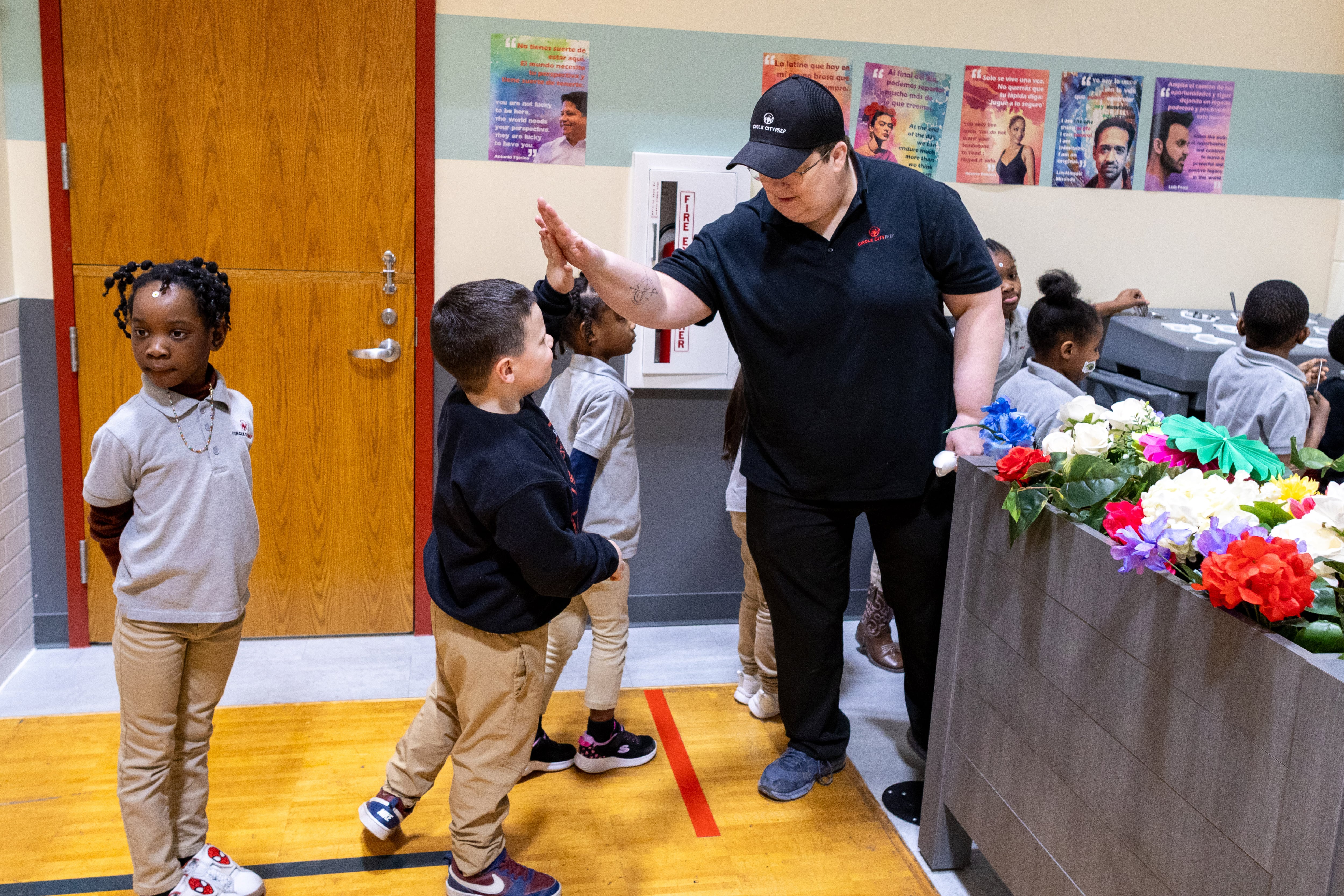
At Circle City Prep, Couillard said the fresh foods help students build healthy habits both inside and outside of school. And it’s led her to build relationships with students too.
“Sometimes kids will be in a sad spot and ask if I can have lunch with them, so then I sit with them and let them talk and let them share their feelings because there are a lot of big feelings between kindergarten and eighth grade,” she said.
Chalkbeat talked to Couillard about her daily routine, what makes her cafeteria special, and the biggest thing she’s learned on the job.
This interview has been lightly edited for length and clarity.
What led you to become the lead chef at Circle City Prep?
I was in the Army National Guard for 20 years, and after I retired from the guard, I started working in restaurants around Indianapolis and did that for about 12 years.
This opportunity popped up at a time when I needed a change, and I honestly didn’t know if it was going to be for me. Working in restaurants with adults is very different than working in a school kitchen with kids from kindergarten to eighth grade as your primary customers
But the kids are the best part. I’ve got kids that come into my office when they are having a bad day, and they build Legos while I’m working on something. I’ve got a couple of kids who come in after school and do extra practice on their reading.
I get a lot of joy and feel like I’m actually doing something helpful and making a positive difference in kids’ days.
Tell me about the meals you make at the school.
It’s mostly all from scratch and we do a lot of our own sauces. We’re very mindful of sodium, fat, and sugar to make sure we are serving good healthy foods for the kids to eat. Students have fresh vegetables and fruit. Every day they have a different salad option.
I started a program at the beginning of the school year to introduce them to new fresh fruits and new fresh vegetables, just trying to broaden their horizons.
At first, they were apprehensive because it’s something new but now, the kids get really excited about it, they are really invested in it.
How has the food made an impact on students?
They eat more vegetables now when they are coming through lunch, and that’s just good fuel for their bodies and their minds. They’re more willing to try something new too. It’s shocking to me how many kids I see with salads compared to last year because it’s just different exposure.
When they ask their people at home to cook something we had at school and it doesn’t taste the same, they’ll ask if I can share a recipe with their parents on how we do it so it tastes like it does here, which is really cool.
What does a typical day look like for you?
My day starts between 6:30 and 7 a.m. I check out the breakfast stations and make sure they are set, and oftentimes I’ll be walking the halls while the kids are coming in, touching base with them and making sure they are getting their breakfast.
I sit in on late breakfast. There are kids that come in late almost every day so they are already a little behind the curve. I sit down with them, make sure they have a good breakfast and their mind is set to jump in and go to class. I’m trying to be a positive touchpoint for them when they are starting their day.
In between breakfast and lunch, we are prepping. And at lunch, I’m helping kids move through the line, making sure that they have all the items they need on their tray to have a good meal.
What do you want people to know about what it’s like to have a cafeteria that emphasizes fresh foods?
They have to look at the kids as they are an investment. We are able to run a fully staffed kitchen and feed breakfast and lunch to more than 430 kids a day, and we are operating a scratch-based kitchen in the black.
You can run a successful school kitchen without using all of the processed foods, it takes practice, and it takes a certain amount of skill that maybe you wouldn’t expect from a school cafeteria.
But it’s an investment in the future. You are building healthy food habits and eating habits and trying to develop healthy relationships for kids with food. I’m teaching kids that good food can taste good.
What do you want to do next?
I would love to have a hydroponic garden in the cafeteria space. I would love to have a little green space where we can grow veggies and fruits and things like that. Because we serve salads every day, so how cool would it be to have lettuce growing in our cafeteria? The kids could see this is what is actually nourishing our bodies and this is how it grows to develop more of that connection of where does the food come from and how does it get to our plate.
What have you learned doing this job?
You don’t understand how much of an impact you can have on somebody else’s day. And you don’t always see that impact with adults, but it’s really easy to see that with kids. You can see their whole day shift with just a “Hey, how are ya? You good?”
You give them two minutes and those little time investments make a difference. That’s the biggest thing I’ve learned because it’s not hard to make somebody smile and share a little joy.
MJ Slaby oversees Chalkbeat Indiana’s coverage as bureau chief. Contact MJ at mslaby@chalkbeat.org.