Sign up for Chalkbeat New York’s free daily newsletter to get essential news about NYC’s public schools delivered to your inbox.
New York City lawmakers are scheduled to vote Thursday on a bill that would force the Education Department to disclose detailed statistics about long-term suspensions of students with disabilities.
A similar bill was recently introduced in the state legislature and would apply to districts across New York.
The flurry of legislation comes after a Chalkbeat investigation found that New York City’s public schools have for years flouted rules designed to protect students with disabilities from lengthy classroom removals.
Under federal law, students with disabilities may not be suspended for more than 10 days if the conduct in question was directly related to their disability or stemmed from the school district’s failure to provide special education services. Schools are required to conduct meetings known as manifestation determination reviews to assess whether either of those criteria are met. If so, the student should immediately return to school, and officials must conduct a behavior assessment.
But the city’s public schools have long failed to consider a student’s disability and how it relates to the suspension, according to a Chalkbeat review of hundreds of pages of special education records, reports from independent monitors, and interviews with dozens of families, advocates, and educators. As a result, some students have served suspensions for weeks longer than allowed.
Last school year, New York City students with disabilities were removed or suspended from their classrooms nearly 14,800 times — representing 41% of all removals, even as those with disabilities only represent 22% of the student body. Black students are also disproportionately suspended, representing 38% of all removals last year and just 19% of city students. (Suspensions ticked down about 2% last year overall, with a larger decline among longer-term punishments.)
In 1,550 cases last school year, students with disabilities were removed from their classrooms long enough to trigger the review process to assess if their conduct was connected to their disability or the school’s failure to provide services, Education Department officials said at an October City Council hearing. In about 23% of those review meetings, schools found that the suspension was due to the student’s disability or a failure to implement their learning plan.
Schools were more likely to find that white students’ behavior was related to their disability compared with their Black or Latino peers, Chalkbeat’s investigation found. (City officials declined to release a demographic breakdown of suspension reviews for last school year.)
Lawmakers say bills would hold school districts accountable
The legislation, which several advocates said would represent a significant step forward, aims to shed light on a process that has not received much public examination. Many school districts across the state, including New York City, do not regularly report suspension review outcomes or even how often they are conducted. The city and state legislation would require districts to disclose those figures every year.
“New York lacks comprehensive, disaggregated data to identify systemic issues or disparities,” said Assembly member Yudelka Tapia, who sponsored the state bill and represents parts of the Bronx.
Suspensions in New York City are typically capped at 20 days, so when students prevail during the suspension review process, they may return to class days or a couple weeks sooner. But in districts across the state, suspensions are allowed to last up to an entire school year, meaning the stakes of the suspension reviews can be high.
The City Council bill, sponsored by Rita Joseph, is scheduled for a vote in the council’s education committee on Thursday and could proceed to a vote by the full council later that day. If it becomes law, the Education Department would also be required to report how often parents are informed of the review meeting and if they are conducted within the required timeframe.
“The main goal right now is to make sure that we have data that will support the future advocacy,” Joseph said, adding that it would help protect the rights of students with disabilities.
Because New York City schools are typically responsible for reviewing their own suspensions, advocates contend that the review process is stacked against families. But since lengthy punishments are usually reserved for the most severe misconduct, school staff frequently say that removing students is important for maintaining a safe learning environment for others.
Families often don’t know their rights at the suspension review meetings, including that they can bring a legal advocate. The city and state legislation would require more detailed reporting on whether families and their advocates are present at those meetings.
The city Education Department updated the materials for families about the suspension review process, explicitly stating that they have the right to bring an advocate and offering a list of potential advocates, a spokesperson said. City officials have also convened focus groups about the process and are updating training materials for school staff.
Some groups that have represented families at suspension review meetings cheered the legislation because it has been difficult to obtain basic statistics about the process.
Michaela Shuchman, a lawyer at Legal Services NYC, said her organization has submitted public records requests to large districts across the state about the suspension review meetings, and several said they don’t collect information. She has been waiting more than a year for a slew of suspension records from New York City’s Education Department, which often drags out public records requests.
“We don’t know what we don’t know, which is why these bills are so important,” Shuchman said. “We need this information to figure out where the gaps are and where we’re falling short.”
City Education Department officials said they support the city legislation and are reviewing the state bill.
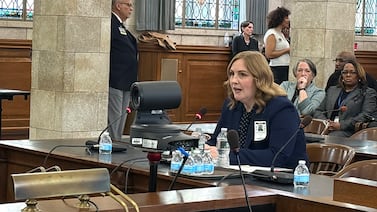
“We have to have this transparency,” said Andie Corso, a city special education official, at the October hearing. “The public deserves this information and it will help us do better.”
Alex Zimmerman is a reporter for Chalkbeat New York, covering NYC public schools. Contact Alex at azimmerman@chalkbeat.org.