Sign up for Chalkbeat New York’s free daily newsletter to get essential news about NYC’s public schools delivered to your inbox.
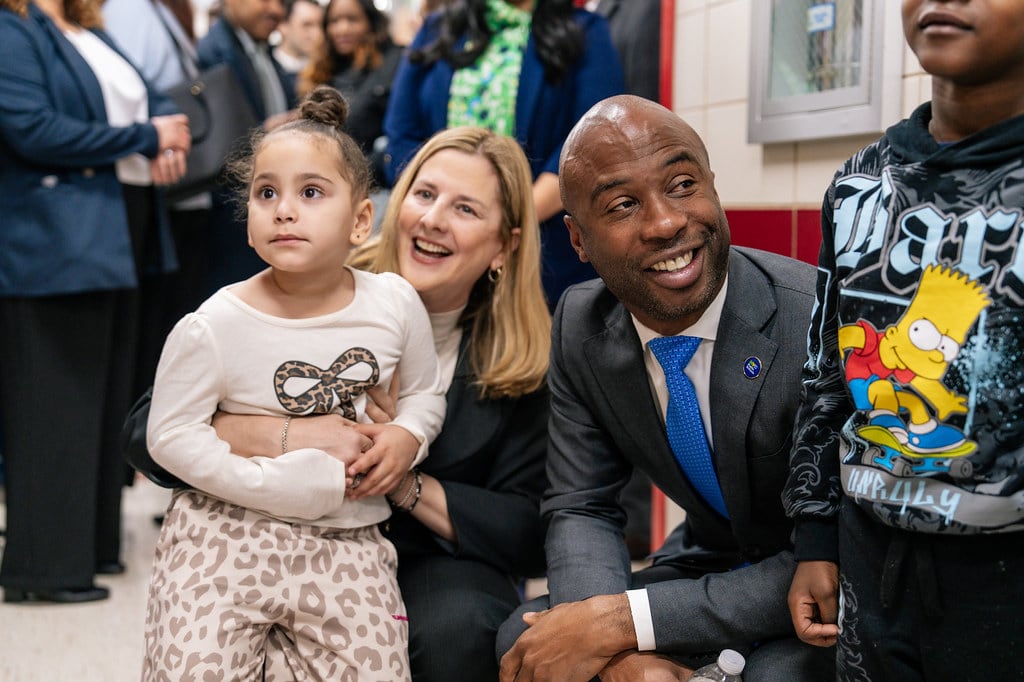
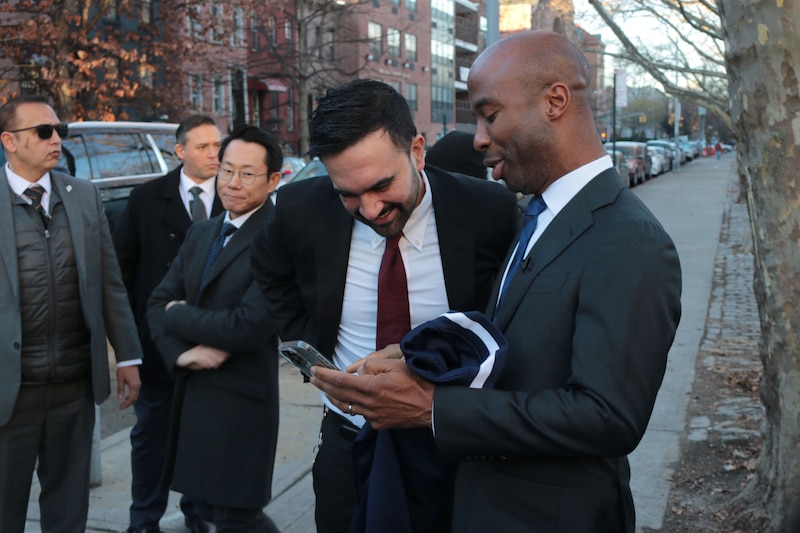
Shortly after Mayor Zohran Mamdani tapped Kamar Samuels to run New York City’s public schools, the two visited a Brooklyn campus where they were swarmed by students jockeying for selfies.
Mamdani soon peeled away, but Samuels toured the school, Arts & Letters 305 United, where he ducked into a room of third graders and began counting students.
As a local superintendent overseeing dozens of campuses, first in Brooklyn and then in Manhattan, Samuels often informally surveyed classroom headcounts on his visits. He’d later check official registers to see how many students were missing that day, a key measure of whether students are engaged at school.
“I really don’t have to do this,” Samuels said with a laugh after leaving the room of 21 third graders. “It’s kind of like muscle memory.”
Mamdani told Chalkbeat he selected Samuels, 48, because of his granular knowledge of the city’s classrooms, learned during more than two decades as a teacher, principal, and superintendent. The mayor also cited Samuels’ track record of pursuing ambitious change.
In both of the racially diverse New York City local districts he oversaw, Samuels used school mergers to address declining enrollment and persistent segregation. He led a transition away from gifted programs, replacing them with International Baccalaureate offerings available to all students. And he helped guide a plan to diversify several Brooklyn middle schools by setting aside a portion of seats for low-income students.
Those moves sometimes generated pushback. But Education Department colleagues saw him as a leader who doesn’t shy away from thorny problems and crafts solutions based on input from schools and families. In nearly 20 interviews with educators, parents, and former and current city officials, Samuels was described as someone who builds deep community ties, listens to critics, and focuses on student outcomes.
“He has not been afraid to touch the third rail and have difficult conversations — be it around equity, low enrollment, the concept of rigor, and the disparities in test scores throughout our district,” said Jill Rackmill, co-president of the parent council in District 3 in Manhattan, which Samuels supervised as superintendent. “Ultimately, he makes the hard decisions and does the tough things.”
In his first week on the job, Samuels told principals that he will build on some of the prior administration’s biggest initiatives, including new career education programs and an overhaul of elementary school reading.
And the new schools chief has pointed to other big problems facing the system, including cratering enrollment and alarming rates of chronic absenteeism, in which 1 in 3 students now miss more than 10% of the school year. He recently gave the system’s overall performance a “C” grade.
Shael Polakow-Suransky, the president of the Bank Street College of Education and a former top Education Department official, said he believes Samuels is up to the challenge.
“He’s politically gifted in a way that’s similar to the mayor,” Polakow-Suransky said. “He’s someone who inspires people and really gets them excited about his vision and supporting change.”
Samuels’ built a reputation for listening early on
Samuels, who moved to New York from Jamaica at age 15, originally pursued a career in finance, landing an accounting job at the National Basketball Association. He hated it.
He saw a subway ad for the city’s Teaching Fellows Program, a fast-track initiative that funnels career-changers into city classrooms. Within a few months, he was teaching sixth grade math at P.S./M.S. 194 in the Bronx.
Over the next two decades, Samuels rose through the ranks at the Education Department, earning a reputation for his strong rapport with community members.
Page Best-Hardy, a retired family leadership coordinator in District 23, which includes Brownsville and Ocean Hill, recalled that when Samuels was a deputy superintendent there nearly a decade ago an attendee at a back-to-school event confronted him about the poor performance of local schools. Samuels wasn’t defensive and won over the crowd by saying he needed their help to improve student outcomes.
“He didn’t say things were all rosy,” Best-Hardy recounted. “They didn’t expect that.”
As the superintendent of District 13, which runs from Brooklyn Heights to Bedford-Stuyvesant, Samuels not only cared about getting to know nearly everyone at the schools he oversaw, but he also was laser-focused on assessment data, said Emily Paige, principal of The Urban Assembly Unison School in Clinton Hill.
During one visit to the school, when he had come to evaluate Paige, she found him in the cafeteria introducing himself to the kitchen staff and sampling the food. He also spent time with Paige reviewing students’ scores on citywide reading assessments.
Samuels took a look at a chart of test scores Paige had prepared and homed in on a single student. “‘What is that telling you about this one child? What does that score mean?’” Paige recalled Samuels asking her. The conversation prompted Paige to think more carefully about how teachers should use the assessment data to tweak their instruction for students who are behind in reading.
That was a “really important moment for us as a school,” Paige said.
Mergers have tested Samuels’ leadership
As superintendent of District 13 and District 3 in Manhattan — a diverse district that includes the Upper West Side, Morningside Heights, and parts of Harlem — Samuels became known for carefully crafting mergers.
In both districts, he combined schools with different demographic profiles to foster integration while addressing declining enrollment. The proposals sparked fraught conversations about school resources and race. But Samuels stuck to his plans, drawing on the relationships he had forged with community members.
In his first full week as chancellor, Samuels highlighted that record by hosting Mamdani at Arts & Letters 305 United in District 13. The school is the result of a merger between Arts & Letters, a more affluent and overenrolled Fort Greene school that served a disproportionate share of white students, and P.S. 305, an underenrolled majority-Black campus in Bedford-Stuyvesant.
“I see a model and an example for the rest of the city,” Samuels declared to a group of parent leaders, school staff, and elected officials.
Samuels told Chalkbeat that mergers may become increasingly necessary, as K-12 enrollment has plunged in recent years. About 793,000 students attend the city’s public schools this year according to preliminary figures, a loss of well over 100,000 children since 2020. As schools shrink, they often struggle to afford basic programs because funding is tied to headcount.
P.S. 305 had slipped below 100 students, making it a prime target. But the merger, finalized in 2020, was at times contentious. Several P.S. 305 families feared it was a takeover of their school. Meanwhile, some Arts & Letters families worried about moving to Bed-Stuy — concerns that had racial undertones connected to neighborhood crime and the school’s concentration of homeless students, according to a case study on the merger released by the city comptroller’s office.
Education Department officials involved in the process were impressed with how Samuels engaged the school communities to build support and diffuse conflict — a sharp contrast with many other consolidations.
“By the time we got to the vote, there was broad consensus,” said Karin Goldmark, a former deputy chancellor who led a public hearing with Samuels about the merger. “It’s a testament to the depth of engagement that he did.”
Samuels’ track record of building community support was likely a selling point for Mamdani. On the campaign trail, the mayor vowed to give educators and families more input in Education Department decisions, though he backtracked from a promise to end mayoral control of the system. Samuels’ experience shifting schools away from gifted programs also lines up with another Mamdani campaign pledge.
Still, not everyone has been impressed with Samuels’ approach to community engagement.
Morana Mesic, a former parent at West Side Collaborative, an Upper West Side middle school, was devastated when the school merged into Lafayette Academy in 2023 — a proposal from Samuels that drew considerable backlash in District 3.
“We will always consider it the closure of our school,” said Mesic, who was the PTA president at West Side Collaborative at the time. The merger disrupted her son’s education. Mesic declined to send him to the newly merged school and struggled to find a campus that was a good fit, ultimately transferring her son to two different middle schools.
Mesic felt some details were left out of initial conversations, including that the school would lose its longtime principal and parent coordinator. She acknowledged that Samuels set up many community meetings to hash out the details but they felt performative to her. “They put a lot of dates on the calendar so they could say to reporters and the media, ‘Look how much effort was put into the process,’” she said.
Still, Mesic is a fan of Mamdani and is willing to give Samuels time to prove himself as chancellor.
The new schools chief has wasted little time trying to earn that trust. His first order of business was to launch a whirlwind tour to visit schools in each of the city’s 45 districts during his first two months in office.
Many of those early visits have included informal roundtable discussions with students, parent leaders, staff, and local elected officials. At Arts & Letters, Samuels gave a short overview of his background and high-level priorities around rigor, safety, and integration before taking questions on the tiny number of school librarians and how he would support parent leaders.
Unlike some of his predecessors, Samuels has avoided making waves in his first days in office.
Before he lays out how he thinks the system should change, Samuels said he needs input. The goal isn’t to get everyone to like him, he said. It’s to generate buy-in for the solutions he ultimately proposes.
“It’s not just about, ‘Do parents like you?” Samuels said during his first meeting with the Chancellor’s Parent Advisory Council. “It’s about: What are we achieving when we work together? And are we solving the biggest problems together?”
Alex Zimmerman is a reporter for Chalkbeat New York, covering NYC public schools. Contact Alex at azimmerman@chalkbeat.org.
Amy Zimmer is the bureau chief for Chalkbeat New York. Contact Amy at azimmer@chalkbeat.org.