Sign up for Chalkbeat New York’s free daily newsletter to get essential news about NYC’s public schools delivered to your inbox.
The nation’s largest school system is now under new oversight.
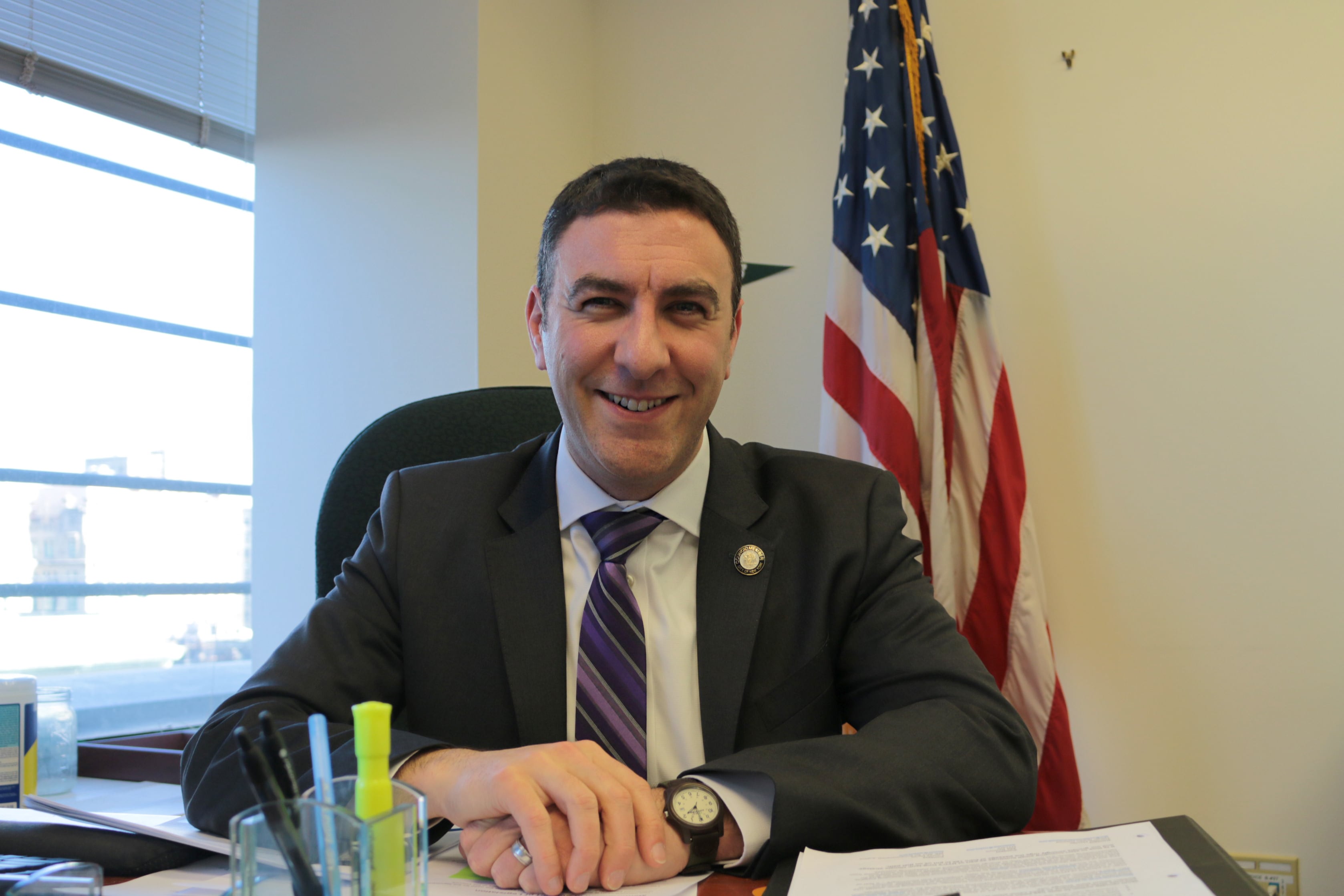
City Council member Eric Dinowitz, whose district spans the northwest Bronx, was recently tapped to chair the council’s education committee. He’s taking over from Rita Joseph, who held the post over the last four years. Joseph will now helm the council’s higher education committee, the post Dinowitz previously held.
Among the committee chair’s most significant powers is to convene oversight hearings that require top Education Department officials to publicly testify on crucial issues facing the city’s schools. Past hearings have drawn attention to flaws with the special education system, school segregation, and a botched attempt to pivot to remote learning during a snowstorm.
Dinowitz’s first oversight hearing next month will focus on mayoral control of the city’s schools, a governance system Mayor Zohran Mamdani criticized during the campaign, but now says he wants to keep.
The new committee chair’s ties to city schools run deep — “K through career” — Dinowitz recently quipped. He grew up attending public schools in the Bronx and graduated from Bronx Science, one of the city’s vaunted specialized high schools. He taught in the public school system for more than 13 years before running for City Council in 2021, following in the footsteps of his father who represents the Bronx in the state assembly.
We caught up with Dinowitz about his experience with the city’s schools, his assessment of the system, and what issues he wants to prioritize. Here are six takeaways from that conversation.
He got his start teaching students with disabilities
Dinowitz launched his career in education through the city’s Teaching Fellows program, a fast track into the classroom for career changers and recent college graduates. The experience was overwhelming. But he wound up in a classroom that included a mix of students with disabilities and general education students, which meant he had a co-teacher to learn from.
“You’re thrown right in,” he said. “I got to experience teaching with another teacher, seeing what they did, what worked, what didn’t work.”
He mostly taught at schools in his home borough, including Bronx Theatre High School, Celia Cruz Bronx High School of Music, and then briefly at NEST+M, a Manhattan gifted and talented program.
Special education is a perennial focus of the education committee, and Dinowitz indicated he will prioritize it, too. He pointed to the city’s growing costs for special education placements in private schools, the need to better integrate students with disabilities with general education peers, and ensuring student learning plans, known as individualized education programs, or IEPs, reflect the help students actually need rather than being a compliance exercise.
Phaseout of Regents exams is top of mind
The requirement that students must pass Regents exams — standardized tests that students must pass to graduate — has created perverse incentives, Dinowitz contends.
“If a superintendent comes in and says, ‘We’re going to strictly look at your Regents scores and your credit accrual,’ you’re incentivizing principals to take money out of things like the arts,” he said.
Officials are in the process of phasing out Regents exams, and Dinowitz said he will be watching closely as city and state leaders think through new graduation standards and how they will affect teaching and learning.
“We have to make sure that the assessments measure what we want the kids to do and who we want them to be,” he said.
Small schools should be merged
As enrollment declines have accelerated since the pandemic, the city is facing a glut of small schools that are expensive to run and often struggle to offer a full range of programs.
Schools Chancellor Kamar Samuels has indicated mergers may be necessary to tackle the problem, moves that often generate fierce pushback. Dinowitz said he agrees with Samuels, noting some small schools can’t support specialized programs for students with disabilities — or electives that draw in students.
“There typically isn’t critical mass for a lot of those programs,” he said. “I do believe mergers should be on the table.” He noted those decisions should be made carefully with opportunity for community input.
Looking for a clearer vision from City Hall
Mamdani said little about how to improve the city’s public school system on the campaign trail — and Dinowitz said he’s looking for a larger vision.
“We need to be talking a lot more about education,” he said. “It sounds like Mayor Mamdani is still formulating exactly what he wants to do.”
Open to school integration efforts — but don’t touch the SHSAT
Mamdani and Samuels have indicated that they want to pursue school integration efforts, which former Mayor Eric Adams largely ignored, though they have said little about their plans.
On the campaign trail, Mamdani suggested he was open to rethinking admissions to eight specialized high schools that admit students based on a single test and enroll few Black and Latino applicants. He wound up reversing that position, saying the exam should stay.
“I’m glad he backed away from that,” said Dinowitz, who, along with Mamdani, attended Bronx Science.
Still, Dinowitz said he is open to other modes of school integration such as rezonings or merging schools with different racial demographics, something Samuels pursued as a superintendent in Manhattan and Brooklyn. Dinowitz emphasized any changes should include community input.
“People who are going to be affected by policy need to have a seat at the table,” he said.
Creative solutions to class size mandate
One of the biggest challenges facing the Education Department is a state mandate to slash class sizes, which will require hiring thousands of new teachers and cost billions of dollars.
The state should pony up more funding to fulfill that requirement, Dinowitz said. He also encouraged the city to pursue creative solutions like staggering school schedules on campuses that have limited space to shrink classes and avoid capping enrollment.
“I’m not sure there’s any single variable more impactful to student learning than class size,” he said.
Alex Zimmerman is a reporter for Chalkbeat New York, covering NYC public schools. Contact Alex at azimmerman@chalkbeat.org.