Sign up for Chalkbeat New York’s free daily newsletter to get essential news about NYC’s public schools delivered to your inbox.
Before Kamar Samuels took the helm of the nation’s largest school system, he set in motion plans to shutter three small middle school programs and relocate another coveted school in the Manhattan district he supervised.
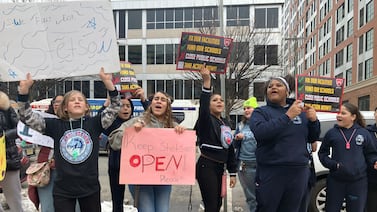
Now, those nascent plans in District 3 — which includes the Upper West Side, Morningside Heights, and parts of Harlem — are generating pushback from families who are hoping to persuade Samuels and other top officials to reconsider.
How the Education Department reacts will represent the first stress test of a major campaign promise from Mayor Zohran Mamdani to give communities a greater voice in decisions that affect their schools. It is also a high-stakes moment for Samuels, who indicated he might ramp up mergers and other significant changes, moves that often spark strong reactions.
Education officials argue the plans, which have been discussed with parent leaders but not yet released publicly, would help address broad systemic issues, including the growing number of tiny campuses that are difficult to sustain and the need to reshuffle school space to comply with the state’s class size mandate.
To families, the moves represent grave threats to beloved community institutions, including a campus that is known for welcoming students with disabilities and another with an emphasis on social emotional learning.
“I’m hopeful about the messages that the mayor and chancellor put forward,” said Olivia Greer, a parent who has children at two schools that would be significantly altered by the proposals. But she worries about what will be lost if the current plans go through.
District 3 plans represent broader issues facing the school system
Enrollment in the city’s public schools has been declining for years, with losses accelerating during the pandemic. That’s resulted in a growing number of schools that officials say are too small to sustain.
At the Joan of Arc campus on West 93rd Street, two of the building’s three middle schools welcomed fewer than 200 students this year.
Schools below that threshold may lead district officials to “question the sustainability of offerings for students,” Mariela Graham, the deputy superintendent in District 3, told families at a community meeting this week. Schools are funded on a per-student basis and could struggle to afford basic programs without healthy rosters.
The city is looking to close the campus’ two smallest middle schools: the Community Action School and the middle school grades of the Manhattan School for Children. Officials hope to phase out the programs over three years, according to district officials and families briefed on the plans. The building’s third middle school, Lafayette Academy, had already merged with a school on a different campus in 2023, despite parent opposition.
District officials also are planning to relocate the Center School, a popular grades 5-8 program, from its West 84th Street home shared with P.S. 9. The elementary school needs more space to comply with the state’s class size law. With pressure to shrink all classes by 2028, these kinds of moves could become increasingly common.
The city would relocate the Center School a mile and half south into a building occupied by P.S./I.S. 191, which would then lose its middle school grades, which enrolled 151 students last year.
Samuels has pulled off controversial school moves, but parents are deeply concerned
During his time as a local superintendent in Brooklyn and Manhattan, Samuels built a reputation for successfully completing mergers and relocations, even as some of them proved contentious.
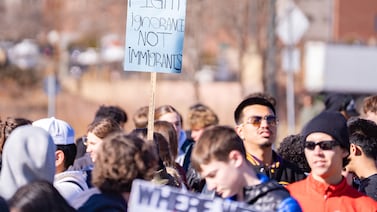
These four proposals will likely face additional scrutiny, as Samuels set them in motion as the District 3 superintendent before Mamdani elevated him to lead the system. Families have launched petitions against the plans and are packing community meetings to voice their opposition.
“We’re not taking this sitting down,” said Tiffany Rodriguez-Noel, a parent at P.S./I.S. 191. She said the school took on many asylum-seeking families and contends the Education Department has not properly supported the program.
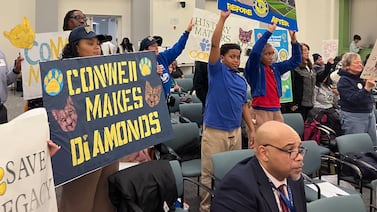
Parents at the Center School have also raised strong objections to the move. They contend their school’s flourishing theater program would struggle because their new campus does not have a proper space for it and that the move would require other programmatic changes. The Manhattan School for Children, which enrolled 130 students this fall in the middle school grades, has developed a reputation for including students with disabilities in classes alongside their general education peers. Families worry it would be difficult to find similarly welcoming communities elsewhere.
Meanwhile, at the Community Action School, dozens of parents and educators pleaded with district leaders not to close the school during a virtual community meeting this week. They stressed that the school’s small size has advantages, and it boasts strong social emotional support and restorative justice programs. Plus, enrollment shot up to 171 students this fall up from 131 last year.
When District 3 officials suggested the school’s below average reading and math scores also factored into the closure proposal, families were quick to counter that the vast majority of students come from low-income families and many arrive behind grade level.
Nicki Holtzman, a Bronx parent of a sixth grader who was bullied at his previous school, said the family sought out the program after an extensive search for a campus with the right support. “All of the teachers are highly engaged,” she said. “My child went from having no self-esteem academically to making honor roll twice.”
The closure plan, she added, “feels like a punch to the stomach — it feels rushed.”
District officials told families during the town hall they began deliberations about the district’s changes more than a year ago and included parent leaders and other representatives from each school.
But that argument did not sit well with some who said details about the plans were largely kept to a district-led working group and only trickled out to wider school communities in the last couple months. In some cases, parents heard rumors of the plans just before the December middle school admissions deadline, causing confusion and last-minute application overhauls to avoid listing schools that could soon close.
Andrew Sullivan, the principal of the Community Action School, noted during the town hall meeting that working group meetings took place during the day, making it difficult for parents to attend. (Mamdani has said he wants to rethink when meetings with parent leaders are held so “working parents can actually attend them.”)
Greer, a parent with children at the Center School and Manhattan School for Children, acknowledged that district officials have incorporated some feedback, such as phasing out middle school programs over three years rather than shutting them down outright.
“It’s not that there has been no listening and incorporation of feedback,” she said. But “my sense is that there has been a plan in place from the beginning and a view about what the preferred outcome is.”
Reginald Higgins, the acting superintendent in District 3, acknowledged in the town hall meeting that families felt the process was opaque and frustrating and suggested the process left room for improvement. He stressed that the proposals were formed before he was appointed and vowed to hear school communities out.
“I want to ensure that whatever we do moving forward, that that is a different experience for all of us,” he said.
Education Department spokesperson Nicole Brownstein noted that District 3 has held several meetings with families, parent leaders, and elected officials since December and said the superintendent plans to “schedule additional engagements.”
“Creating space for community voice is critical to this administration,” she wrote.
Fight over school closures comes at an awkward time for Mamdani
How Higgins manages the process could offer an early window into the new administration’s approach to community engagement, and it comes at a politically delicate moment for Mamdani.
On the campaign trail, the mayor vowed to cede his substantial power over the school system to give families and educators more voice. But he recently abandoned that proposal and is now pushing lawmakers to extend mayoral control of the school system, which expires this summer and is dictated by state law.
Mamdani pledged his version of mayoral control will give communities more of a say without giving up his power. That could be an awkward sell while scores of parents from District 3 are protesting decisions to close their middle schools.
Making matters more complicated, Mamdani has not been able to appoint the majority of the members of the Panel for Educational Policy, the board that makes the final decision on school closures and relocations and has historically voted in line with City Hall’s wishes. The terms of the current members, including appointees of former Mayor Eric Adams, don’t end until June. But if the Education Department moves forward with the plans in District 3, they would likely come up for a vote by the panel in April.
Board members are already paying close attention, with several attending community meetings in District 3 to learn more about the plans.
Panel chair Greg Faulker said he expects the board to carefully weigh the Education Department’s proposals, offering no guarantee of their fate. “The DOE has to work harder because they have to convince us,” Faulkner said. “I don’t think the days of ramming things through really exist anymore.”
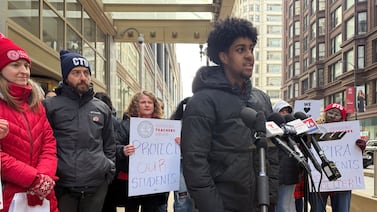
On the campaign trail, Mamdani’s critique of mayoral control invoked the image of parents protesting plans to upend their children’s schools in hourslong meetings, only for the panel to vote in line with City Hall’s wishes.
In the coming months, the mayor that families might be protesting is Mamdani.
Alex Zimmerman is a reporter for Chalkbeat New York, covering NYC public schools. Contact Alex at azimmerman@chalkbeat.org.