Sign up for Chalkbeat New York’s free daily newsletter to get essential news about NYC’s public schools delivered to your inbox.
When Maria Santana first started dropping off her son Anthony at FirstStepNYC, an early education center in Brownsville, Brooklyn, he would cry for hours, refusing to eat or nap until she picked him up.
Santana, who was working as a home health aid, told the center’s director that she thought she’d need to pull Anthony out. The director, Catharina Oerlemans, had a better solution: She asked Santana to come work for FirstStepNYC as a food handler.
FirstStepNYC was originally built in 2013 as a demonstration: What could early education look like if the city drew on the resources and expertise of the school system, the supports provided by a social service agency, and the principles of Head Start, to create a program that works with entire families — starting from before children are born and continuing until they go to kindergarten?
As New York City Mayor Zohran Mamdani seeks to expand the city’s fractured, unwieldy, and financially stressed assortment of subsidized early childhood programs, FirstStepNYC’s founder thinks his administration should look to the program as a model again.
Mamdani has promised to create 2,000 new “2-Care” seats for 2-year-olds in the fall, with a plan to grow the program to 8,000 seats next year and make it universal in four years.
It’s a project that will involve major financial, logistical, and workforce challenges, especially as current early education teachers maintain that they are dramatically underpaid. And even if successful, it won’t solve the problems of a system that is fragmented and often reaches families too late, said Laura Ensler, a longtime coach and consultant who worked with the administration of then-Mayor Michael Bloomberg to create FirstStepNYC.
“Education begins prenatally,” Ensler said. An early education plan that begins with older kids is “like starting to build the house on the fourth floor.”
Using Head Start funding, FirstStepNYC sends home visitors to spend time with pregnant parents each week. They provide education on prenatal care and early childhood development, but also work with parents on their own goals for education and employment.
If parents are interested in working in a school, the program supports them to get the training they need and, if possible, hires them.
Anthony is now 14, but Santana is still at FirstStepNYC, not only preparing meals for the kids but managing Excel reports, running the front desk, and assisting the family support team — all skills she learned on the job.
She’s far from the only one. There’s Ms. Cheryl, who began as a client of the home visiting program and now works as an assistant teacher. There’s Ms. Destiny, whose daughter was in the infant room when she started working as a classroom floater. And there’s Ms. Maritza, Ms. Lakiesha, and Ms. Julissa, the office manager.
“You have to have a two-generational approach,” Ensler said. “It’s a family affair.”
Tackling teacher turnover
FirstStepNYC’s particular set-up allows the program to evade some of the financial stress and teacher turnover that plagues many early education programs. It also offers an example of what educators can do when they are not strapped for funds.
The center — which is run by SCO Family of Services — is housed in a public school building, so it doesn’t have to use funds from its early education contracts to pay for services like janitors, security, and food. Instead, the program uses that money to pay for positions like family support staff and a dedicated disability coordinator.
The result is more support for teachers, as well as opportunities for staff members to move into different jobs, reducing the isolation and career stagnancy that often leads to burnout in the field.
In turn, reduced teacher turnover creates stability and a sense of safety for kids, Oerlemans said. That’s important for all young children, but especially for kids who regularly experience upheaval in other parts of their lives.
“No matter how many shelters you go to, or how many foster care families you are a part of, knowing there’s a place that you’re always loved, a place that you’ll be fed something, a place that’s warm, that’s the most important thing,” Oerlemans said. “That really solid attachment allows children to know that they’re in a safe space. And when they know that they’re safe, they will learn.”
Teaching toddlers, feeling supported
On a very cold Friday morning in February, attendance was low — both because of a recent snowstorm and because FirstStepNYC had scheduled a half day to accommodate a professional development session on potty training.
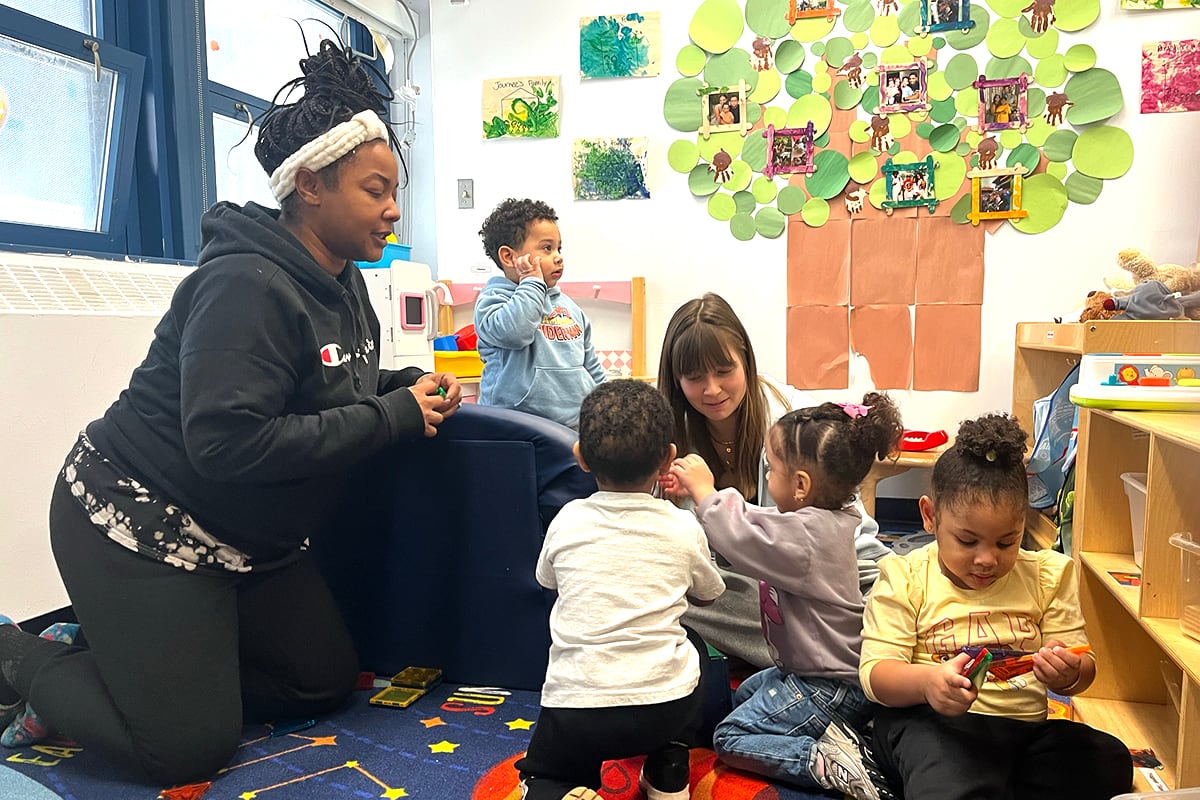
In the “large movement” room, a group of 1-year-olds played with rubber balls and flopped on foam mats. In a 2-year-old classroom, teachers wiped noses and checked diapers while kids built a collective project with Magna-Tiles. Classrooms were adjoined by bathrooms with tiny sinks and toilets. The wall outside a prekindergarten classroom showed pictures of kids experimenting with flashlights — part of a unit on light and shadows.
In a hallway, Annie Mayor, FirstStepNYC’s assistant director of Early Head Start, had time to peek in at her son, who’s a student in a 2-year-old classroom.
Mayor always assumed she’d work as a traditional K-12 teacher, she said. “When you go to school, you never think about toddlers. No one goes to get a master’s and thinks, ‘I’m gonna change diapers.’”
But when she came to FirstStepNYC, she found that she loved the work, and she appreciated that there was support and opportunities to grow. Mayor started as an assistant teacher, then became a toddler teacher, and then the schools disability coordinator before moving into her current role.
“We have family support, an assistant director, an education director. We get coaching, we’ve been able to get a lot of support to complete our career goals,” Mayor said. “In other centers, there really is just you and your classroom.”
When teachers and staff are supported and less stressed, Mayor added, it allows for a sense of peace and calm for everyone.
Farther down the hall, five pre-K students sat on their classroom rug, listening to a guided meditation.
“Feel your breaths,” the guide said. “Feel that this is what’s keeping you alive. Feel how amazing it is to just … breathe.”
Abigail Kramer is a reporter in New York City. Contact Abigail at akramer@chalkbeat.org.