School officials say they are seeking more information and weighing their options after the Philadelphia Parking Authority claimed that it overpaid the district by $11.3 million in 2020 and wants a refund.
The district’s chief financial officer, Uri Monson, said that while the amount may seem small compared to the district’s $3 billion annual budget, the PPA’s move could have big implications for the district’s future planning if it is allowed to stand.
Monson said that money from the PPA, given annually as part of a longstanding revenue-sharing arrangement, is “recurring money” and adds up over time. If the annual amount can’t be predicted with some certainty, “that significantly affects how we make investments in schools,” he said.
The $11.3 million is 77% of the $14.7 million the PPA paid the district last year.
As far as Monson can tell, the PPA is recalculating what it should have paid the district in the 2020 fiscal year based on new estimates of its future liabilities, he said.
PPA’s latest action “has raised questions,” he said. “We don’t understand all the numbers and are not convinced all the things they’re putting in are supposed to be counted” as part of the state’s revenue-sharing formula.
The PPA told Monson it “does not have any supporting documentation to provide” to back up its claim of overpayments, according to an email obtained by Chalkbeat through the office of City Council member Helen Gym. But emails between Monson and the PPA’s chief financial officer suggest that the overpayments had to do with miscalculations relating to debt incurred as a result of its obligations to retirees.
The PPA also did not explain why those funds were tied to payments to the school district and not another part of its budget.
Monson has been aware of the claim since October. The issue became public after the school district presented its quarterly report to the City Council.
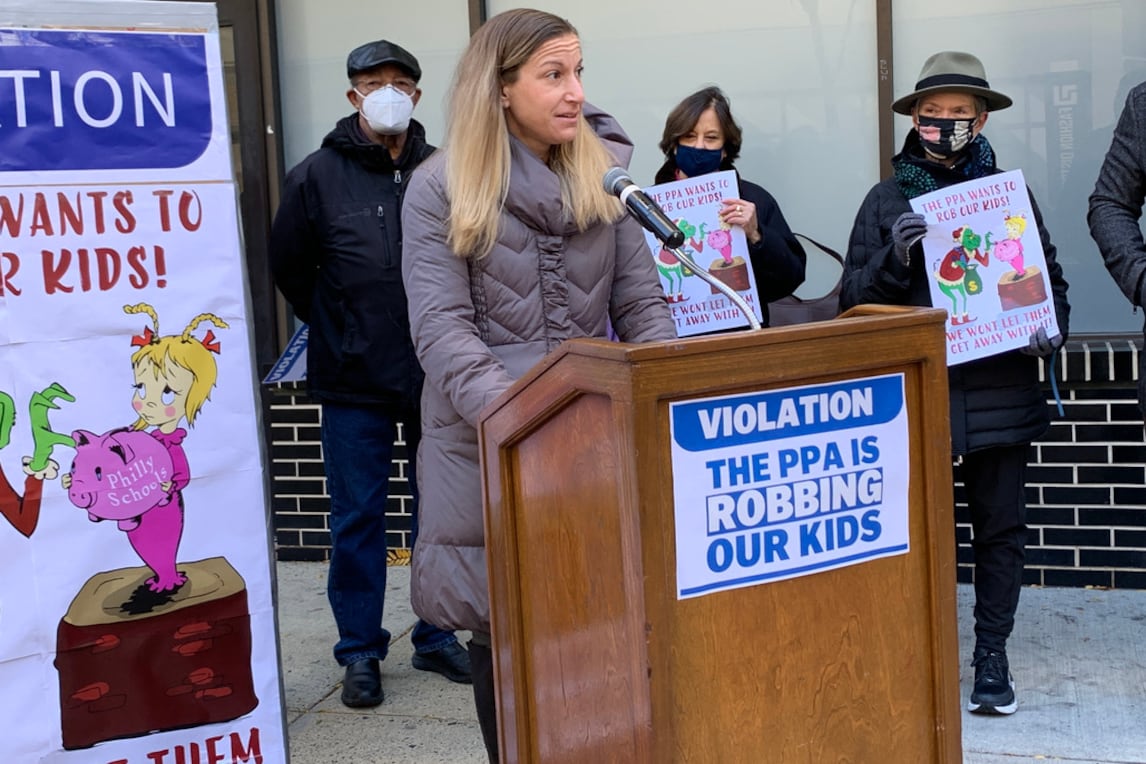
Gym organized a protest Monday outside the PPA office, where people go to pay and contest parking tickets. She was joined by leaders from the district’s two major unions, the Philadelphia Federation of Teachers and the Commonwealth Association of School Administrators. Also, there were advocacy groups, including Children First and the faith-based organization POWER.
“The PPA wants to siphon millions of dollars from our schools where every single day students and staff … endure conditions that would never be tolerated in a wealthier, whiter school district,” said Hillary Linardopoulos, representing the PFT.
The amount that the authority wants back is equivalent to the cost of 100 teachers, counselors or nurses, or could be used to remove a lot of asbestos, mold, or lead pipes in the district’s aging schools, Gym said. She called the PPA’s action “an outrage.”
A PPA spokesperson could not be reached for comment.
In 2004, Republicans in Harrisburg engineered a takeover of the PPA, which not only hands out the tickets when meters expire but also runs the Philadelphia airport, operates parking garages across the city, regulates taxis and limousines, and manages red light cameras.
As part of that deal, some of the revenue PPA collects from parking tickets is supposed to be paid to the school district. It was expected to yield $45 million a year for schools. However, that much money has never materialized, and in some years, there have been no payments at all.
In 2014, parking fines nearly doubled, which PPA justified as a way to send more money to the schools. But after that, money sent to the district declined until the City Council held a hearing in 2016, drawing attention to the issue again.
A blistering 2017 audit by then state Auditor General Eugene DePasquale found that PPA potentially shortchanged the district by $77.9 million.
Since 2015, revenue from the PPA to the district totaled $53 million, meaning that PPA is seeking the return of more than 20% of its payments since then. The district got nothing in the 2021 fiscal year due to the pandemic, said Monson, but it had been counting on returning to annual PPA payments of about $15 million a year in its future projections.
Monson said that PPA has promised additional answers in January.