Sign up for Chalkbeat Philadelphia’s free newsletter to keep up with news on the city’s public school system.
The middle schoolers at Philly’s Marian Anderson Neighborhood Academy have a lot of questions about artificial intelligence.
They want to know how the government is using AI and what impact the technology has on the environment. They’re curious about how it’s being used for creativity, and whether it will be with us forever — or if it’s an economic bubble waiting to burst.
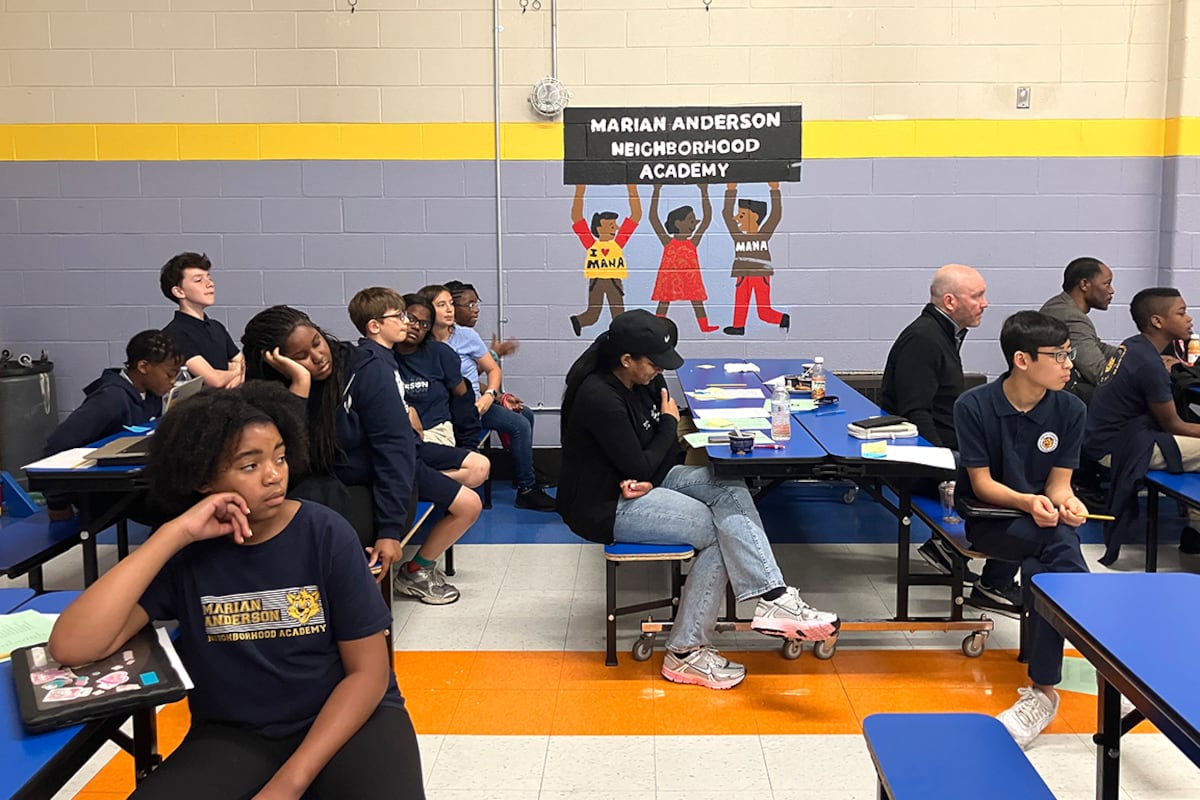
The sixth through eighth graders have been researching these topics and grappling with how it makes them feel about themselves, their education, and the world around them. On Friday, they presented their findings to their parents, teachers, and some state and local officials in their school cafeteria. Overall, they said there’s a lot they still don’t know.
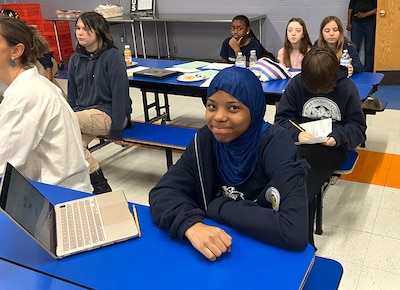
Sixth grader Azizah Simmons said she’s weighed the pros and cons and she’s pretty confident that AI’s overall effect on our society is negative. If used correctly, Simmons said language models like ChatGPT could help kids her age improve their writing. More often than not, she said students use it to cheat on homework or cut corners on writing assignments.
But it’s the ubiquity of the technology that worries her most.
“You can’t really escape AI,” Simmons said.
Conversations about AI have permeated every aspect of education since the arrival of models like ChatGPT. Familiar debates about cheating have given way to protests about transparency and student surveillance. Marketing pitches from companies promising “transformative” AI tools are now overwhelming superintendents’ inboxes. In Philly, educators are working with students to build their own curriculum to separate truth from AI slop, and confront the bias that can be embedded deep in the internal code.
And students say they feel like they have as much knowledge — or sometimes more — than the adults in their lives.
Sixth graders Thomas Mapp and Tyshaan Anderson’s research project focused on how video game designers use AI for level design, character creation, and visuals. Outside of school, they’ve been using AI to help them code games in Roblox and edit videos.
Anderson said he thinks the technology has helped kids like him experiment with creative fields like game design without needing to know the ins and outs of specific coding languages.
Marian Anderson Principal Nicole Patterson said she’s been inspired by her students’ civic inquiries and has learned a lot from them.
Patterson said she sees her school as a trailblazer in leading challenging conversations about AI. But she cautioned that “this is unfinished work.” She said students will continue their research and keep talking about these issues.
Marian Anderson computer science and technology teacher Trey Smith said the goal of Friday’s event was to help students and parents discuss how AI is now part of society, culture, politics, and everyday life, not just about how AI works.
“We’re all still trying to figure this out together,” Smith said. “For students to be in dialogue, not just with themselves and each other and me, but also with their families and with legislators and with school district officials and professors — I think it’s so important for them to learn together.”
That learning process can be tricky. Simmons said she ends up using AI involuntarily because search engines like Google now frontload AI overviews. That makes it difficult for young users to differentiate between what is a primary source link and what is AI generated.
“You use it without meaning to. It’s everywhere implanted in our lives,” Simmons said.
Carly Sitrin is the bureau chief for Chalkbeat Philadelphia. Contact Carly at csitrin@chalkbeat.org.