Did you know search engines like Google are changing the way you see news? Keep Chalkbeat’s valuable education coverage at the top of your feeds by clicking here and checking the box next to our name.
New York City public schools not only met the state-mandated targets to shrink classes, they surpassed the goal, Mayor Zohran Mamdani announced Friday.
Nearly three-quarters of classes across New York City’s public schools are capped at 20 to 25 students, depending on the grade.
The city cleared the state’s benchmark for two reasons. First, state lawmakers moved the goal post when they agreed in June to give the city more time to comply with the law, requiring 70% of classes meet the caps this school year instead of the original target of 80%.
Additionally, the city made a change this year in which classes it counted toward class-size compliance. Officials added to the calculation for the first time “cluster” classes in elementary schools — courses like science, art, physical education, and music that are not taught by students’ typical classroom teacher. Without counting cluster classes, 69.5% of classes would have met the caps, schools Chancellor Kamar Samuels said, just shy of the new requirement.
Unlike last year, city officials are no longer exempting any classes from the size limits, after agreeing with the teachers union to pay a financial bonus of up to $8,500 to certain teachers whose classes were excused from the requirements.
All classes must meet the class size mandates by the 2029-30 school year.
Granting the city a two-year extension to meet the mandates came after months of lobbying from Mamdani, who maintains a close relationship with Gov. Kathy Hochul and was desperate to cut spending amid a budget deficit. State legislative leaders said they were satisfied with Mamdani’s plans to recruit new teachers and build additional space for the most crowded schools.
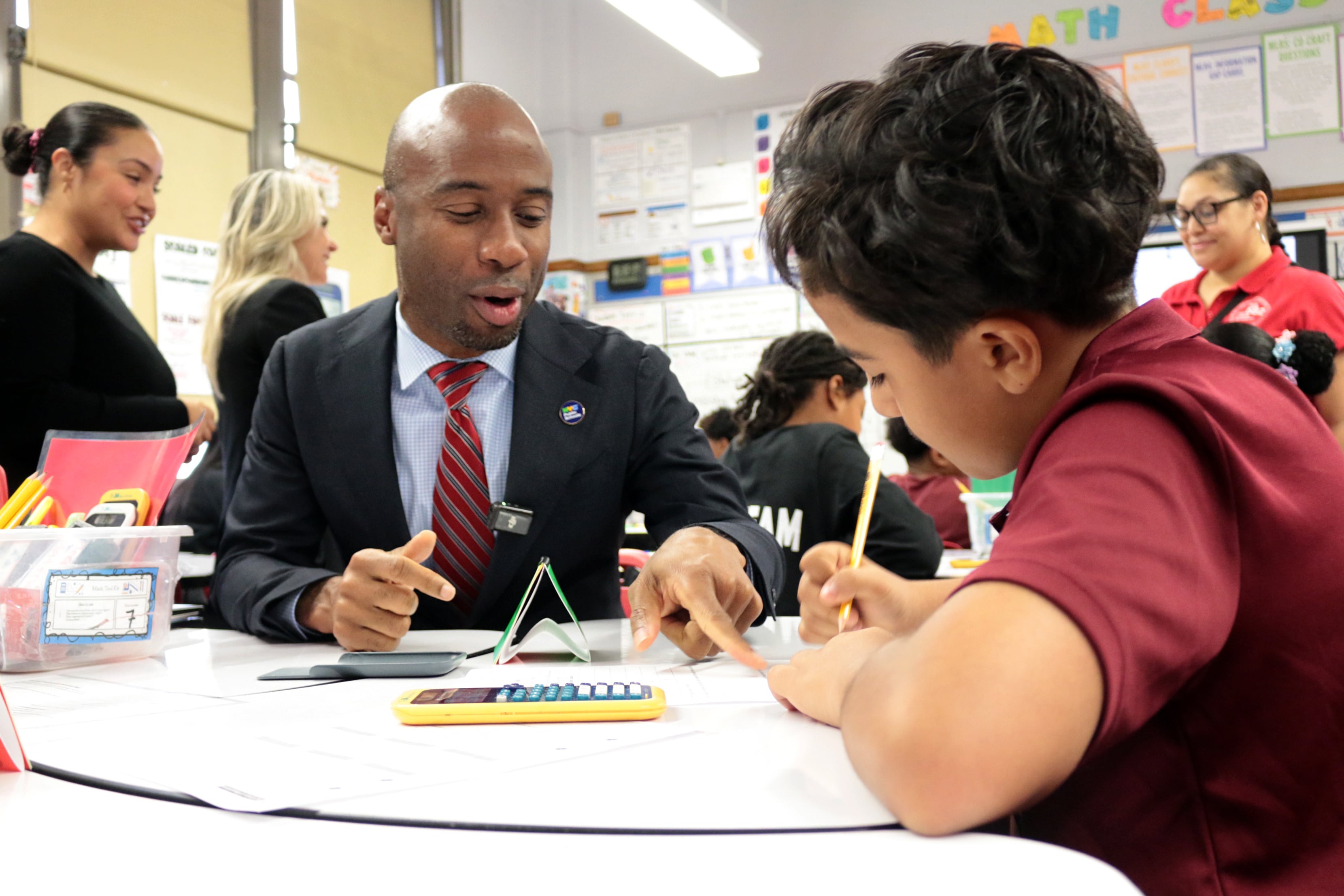
Samuels said the improving class size compliance rates are a “huge, huge step forward” during a visit Friday to Brooklyn’s M.S. 582, which received funding to hire four additional teachers. “Simply put: More attention for our kids, more one-on-one time from their teachers.”
Counting art, gym, and music classes gave NYC’s compliance rate a crucial boost
The city did not previously count elementary school cluster classes because the Education Department didn’t have the ability to track those classes’ sizes, officials said. But this year, the city updated its reporting capabilities to count those courses, which turned out to be a big boon to the city’s overall compliance rate.
Physical education and “performing group” courses like band and dance are capped at 40 students. Nearly 100% of those classes are under their caps, according to the new city data.
City officials said they also started counting middle and high school “exam prep” courses for the first time, but didn’t immediately explain what qualifies as an exam prep course or provide a breakdown of what percentage met the state requirements.
Including those new courses pushed the city’s compliance rate up to 73%.
New hires, declining enrollment, and union penalties helped shrink classes
City officials credited a $244 million investment last spring that helped schools hire some 1,900 teachers to reduce class sizes. The year before, the city shelled out roughly $400 million to help schools hire an additional 3,700.
Despite the extra investment, the city’s overall teacher headcount actually went down slightly compared to last year, from about 69,900 to 69,400. (That’s still about 5,000 more teachers than the city had two years ago.)
At M.S. 582, the funding helped the school significantly reduce class sizes, in some cases cutting them to 20 students down from about 30, said Principal Jeffrey Merced. The math class Samuels toured included 15 students, though a few were absent.
The hiring has been a boon for the school, Merced noted, allowing more opportunities for small group instruction. There are other benefits, too. A new cluster teacher, hired with extra class size funding, is offering photography lessons. Several students with professional cameras trailed Samuels through the school on Friday.
“What really helped us was the manpower,” Merced said.
For now, the Education Department is picking up the tab for new hires, but Merced is “very worried” the costs will one day have to come out of his own budget. His school’s enrollment ticked up this year, which brings additional money, and he hopes the school will have enough resources to maintain its staffing levels in the future.
Declining enrollment has likely also helped the city shrink classes. Officials did not immediately share enrollment figures for this school year, but city projections anticipated a 20,000-student drop this year, according to a Chalkbeat analysis of the data. (The enrollment projections don’t include students in prekindergarten programs, or District 75 schools for students with complex disabilities.)
Union officials believe that imposing a financial penalty for exemptions from the law — the bonus of $8,500 for teachers whose classes were excused from the state caps — helped coax the city to meet the mandate. Principals are also eligible for pay bumps of up to $10,000 for bringing class sizes into compliance, though Samuels did not say how many will receive them.
Officials said they offered no exemptions this year, down from 10,000 the year before, which helped schools meet the state’s 60% requirement last year.
The pay bonus remains in place for next year, when the city will have to hit 80% compliance, union officials said.
Broad progress across the city, but nearly 500 schools still lack space
The progress on class sizes stretched across almost the entire city, with 31 of the 32 geographic districts increasing their percentage of classes under the caps.
There was one notable exception: Brooklyn’s District 13 dropped from 78% of classes under the caps last year to just 59% this year. Education Department officials didn’t immediately respond to questions about what led to the surge in class sizes in that district, which spans from Brooklyn Heights to Prospect Heights, Fort Greene, and parts of Bedford-Stuyvesant.
Districts’ class sizes varied widely, from a high of 92% of classes under the caps in District 32 in Bushwick, Brooklyn, to a low of 56% in District 26 in northeast Queens.
At the poorest city schools, an average of 90% of classes were under the caps, while 57% of classes were under the caps at the wealthiest schools. Education officials and experts have repeatedly raised equity concerns, as high-need schools stand to benefit least from the new investments in smaller classes.
There are still nearly 500 schools that city officials say do not have enough space to bring all their classes under the caps.
Michael Elsen-Rooney is a reporter for Chalkbeat New York, covering NYC public schools. Contact Michael at melsen-rooney@chalkbeat.org.
Alex Zimmerman is a senior reporter for Chalkbeat New York, covering NYC public schools. Contact Alex at azimmerman@chalkbeat.org.