Sign up for Chalkbeat Chicago’s free daily newsletter to keep up with the latest education news.
The head of Chicago’s largest high school charter network is stepping down after six years on the job.
Noble Schools CEO Constance Jones announced in an email to staff and families that she will “pass the torch to a new leader” and work with the network’s board and an outside consultant to find a new CEO.
In a statement, Jones said she is focused on the start of the school year and plans on staying and overlapping with the new CEO “for several months to support a smooth transition during the year ahead.”
“Noble is in strong and stable shape, both organizationally and financially, and recently secured the longest charter renewal term granted by Chicago Public Schools,” Jones wrote in a statement.
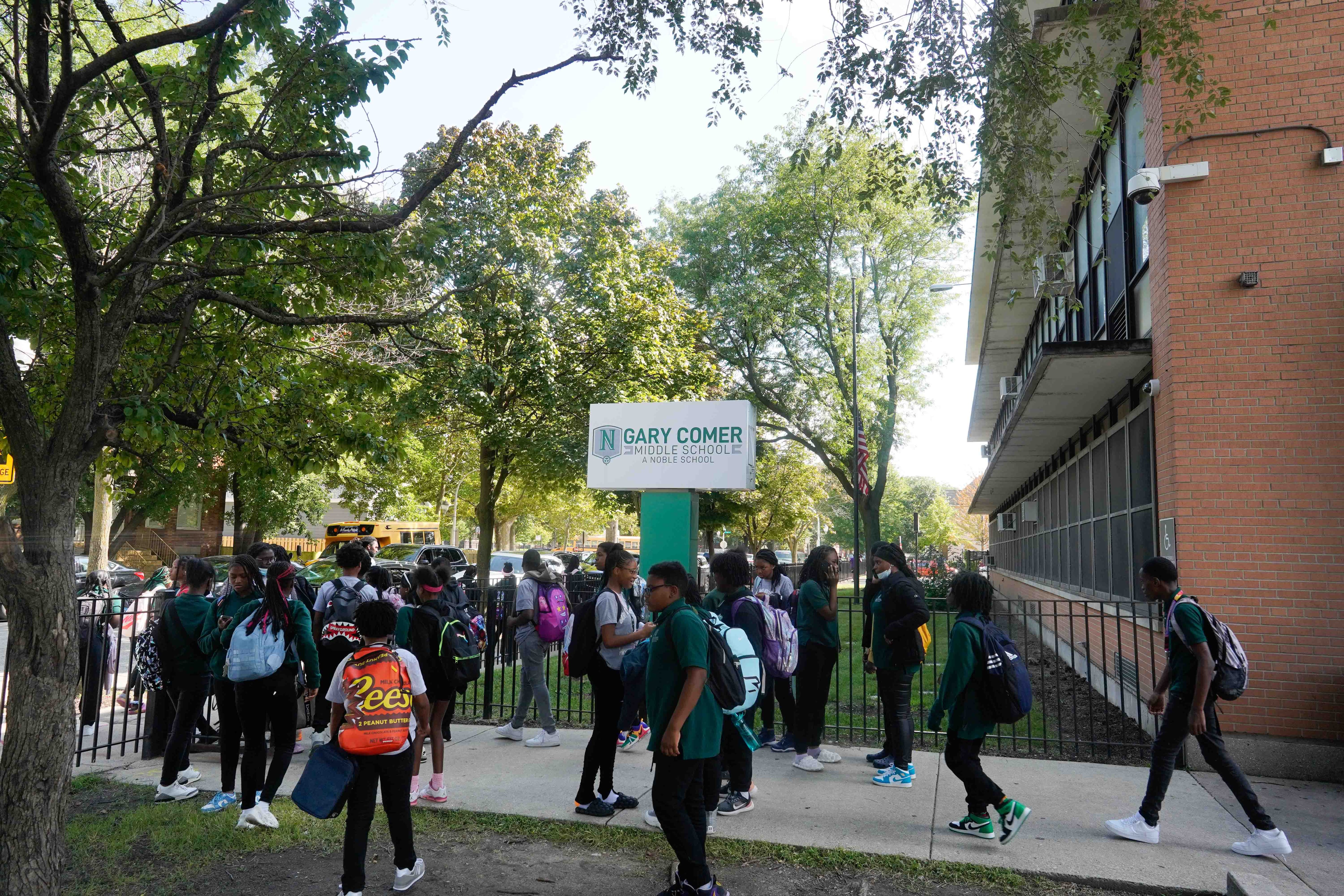
Noble opened its first campus in 1999 and now serves more than 12,000 students across 18 campuses.
Jones took the role in 2018 after the sudden resignation of Noble’s CEO and founder Michael Milkie amid concerns over an alleged “pattern of inappropriate behavior with alumni.” At the time Jones took over, Noble staff was also considering unionization, which ultimately didn’t happen.
As the first woman and first Black person to hold the position, Jones led the organization through a series of policy changes impacting Noble’s mostly Black and Latino students, including the relaxing of the network’s once-stringent dress code and a shift away from a “no-excuses” approach to discipline in 2020 amid a broader racial reckoning following the police killing of George Floyd.

The Noble Schools network has had a reputation for strong academics and a college-going culture. In her email, Jones said the network’s recent graduating class received 17,000 college offers, including from Yale, Brown, Howard, and Stanford Universities. The network enrolled more than 2,800 seniors last school year, according to district enrollment data.
Charter schools are publicly-funded, but privately-operated and go through an authorization process with the Chicago Board of Education. Chicago opened and expanded charters throughout the 2000s, but a moratorium on new charters was put in place in 2016 amid declining student enrollment and overall drops in Chicago’s child population.
Former Mayor Lori Lightfoot’s appointed school board increased scrutiny of existing charter schools. Mayor Brandon Johnson, who was a former Chicago Teachers Union organizer, opposed charter school expansion and has said he would like to move away from a competitive school choice system.
Despite shifting political winds, Jones has been a vocal advocate for school choice and charters. She was recently selected for an Eisenhower Fellowship, for which she plans to travel to Ghana and Brazil to study community engagement and violence prevention.
Before joining Noble in 2014, Jones was the national development director at KIPP, a network of public charter schools.
Becky Vevea is the bureau chief for Chalkbeat Chicago. Contact Becky at bvevea@chalkbeat.org.