Sign up for Chalkbeat Chicago’s free daily newsletter to keep up with the latest education news.
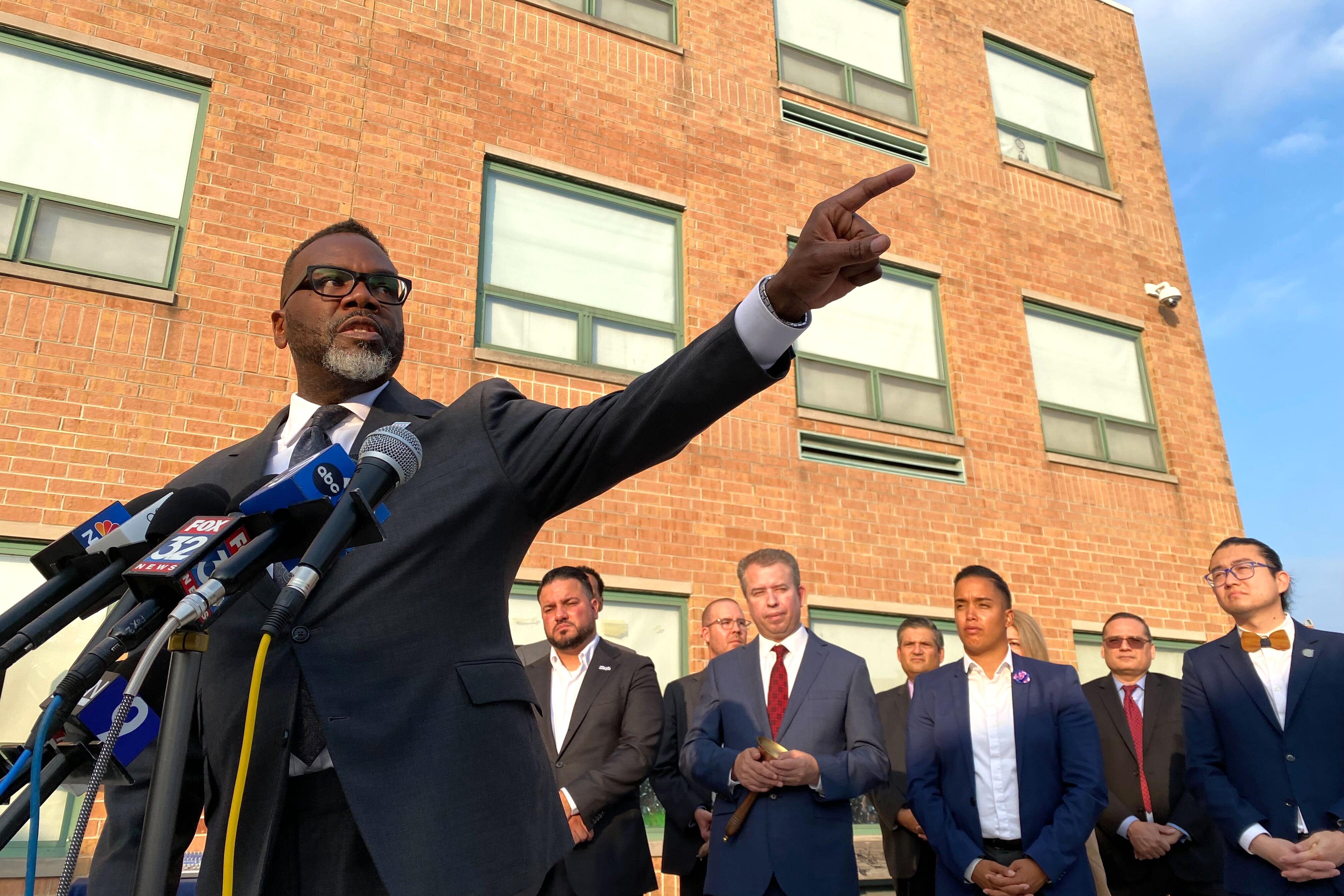
Facing a nearly $1 billion deficit next year, Mayor Brandon Johnson proposed a city budget Wednesday that would send roughly $300 million to Chicago Public Schools.
That’s nearly $140 million more than what CPS already budgeted to receive from the city. But it’s still roughly $190 million short of what CPS wants to help cover critical upcoming costs that have been at the heart of leadership conflicts between the mayor’s office and CPS.
The makeup of the city’s budget could have a significant impact on the school district’s finances this year. It could also decide whether the district will cut spending or borrow money to cover looming costs.
District leaders, union officials, and the mayor have balked at the idea of CPS budget cuts.
“We are building a government that truly works for the people … no longer will the city of Chicago be dismissive about our young people and the children who are the future of the city,” Johnson said during his budget speech to the City Council.
The key to the money CPS wants from city coffers is surplus funding from Tax Increment Financing, or TIF. This comes from special taxing districts meant to fight blight and spur development.
Johnson’s $17.3 billion budget plan, which would raise property taxes to help the city close its deficit, includes $570 million in TIF surplus funds. By declaring a surplus, the mayor is releasing TIF dollars that have not been dedicated to any specific project. When that happens, by law, 52% of those funds — in this case, $296 million — would go to CPS under Johnson’s budget. Last year, the district received $226 million in TIF surplus funds, according to CPS.
In July, the Chicago Board of Education approved a $9.9 billion budget that assumed the district would receive $159 million in TIF funds from the city. But that budget did not include union contract costs or pensions for non-teaching staff. The latter is an expense the city used to cover until Mayor Lori Lightfoot took office. This year, the district has refused to cover the cost without the city’s help.
To help pay for those pensions and labor costs, CPS CEO Pedro Martinez has asked for an additional $325 million in TIF surplus funds, a request he says he began making in the spring. Without such help or additional revenue, district officials say they may have to turn to cuts or borrow money to cover upcoming expenses of those contracts and pension obligations.
CPS did not immediately respond to the mayor’s budget proposal. The Chicago Teachers Union, an ally of the mayor, applauded his budget plan but called for alternatives to raising taxes. In a statement, CTU President Stacy Davis Gates said that if there’s at least $500 million in TIF surplus funds, “there’s likely double that available” to be used on city services, including public schools.
Ald. Gilbert Villegas, who has criticized the mayor’s request for Martinez to resign and recent leadership turmoil at the district, said CPS should have been more responsible with its COVID relief dollars, which have buoyed the district’s finances over the past few years. The money recently expired, blowing a more than $500 million hole into CPS’s budget this year that officials closed through central office cuts and other savings.
“The reliance on the city of Chicago to help bail out CPS is really frustrating because we have no say in how they appropriate their budgets,” Villegas said Wednesday. “Basically what they’re doing is telling us, ‘We need all this revenue,’ and we have no say. This reliance on us only when and wanting to include us only when they need money is a problem for me.”
CPS has defended its use of COVID relief money, which went toward more staffing and programming for students, and says it resulted in important academic gains.
Ald. Jason Ervin, a West Side alderman who is a close ally of the mayor’s and chairman of the council’s budget committee, said the city allocates the TIF surplus funds that it is required to, and CPS always gets a chunk of that.
During Martinez’s five-hour testimony to City Council two weeks ago, Ervin sharply criticized the district for increasing its request for TIF surplus funds, arguing that such a move takes away development dollars from low-income communities like the one he represents.
“Whatever CPS needs to do to manage beyond that [money] is their decision,” Ervin said Wednesday after the budget address.
The mayor’s office has pushed the district to take out a short-term loan to cover those costs. But district leaders have so far rejected the idea, saying such borrowing would incur high interest rates, further degrade the district’s bond rating status, and saddle it with payments that will ultimately hurt classrooms.
That was one reason the previous Board of Education resigned en masse earlier this month. Johnson has appointed a new board that could still take out such a loan. They are set to meet this Friday, Nov. 1.
Alternatively, the question of how to pay for major upcoming costs could fall to the district’s new, 21-person board that will be half elected and half appointed by the mayor. The school board election is on Nov. 5, and the new board will be sworn in on Jan. 15, 2025.
Reema Amin is a reporter covering Chicago Public Schools. Contact Reema at ramin@chalkbeat.org.