Sign up for Chalkbeat Chicago’s free daily newsletter to keep up with the latest news on Chicago Public Schools.
Illinois state school board members are questioning officials’ proposed overhaul of the state’s accountability system. They want answers about why certain metrics could change and how the state will help schools and the public understand the new performance categories for schools.
The proposal currently before the Illinois State Board of Education changes the names of the five labels used to categorize schools and overhauls the calculation used to determine which category schools fall into.
Under the proposed system, schools would be listed as either Exemplary, Commendable, Approaching, Developing, and Comprehensive. These categories would be based on student attendance and how their students perform on reading, math, and science proficiency and how well they educate certain groups, such as students with disabilities and those learning English. High schools would also be scored based on graduation rates.
Currently, the top 10% of schools in the state are categorized as Exemplary while almost 70% of schools are labeled as Commendable. The remaining 20% are divided among the bottom three labels: Comprehensive, Targeted, and Intensive.
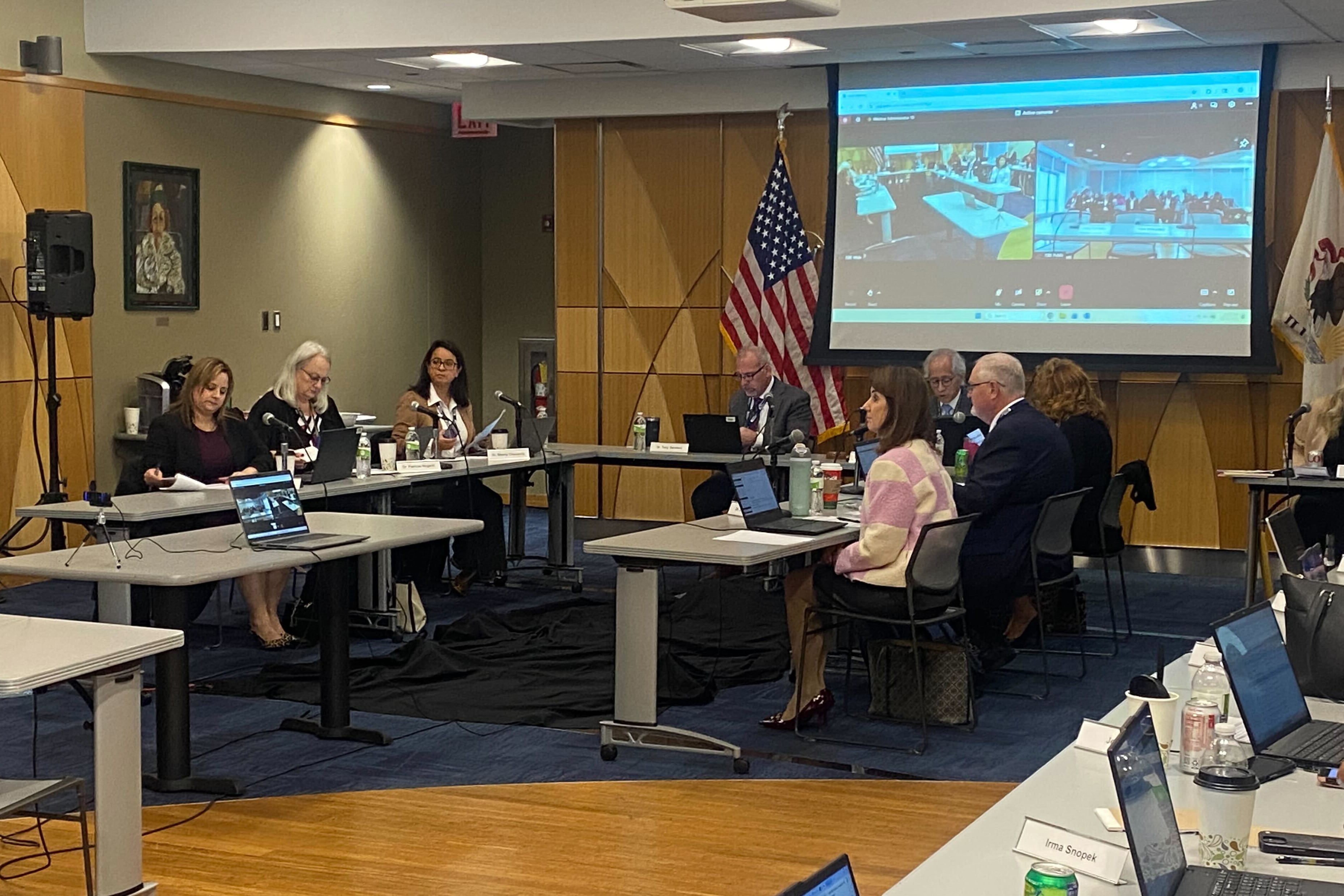
During the monthly board meeting held on Thursday, state Superintendent Tony Sanders said the fact that so many schools are lumped under Commendable is problematic.
“Not everybody can be Commendable and Commendable cannot be 0% of students proficient, all the way up to 72%,” Sanders said. “That’s just too wide of a band to be considered Commendable.”
Rae Clementz, executive director of data, accountability, and assessment at the Illinois State Board of Education, said sorting schools based on rank has made it difficult to understand the differences in school performance and what support schools needed.
“Our objective was to redesign the accountability system in a way that recognizes school strengths and supports school improvement in every school,” Clementz said.
But Donna Leak, board member and superintendent of Community Consolidated School District 168, worried some schools that were once considered Commendable would fall into the new, lower-ranked categories of Approaching or Developing. According to a presentation of the plan, about 56% of elementary schools would be labeled Approaching and Developing.
“I think it’s great that we’re delineating and we’re differentiating, because the commendable group was so huge. It really did not tell the community how your school was doing,” she said at Thursday’s meeting. “But this feels almost like it’s not even a rip of a Band-Aid. It’s like a rip of stitches.”
Sanders said his staff would work on creating a toolkit to help explain the changes in labels to school communities.
Another proposed change is the use of indicators to determine a school’s category. ISBE’s proposal removes the 9th Grade On-Track metric from the calculation used to come up with a school’s rating, though it will still be reported on the state’s report card. That metric measures the percentage of first-year high school students likely to graduate based on grades.
Local education advocates also shared their concerns about the potential changes to indicators in the state’s accountability model and timeline about the agency’s process during the public comment section of Thursday’s meeting.
“Eliminating the 9th Grade On-Track metric would diminish schools’ incentive to focus on ninth grade success and a pivotal year for students who are transitioning into high school and for English learners often navigating new language demands,” Erika Méndez, director of early childhood and K-12 education policy with the statewide advocacy group Latino Policy Forum, told the board Thursday.
Méndez also asked the board to consider strengthening attendance metrics and including post-secondary indicators, such as college enrollment and students taking advanced courses, including Advanced Placement and dual credit.
Perla Santoyo, senior government relations associate at Advance Illinois, asked the state board on Thursday to consider extending the public comment period to allow school communities to review changes in the proposal and provide feedback.
“Such transparency is critical to building trust and ensuring that the framework works as intended,” said Santoyo.
Sanders pushed back against some of the criticism.
“This has not been a rushed or non-transparent process. Everything we’ve done has been in the public view,” he said, noting that the agency asked educators and school leaders about changing the accountability system during feedback sessions regarding changing the cut scores for state standardized tests over the past year and a half.
The board will continue discussing the accountability system proposal in December and is expected to vote on it in the January meeting, according to a presentation by the state board. If approved by state officials, the board will submit it to the federal government for approval.
The current plan is to roll out the new accountability system and performance labels in October 2026.
The Illinois State Board of Education is hosting virtual meetings on the proposed changes to gather more feedback from the public on Nov. 24 and Dec. 1 between 4 p.m. to 6 p.m.
Samantha Smylie is the state education reporter for Chalkbeat Chicago covering school districts across the state, legislation, special education and the state board of education. Contact Samantha at ssmylie@chalkbeat.org.