Sign up for Chalkbeat Chicago’s free daily newsletter to keep up with the latest news on Chicago Public Schools.
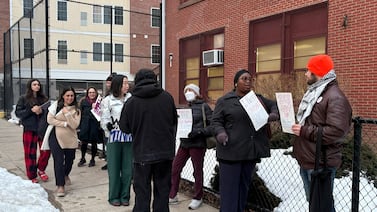
Chicago school board members, educators, and community advocates rallied Tuesday outside Austin High School to advocate for Mayor Brandon Johnson’s $16.6 billion city budget, which would mean $552.4 million for Chicago Public Schools.
Their support comes after the mayor’s budget was rejected by a key committee last week, sending the City Council’s process back to square one. The mayor then launched an online portal to solicit more ideas for budget efficiencies from aldermen. Some aldermen are reportedly putting together an alternative proposal.
Jitu Brown, an elected school board member representing District 5A on the West Side, urged Chicago aldermen to vote in favor of Johnson’s proposed budget.
“The status quo is starving a school like Douglass, to where it goes from a school with 600 children, a thriving middle school to a school with only 35 children,” Brown said at the rally. “The status quo is getting rid of all the [career and technical education] programs that used to be in places like Austin and Dunbar and leaving those schools as shells of their former selves.”
Wallace Wilbourn Jr., a teacher at Oscar DePriest Elementary School on the West Side, said if the city’s budget is not approved, school staff could be cut and taxes could go up.
“A no vote on the mayor’s budget will support higher taxes and fees on us, the working people, and cuts to our schools and the services our families rely on,” Wilbourn Jr. said.
Several board members who spoke said there would be cuts at specific schools if Johnson’s proposed budget doesn’t pass. Their comments were based on calculations done by the Chicago Teachers Union.
But city budget officials have said the $552 million for CPS that would come from a surplus of special taxing dollars, known as TIF, are not allocated per school. They are provided to CPS by law as one amount that the school board would decide how to spend.
A spokesperson for the mayor said Tuesday the amount of the TIF surplus “is one of the least controversial parts of the budget.” If the mayor’s $1 billion surplus proposal is approved, the city would also get $223 million in revenue from those special taxing districts.
Depending on the final amount of TIF surplus approved, the district could likely maintain its current budget and avoid midyear cuts. The Chicago Board of Education approved a $10.2 billion budget for the 2025-26 school year in August with an assumption that it will get at least $379 million from the city. The City of Chicago’s budget is separate and operates on a calendar year from Jan. 1 to Dec. 31, 2026.
After Johnson put forward his budget proposal, the Board of Education approved an agreement that said it would use additional TIF surplus funds to reimburse the City of Chicago for certain pension costs the city covers that became the center of heated debate this year.
This story was updated to include comment from a mayoral spokesperson.
Becky Vevea is the bureau chief for Chalkbeat Chicago. Contact Becky at bvevea@chalkbeat.org.
Samantha Smylie is the state education reporter for Chalkbeat Chicago covering school districts across the state, legislation, special education and the state board of education. Contact Samantha at ssmylie@chalkbeat.org.
Reema Amin is a reporter covering Chicago Public Schools. Contact Reema at ramin@chalkbeat.org.