Sign up for Chalkbeat Chicago’s free daily newsletter to keep up with the latest news on Chicago Public Schools.
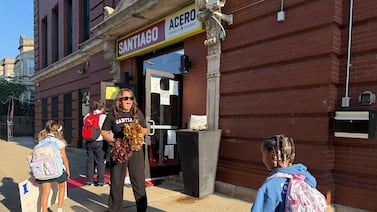
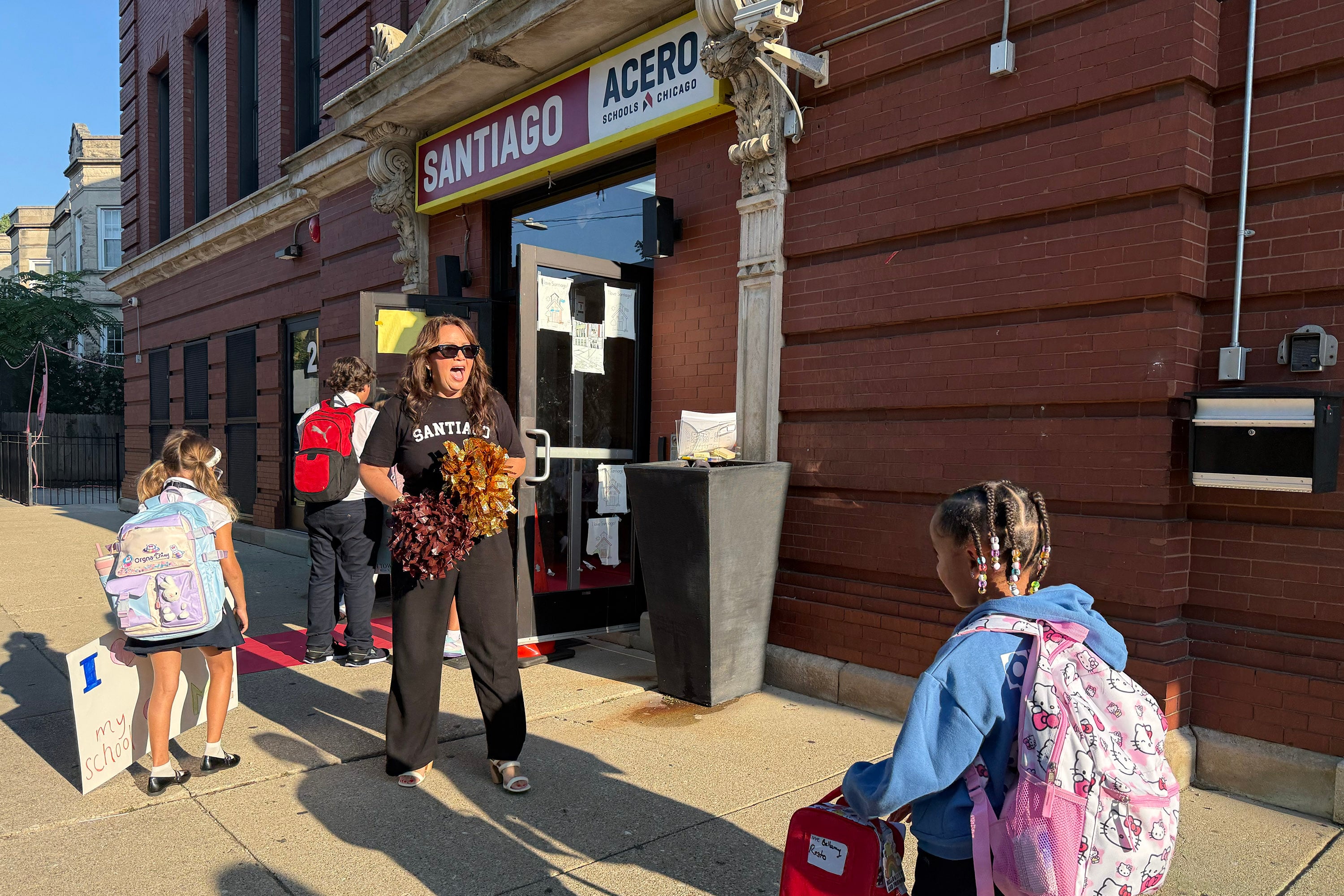
Jema Fabara knows what can happen when a charter school hits financial turbulence. She lost her teaching job when the Acero network’s Cruz campus closed last year.
Now Fabara, who is teaching at the ASPIRA charter network’s alternative high school, worries the same thing could happen again as that network struggles to make payroll and considers merging schools. This time, the turmoil could also affect her son, who is a senior at her school, and a nephew attending ASPIRA’s nearby Early College campus.
ASPIRA is one of a string of charters in the city that have floundered financially and in some cases moved to merge or close schools over the past year and a half. Two other charters asked Chicago Public Schools to front them money this winter just months after the district chipped in to help the South Side’s EPIC Academy High School finish out the school year before it closes this summer — and less than a year after the school board’s unprecedented decision to absorb five of seven Acero schools the network had slated for closure.
The district, which oversees most city charters, has flagged some of the struggling charters for financial issues for years and still renewed their contracts. CPS officials say they have taken numerous steps to tighten fiscal oversight in recent months, even as some charter critics say CPS should be doing more.
But in a confidential memo sent in October to interim CEO Macquline King and the school board and obtained by Chalkbeat, Alfonso Carmona, the district’s interim chief education officer, says charters face a widespread and systemic “crisis.”
Citywide enrollment losses have hit charter budgets hard, even as CPS has stepped in to heavily subsidize its own shrinking schools. Meanwhile, the district is withholding thousands of dollars per pupil from charters to chip in for CPS’ massive pension and debt service costs, forcing them to rely on increasingly uncertain funding sources, such as federal grants and fundraising, the October memo said. At the time, the district projected that six charter operators would end this fiscal year in the red.
In the memo, Carmona, who was overseeing the district’s charter schools, also voiced alarm about the school board’s decision to absorb the Acero campuses rather than letting them close — a precedent that created a “moral hazard,” he wrote.
“We are confronting a structural financial problem with the potential collapse of a significant portion of the charter sector, which now looks to the district as its financial backstop,” Carmona wrote.
About 50,000 students, or about a fifth of CPS’ enrollment, attend charters, which are publicly funded and privately managed — a student body that’s overwhelmingly Black or Latino and low-income. For Farbara’s family and others at charters, the financial issues have brought protracted uncertainty and even the specter of having to switch schools midyear.
Now, a new working group made up of school board members and charter and district leaders has started meeting to seek solutions, hard as they might be to come by for the budget deficit-plagued, shrinking district.
Does CPS fund charters equitably?
In recent months, charter leaders have blamed the sector’s budget struggles on chronic underfunding by CPS. The district is required by law to give charters at least 97% of the “per capita tuition charge,” a calculation the state sets that’s meant to ensure per student funding for charters is comparable to that for district-run schools. For the current school year, that 97% portion is about $19,740.
The district then charges a 3% fee to cover expenses related to overseeing the charters and withholds thousands of dollars for its long-term pension liabilities, short-term borrowing costs and — for charters in district-owned buildings — long-term debt related to facility spending. That brings the per-pupil amount down to $14,800 for charters in CPS-owned buildings and $17,600 for other schools, according to the district’s memo, which means the district is providing just 83% of the per capita tuition charge on average.
CPS officials say state and federal grants round out these funding amounts, and all schools — district-run and charter — should share in pension and debt costs the entire district is facing. The district is allowed to deduct these costs from charters under state law, notes Justin Marlowe, director of the Center for Municipal Finance at the University of Chicago’s Harris School of Public Policy.
But charter leaders such as Serdar Kartal, the Illinois regional superintendent of Concept Schools, note that not all schools receive added grants at the same level; those tend to be increasingly uncertain and come with many strings attached.
Charter officials say it’s unfair to pass on massive pension and debt costs to charters, arguing that these costs exist because CPS leaders historically underfunded the district’s teacher pension fund and made bad borrowing calls without any input from charters.
“These are longstanding decisions that have created a structural deficit for CPS, and the gap should not be closed on the backs of charter students,” said Mike Madden, president of the Noble charter network.
For charters, other financial pressures also have ramped up recently. Even as the district shifted to a school funding model that guarantees core positions to all district-run schools regardless of size and takes into account their students’ needs, charters — where 87% of students live in poverty, compared with 69% in district-run schools — still get dollars largely based on enrollment.
For years, charter enrollment remained more stable than that at other district schools, but this fall, it dipped about 4.5% compared to 1.7% in CPS-run schools. Some charters felt budget pain — with none of the financial cushion CPS gives its own small schools.
The advocacy group Illinois Network of Charter Schools holds up the example of Noble’s Baker College Prep campus and the district-run Bowen, two high schools with fewer than 300 students that share a building on Chicago’s Far South Side. Baker got $15,800 per student this year; Bowen got $25,150, according to CPS data Chalkbeat reviewed.
Charter leaders say recent changes to the district’s GoCPS school choice site have made it harder to find charter options, and the district has held the line on enrollment caps in charter contracts even for thriving schools.
Carmona, who oversaw the district’s charter schools from 2022 to 2025, told Chalkbeat the end of COVID relief funds, a drop in philanthropic support for charters, the cost of maintaining aging buildings, and rising labor costs, particularly for charters that have unionized, have added to the pressures.
“What we’re seeing today is not even close to what we have seen in the past,” he said.
Should CPS watch charter finances more closely?
Some school board members and the Chicago Teachers Union have blamed at least some of the charter issues on poor financial management — and called on CPS to hold charter operators on a tighter fiscal leash.
The union points to EPIC, the South Side charter high school serving about 240 students, whose board of directors announced in September the school would close by the end of this school year. The union has said EPIC’s demise had a lot to do with an ill-conceived purchase and planned $22 million renovation of an old church building to house the school even as enrollment dropped for years.
EPIC has argued it needed the space to replace its crumbling building, and leaders hoped an attractive new campus would help arrest steep enrollment declines.
EPIC had gotten a clean bill of fiscal health on a financial scorecard CPS keeps and uses in deciding whether to renew charter contracts. But other charters that have reported money problems recently had shown signs of “living beyond their means” on that scorecard. In a letter to ASPIRA leadership late last year, CPS officials criticized the school for financial missteps and lack of transparency, including for budgeting based on unrealistic enrollment projections.
In recent years, CPS repeatedly determined that both Passages, a Far North Side elementary school serving about 380 students, and Urban Prep, which operates two small all-boys high schools, did not meet all standards for good financial health. The two schools were the latest to turn to CPS for help with cash flow issues this winter. The district, which itself resorts to short-term borrowing to make payroll and pay vendors, said that as of last month it has advanced $3.9 million to Urban Prep and ASPIRA. Carmona says he expects Passages and Urban Prep to “end the school year without any financial issues.”
Dennis Lacewell, Urban Prep’s chief academic officer, said the school has cut administrative positions, among other recent steps to strengthen its fiscal health. After a protracted legal battle, the school averted a CPS plan to shutter it and take over based on allegations of financial mismanagement and sexual misconduct the network vehemently denied. But Lacewell said its recent issues stemmed primarily from the federal government freezing a payment from a COVID-era Paycheck Protection Program the school was counting on.
ASPIRA board members and Passages did not respond to requests for comment.
Despite flagging their financial shortcomings, the district last May proposed renewing contracts for ASPIRA, Passages, and Urban Prep for two more school years, and the school board approved.
That was by design: Two-year renewals are a way to signal there are issues that must be fixed, and not doing that in time could mean closure, Carmona said.
As a condition of their latest contract renewals, CPS placed ASPIRA, Passages, and Urban Prep on financial remediation plans, which include submitting monthly cash flow statements to CPS.
Matthew Luskin, chief of staff at Chicago Teachers Union, said the district should consider asking for oversight of charter budgets in order to prevent midyear closures by catching “risky spending,” such as spending down their reserves.
CPS “can actually make the effort here to police this a little bit and get out ahead of these crises,” Luskin said.
At Chalkbeat’s request, Marlowe, the municipal finance expert, reviewed the district’s financial scorecards and characterized them as “the absolute bare minimum” and a “very retrospective” way of looking at a school’s finances.
While audits show how money was actually spent, they’re usually not available until nine to 18 months after the end of a fiscal year for public sector agencies, such as school districts or charters, Marlowe said. In order to get a more current picture, CPS could consider requiring monthly cash flow reports for all charter networks, not just those in financial remediation, or examining who they’re contracting with for certain services, Marlowe said.
Carmona said the district has tightened up financial oversight in several ways. That includes using actual enrollment figures from the previous school year rather than projections for the first quarter of payments for charters so they can budget better, requiring more reporting on charter debt obligations, and asking for more years of budget projections.
Meanwhile, some school board members and charter operators say they have been encouraged by the first two meetings of the new charter working group that school board President Sean Harden formed late last year.
Board member Ellen Rosenfeld said the group is focused on better cooperation between CPS and charters and on solutions, such as a request that the Illinois Network of Charter Schools start providing a “watch list” of schools that are struggling so the board isn’t caught off guard if some need help from CPS.
Fabara, the ASPIRA parent and teacher, says after months of fingerpointing, families are hungry for a proactive push for solutions that takes in their input and ideas.
Otherwise, she said, “You’ve already fallen off the boat, and you’re crying for help as you’re going down.”
Mila Koumpilova is Chalkbeat Chicago’s senior reporter covering Chicago Public Schools. Contact Mila at mkoumpilova@chalkbeat.org.
Reema Amin is a reporter covering Chicago Public Schools. Contact Reema at ramin@chalkbeat.org.