Sign up for Chalkbeat Chicago’s free daily newsletter to keep up with the latest news on Chicago Public Schools.
Eleven-year-old Carter Darling was so excited Monday morning that he was awake before his mom and the sun.
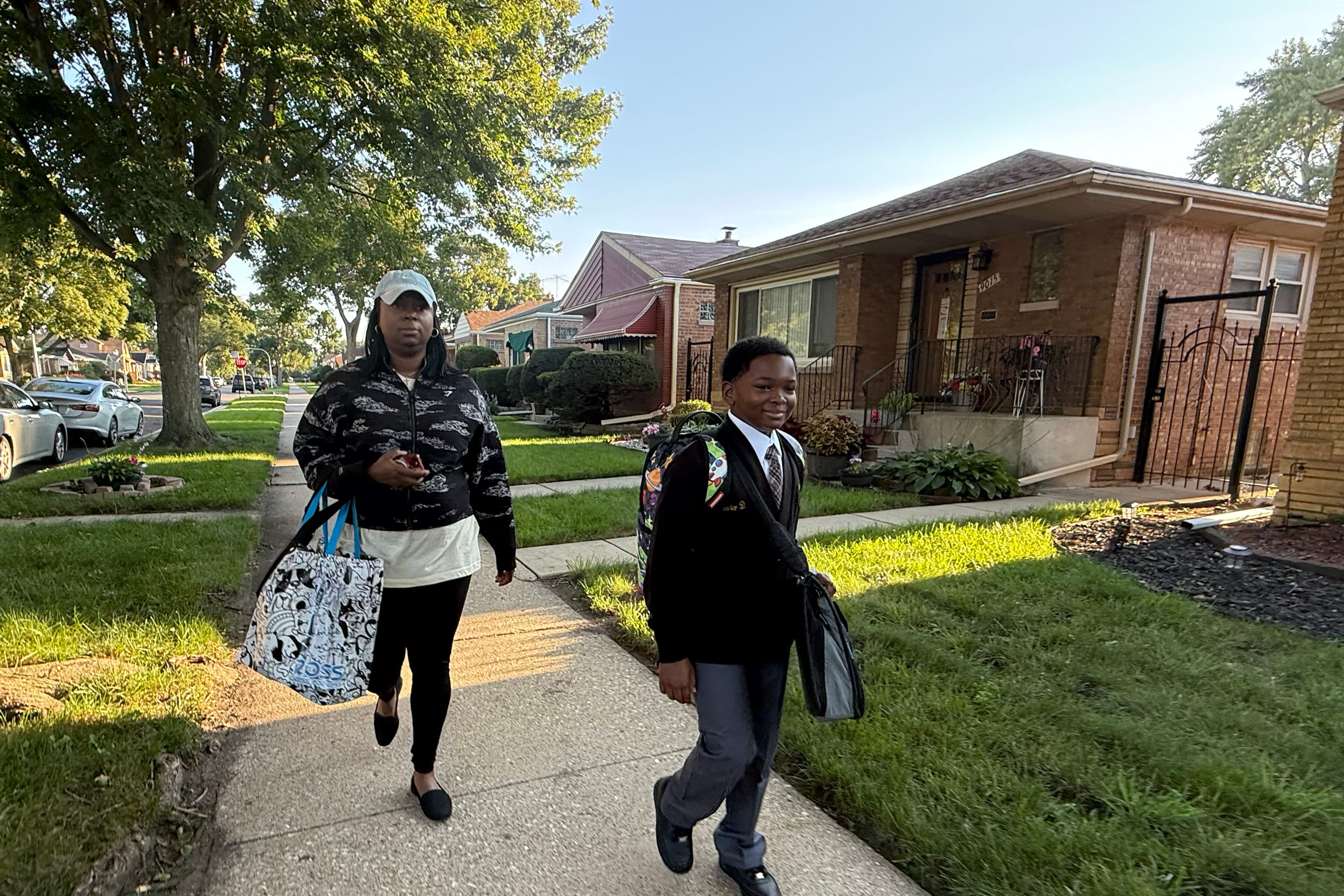
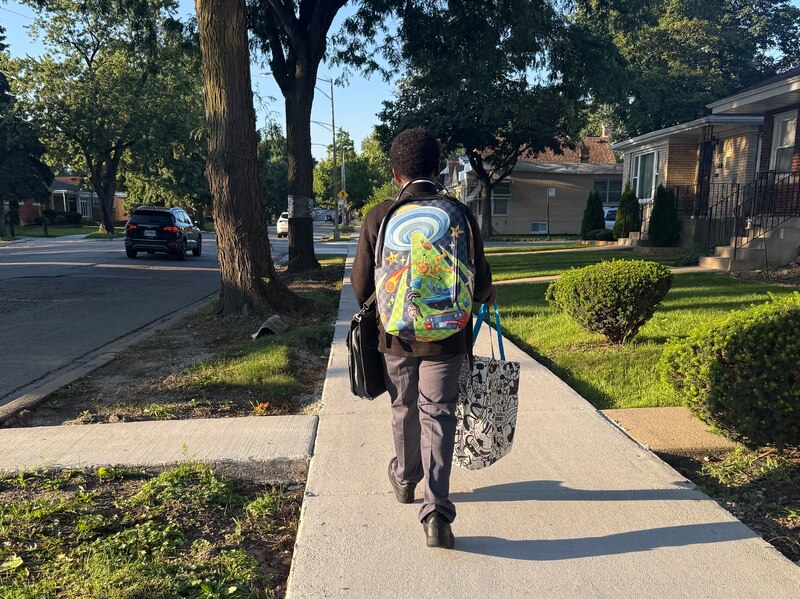
By 6:45 a.m., Carter was wearing his backpack and the school uniform he typically hates: a black cardigan with the school’s name embroidered on the upper left corner, a white collared dress shirt, a plaid tie, gray slacks, and black sneakers.
“I feel good,” he said, smiling, before embarking on the two-block walk to his first day of sixth grade at Robert A. Black Magnet Elementary School in the Calumet Heights neighborhood on Chicago’s South Side.
Carter is one of more than 300,000 Chicago Public Schools students who returned to the classroom Monday. It’s a big year for the nation’s fourth largest school district. Mayoral control is set to formally end in January and be replaced by a fully elected school board that will manage a $10 billion budget, oversee district leadership, and set the vision for the city’s more than 600 public schools.
The school board’s decisions directly affect schools like Carter’s. Last month, the current board approved a budget that assumes CPS will get $150 million more in state funding than Illinois lawmakers allocated in May. The additional money would help reverse summer layoffs, but schools could face midyear cuts if it doesn’t come.
Before Mayor Brandon Johnson rang the first bell Monday at George Leland Elementary School in the Austin neighborhood where he lives, he repeated his push for Illinois to implement a state millionaires tax to fund public education.

“We’re going into a season where we have to demand more from those who have the ability to give more to actually do more,” Johnson said. “You have politicians that have greater expectations of third graders than they do of themselves.”
Back on the South Side, Carter’s mom, Jaciel Cathey, recounted taking a photo of Carter shaking hands with Johnson last year when he visited his school alongside then-interim CPS CEO Macquline King.
Cathey learned more about the district’s budget situation during one of the district’s family webinars last week but said she still doesn’t know what it will mean for her child’s school.
“Why are we including money in the budget that is not set in stone?” she said. “You’re depending on money that is not there.”
Cathey hopes to use her new role on the school’s Local School Council to help address funding and resource gaps, including securing money to fund a crossing guard for the small but sometimes busy streets around the school.
She and Carter are also trying to remain focused on what they can control.
Carter will probably take an admissions test this fall for sixth graders interested in attending the district’s selective middle school programs, known as Academic Centers.
The family is no stranger to navigating CPS through periods of instability. Cathey grew up in the Woodlawn neighborhood and graduated from CPS schools before becoming a CPS teacher and later changing careers.
When Carter turned 3, Cathey enrolled him in a full-day preschool program at Holy Angels, a Catholic school near her Bronzeville home, with hours that allowed her to work.
Before Carter entered kindergarten, CPS schools saw midyear cuts, then received a historic funding commitment from the state. In 2019, the Chicago Teachers Union went on an 11-day strike. Cathey said this unpredictability made her want to keep him at Holy Angels through eighth grade.
“You knew they would have the staff, you knew they would have the resources,” Cathey said of the private school, which costs about $7,000 annually.
But Cathey felt Holy Angels focused too heavily on the arts and disciplining students and not enough on reading and math. When it was time for kindergarten, Carter applied and was admitted to Walt Disney Magnet School, a coveted public magnet school on the North Side.
They liked the school. But at the end of first grade, a white child called Carter a racial slur on the playground, Cathey said. According to an incident report reviewed by Chalkbeat, staff planned to hold a “restorative conversation” with the other child. She didn’t feel the school was being responsive enough to her or handling the situation well, so Carter returned to Holy Angels for second grade.
“Let’s put him in CPS, see what happens — well, he gets called the n-word,” Cathey said during an interview last week. “OK, let’s go back to what we know.”
CPS now has a Black Student Success Plan, meant to improve outcomes and the school experience for the city’s Black students. But the Trump administration is investigating CPS in part over the plan, claiming that it discriminates against students who aren’t Black.
By the end of second grade, the Cathey family had moved further south to Pill Hill. Black Magnet was just a five-minute walk from their new home. The state has labeled the close-knit, small school “commendable,” and students last year outpaced their peers across the district and state in math and reading proficiency.
Carter enrolled at Black Magnet in fourth grade and in the two years since, hasn’t looked back. He likes the staff, has made friends, and enjoys learning — especially the “pretty fun” projects in science, he said.
Cathey said Carter will stay at Black Magnet through eighth grade if he doesn’t get into an Academic Center. But she wants him to have “consistency” as he prepares for college, and that means leaving CPS for high school, she said.
“We need for him to get the most support that he can get and the most rigorous education that he can get without, you know, Mr. Johnson teaching math on Monday, then Mr. Johnson is laid off because Springfield didn’t send the money,” Cathey said.
As the mother and son walked up to Black on Monday morning, Cathey reminded Carter about their annual tradition of getting ice cream after school on the first day. She gave him a hug and sent him into the building with a tote filled with paper towels and tissues for his classroom.
Mila Koumpilova contributed.
Reema Amin is a reporter covering Chicago Public Schools. Contact Reema at ramin@chalkbeat.org.