Sign up for Chalkbeat Chicago’s free daily newsletter to keep up with the latest news on Chicago Public Schools.
This story was reported and published in collaboration with WBEZ and the Chicago Sun-Times.
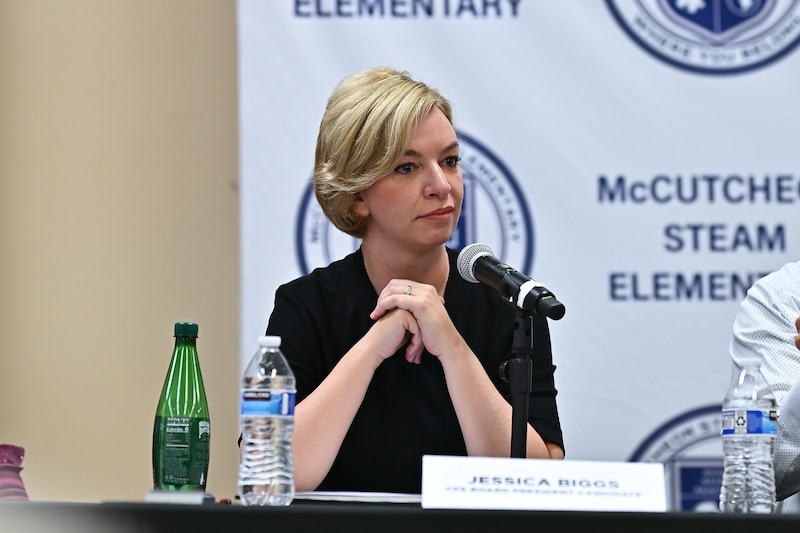
Jessica Biggs holds up her work leading a South Side elementary school as a top reason voters should pick her in an intense fourway race for Chicago’s first elected school board president.
That’s even though she was fired from that job as principal at Burke Elementary in 2018, and until recently, was banned from working in Chicago Public Schools.
Biggs, a current school board member, has long maintained she was terminated based on a rushed internal investigation after openly criticizing problematic district practices — a claim she doubles down on in a TV ad she released this week.
But all three opponents in the race to lead the 21-member school board have highlighted her dismissal, arguing it’s disqualifying. Candidate Sendhil Revuluri said the investigation found “a deliberate, multi-year scheme to falsify attendance data to game her school’s rating.” Opponents have also questioned whether Biggs’ removal from the Do Not Hire list last summer involved quid pro quo with district Superintendent Macquline King — a suggestion Biggs and King have strongly denied.
A close Chalkbeat and WBEZ review of the 2018 district inspector general’s report, CPS data, and all available court records, including transcripts, and interviews with at least a dozen district officials, educators, experts, and others show a more nuanced picture: At Biggs’ direction, Burke staff improperly marked students tardy when they arrived late enough that they should have been flagged as absent for half the day. An uptick in the school’s attendance rate under Biggs helped improve a high-stakes rating given to the school at the time. But the OIG report does not lay out a full-blown conspiracy to cheat, and it’s hard to say how much of the attendance bump came from mislabeling students versus a concerted effort to get kids to school. The watchdog recommended that Biggs be disciplined, but did not suggest she be fired.
Former CPS CEO Janice Jackson stands by the decision to fire Biggs. But now, Jackson supports Biggs’ campaign to lead the school board, saying she has been impressed with her school board service.
“She didn’t come back with a chip on her shoulder,” Jackson said. “She came back to serve and did the same thing she did when she was a principal, which was to look out for the kids and the families that she was entrusted with.”
The timeline of Biggs’ removal from the Do Not Hire list does not support the quid pro quo allegation, but there are unanswered questions about how she got off the list after a previous request was denied citing “serious” findings in the inspector general report. The reversal came eight months after Biggs started serving on the school board.
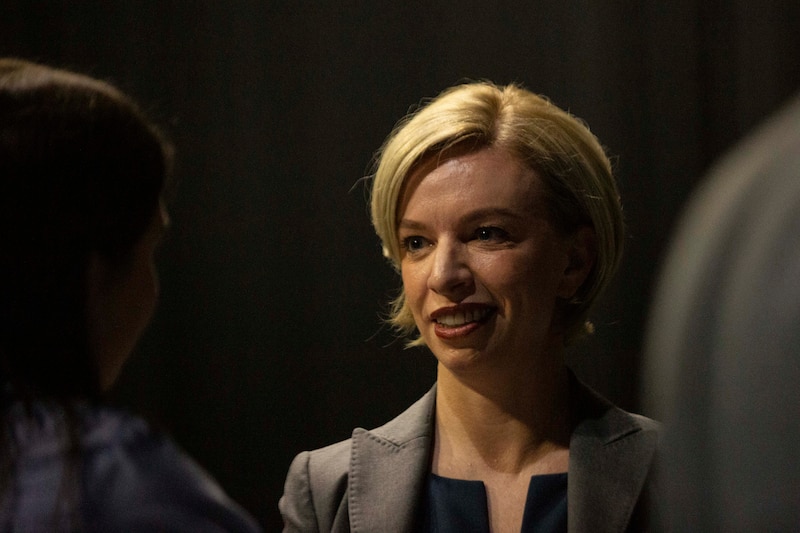
At a forum last week, Biggs said the allegations in the watchdog report “were around minor bureaucratic issues.”
“I have always said that this was unjust,” she said of her firing, adding that she was proud the Do Not Hire designation was removed.
Concerns about attendance-tracking, student transportation led to Biggs’ firing
Biggs took the helm at Burke Elementary in Washington Park in 2012 at a particularly contentious time. A former teacher, Biggs took on Burke as her first principalship after serving as an apprentice leader for a year at a different CPS school.
In her first year, Burke — serving about 270 mostly Black and low-income students — was on a list of 129 schools facing closure. It survived, but was then designated to take in students from a nearby shuttered school.
At the time, principals were under intense pressure to improve their schools, even as they had to make do with less amid recurring budget crises. Schools were given number ratings that carried high stakes, driving parents’ school choices and even district decisions about closures.
During the 2016-17 school year, a staffer complained to the district’s internal watchdog that Biggs was directing the attendance clerk to misrepresent attendance data and sent staff to pick up students in their personal vehicles without getting written permission from parents, as was CPS policy. One of her opponents, Hilario Dominguez, said this failure to follow transportation protocols “endangered students.”
The inspector general’s office substantiated the complaint after interviewing teachers, clerks, and other staff. Burke’s assistant principal told the watchdog that even a student who arrived 30 minutes before the end of the school day might still be marked tardy instead of absent. Illinois law requires that students attend for at least 300 minutes to be considered present.
Investigators suggested in their report that the school’s flawed tracking of attendance was tied to efforts to better its standing. In one email highlighted in the report, Biggs thanked school staff for their hard work to improve attendance and said that to boost the school’s rating, “we MUST hit 94% by the end of the year!” One teacher told the watchdog that staff felt pressure to increase attendance.
The inspector general’s office acknowledged it could not determine how widespread the tardy mislabeling was. But it noted Burke’s tardy count was four times the district’s average in 2016 and 2017. Staff at Burke logged more than 10,000 tardies in each of those two years and less than a dozen half-day absences.
Even before the watchdog’s investigation, Biggs’ supervisor had instructed the school not to mark students arriving really late as tardy.
In an interview with Chalkbeat and WBEZ, Biggs said she owns some of the report’s findings.
She admitted that she failed to keep proper documentation on student rides. Biggs said she likely reviewed driver’s licenses and insurance for staffers giving student rides, though she told the OIG in 2018 she was not aware she needed to verify them. But Biggs said her team was simply trying to help out families struggling with transportation, including some living farther away that enrolled at Burke after the school closures.
She acknowledged that some students were marked tardy who should have been designated as absent half a day. But she dismissed the idea that she oversaw an intentional plot to fudge attendance data. She said the district gave schools some leeway to determine when a tardy becomes a half-day absence. Biggs also noted schools with earlier start times, like Burke, tended to see many more late arrivals.
During Biggs’ six-year tenure, Burke’s attendance went from 88.1% in 2012 — a tough school year when a newly hired Biggs and her team battled closure — to 93.7% her last year in charge. The school’s rating got a boost from state test score growth and a positive school climate survey, but the attendance rate remained consistently shy of the school’s 94% goal that would have pushed the rating up further. The year after Biggs was fired, the attendance rate dipped to 89.5% — a drop she attributes to staff turnover.
Stephanie Garrison, who taught at Burke for almost 20 years and is now retired, said she was concerned about student safety when she realized Biggs was telling employees to pick up children without following the required steps.
Garrison, a former union representative in the school, said some staff complained about Biggs’ “my way or the highway” attitude.
“The administration sets the tone,” said Garrison, who responded to outreach from WBEZ through the union. “There were a number of talented teachers that felt they had to really just move on.”
The teachers union backs Dominguez, Biggs’ opponent in the board president race.
Ever since her 2018 termination, Biggs has insisted she became a target because she complained about her school being dirty and that it was not being given enough special education staff or resources — two major controversies under then-Mayor Rahm Emanuel. During summer break after her firing, parents, staff, and community partners came out in support of Biggs at a meeting with school officials and questioned their motivation for letting her go.
Matt Lyons, who led the district’s talent office at the time of Biggs’ firing, said he didn’t see evidence in the OIG’s investigation that she had intentionally manipulated attendance data.
Lyons said Biggs was not fired for speaking out but noted that her firing came in the months following an explosive Chicago Tribune series about systemic failures to address sexual misconduct in the district. While Biggs’ case had nothing to do with sexual misconduct or the Tribune’s reporting, Lyons maintains she faced harsher discipline because of the spotlight the report placed on CPS practices.
“It was a time of heightened scrutiny, and we felt public pressure to ensure school leaders were following policies by the book,” he said.
Biggs’ removal from Do Not Hire list raises questions
Biggs spent years working to clear her name after she was fired. She filed a lawsuit against CPS months after her 2018 firing, claiming that her firing violated her due process rights and stunted her education career. The court dismissed it because she had been an at-will employee and it found she failed to prove her firing prevented her from getting another job.
Later, in 2023, she asked CPS to remove the Do Not Hire designation in her employee file because it prevented her from volunteering to chaperone her daughter’s field trip. An internal CPS committee reviewed her request and allowed her to volunteer, but declined to make her eligible for employment.
In July 2024 after filing to run for school board, Biggs asked again. She cited her work on coordinating the city’s response to the COVID-19 pandemic and vaccination efforts with the nonprofit Southwest Organizing Project.
The district, under then-CEO Pedro Martinez, referred the petition to an outside law firm, likely to avoid conflict of interest concerns. In a detailed, five-paragraph letter, attorney Elizabeth Babbitt denied the request, saying the misconduct outlined in the OIG report was “serious.”
“At your direction, a CPS school manipulated attendance data and placed students’ safety at risk by failing to comply with the CPS student travel policy,” Babbitt wrote.
In July 2025, Biggs tried a final time, arguing that her situation had changed because, in 2024, 40,000 voters elected her to the school board.
“I felt like it was an opportunity to right a wrong that had existed for a long time,” she said in the Chalkbeat/WBEZ interview.
The district, led by then-interim CEO Macquline King, turned to Babbitt again. A month later, the lawyer wrote a three-sentence letter to Biggs approving her removal from the Do Not Hire list. It did not contain a reason.
Babbitt did not respond to questions from Chalkbeat and WBEZ.
Lyons, the former HR chief at CPS, backed Biggs’ final successful attempt to get off the Do Not Hire list. In a letter, he wrote the OIG report detailed only “minor policy violations” that didn’t harm students and said Biggs was “widely regarded as a strong and beloved school leader.” More recently, he has donated to her bid for school board president.
Andre Smith, who lost to Biggs in the 2024 school board election and has been working for Victor Henderson, another candidate for school board president, said he is suspicious of the timing and the outside lawyer’s about-face. Smith is calling on the Cook County State’s Attorney, the CPS inspector general, and others to investigate.
He said it would be easy for a government investigation to pull phone and text messages to ensure there was no collusion between Biggs and King or other district leaders.
In a statement, CPS officials said “King did not review or decide any of the Do Not Hire petitions involving Ms. Biggs.”
That fall, the superintendent search committee led by Biggs voted not to include King on a list of finalists. Biggs said that’s evidence there was no quid pro quo.
The search then stalled, and Biggs distanced herself from it. In March of this year, Biggs eventually voted with 17 other school board members to give King the permanent position.
Sean Harden, the current appointed school board president, said he doesn’t think “anything malicious or untoward” happened. But “it probably would have been best practice” for Biggs to notify the school board that her Do Not Hire designation had been lifted before she voted to hire King.
Biggs said she didn’t bring it up because there was no conflict in her vote for King since a third party decided to remove her from the list.
Jonathan Collins, a school board expert at Columbia University’s Teachers College who also serves on New York City’s appointed school board, said Biggs’ case put CPS in a tough spot.
Outsourcing doesn’t completely ward off the perception that a board member leveraged her position, he said. But having a board member barred from working for the district makes for “terrible optics.”
“It’s a lose-lose situation,” he said.
As the next school board president is about to take over, principals are once again under pressure to increase attendance. CPS has struggled to recover from a pandemic-era absenteeism jump.
Asked how she would approach the case of a school leader accused of manipulating data, Biggs said she would take the allegations seriously. But she’d also interrogate the charges and focus on due process for principals.
“I think one of the most important levers for change in the district is really strong principal leadership, and we ask our principals to do a lot, and they need to be protected in their jobs,” Biggs said. “I’m also aware that humans, government entities, are fallible, and so it’s why it’s important to read documentation that comes before us to ask questions to push back.”
Mila Koumpilova is Chalkbeat Chicago’s senior reporter covering Chicago Public Schools. Contact Mila at mkoumpilova@chalkbeat.org.
Sarah Karp is an education reporter for WBEZ, part of Chicago Public Media. Contact Sarah at skarp@wbez.org.