Sign up for Chalkbeat Detroit’s free newsletter to keep up with the city’s public school system and Michigan education policy.
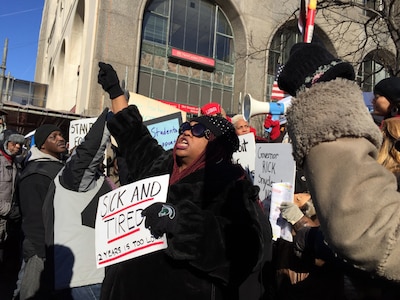
Ten years ago, a big crowd of Detroit teachers and their supporters marched down Jefferson Avenue toward Cobo Hall, where the annual auto show was being held, to draw national attention to the substandard conditions inside city schools.
The Detroit Federation of Teachers timed another rally later that afternoon outside Cobo (now Huntington Place) to coincide with the arrival of President Barack Obama at the auto show, whose appearance drew journalists from across the country.
The protests on Jan. 20, 2016, which closed most schools that Friday, produced stunning headlines that explained why teachers in Detroit Public Schools had called in sick en masse multiple times in that month.
“Rats, roaches, mold – poor conditions lead to teacher sick-out, closure of most Detroit schools,” a Washington Post headline said. “These Photos Will Make You Understand Detroit’s Education Crisis,” a HuffPost headline read. “How Detroit’s teacher ‘sickout’ cast a spotlight on unsafe school conditions,” was a Guardian headline.
The local and national coverage of the crisis proved instrumental, prompting the mayor to order school inspections and the district to begin repairs. After years of emergency management by the state, the new administration and school board that took over in 2017 ordered an audit of conditions in every building. More than $700 million in federal funds went into renovating and rebuilding schools, helping address needs officials say were created in part by a lack of equitable state funding. A decade later, the district is still constructing new schools to replace a handful of buildings that were in the worst condition, as well as addressing the biggest needs in other buildings.
But the scale of the challenges — both financially and physically — mean many students still attend school in buildings with significant problems.
“I am proud of the investments we have made and the improvement we are seeing in our infrastructure, but I am not satisfied with it,” Superintendent Nikolai Vitti wrote in an email to Chalkbeat. “Our students and staff deserve EXACTLY and even MORE than suburban districts have.”
The $700 million investment, made during the pandemic with federal COVID relief dollars, addresses a fraction of the $2.1 billion infrastructure needs, according to the district.
“Many buildings still require major modernization, and some remain in deficient or failing condition based on industry standards,” Vitti said. “Aging systems continue to drive future costs, and without sustained investment, deferred needs will grow.”
Teachers push for change in building conditions, higher pay
The protests happened in the midst of turmoil and division within the Detroit Federation of Teachers.
The union’s fiery leader, Steve Conn, had been ousted by the union board in August 2015, after a two-day trial that ended with him being convicted of five misconduct charges, the Detroit Free Press reported.
As part of its attempts to stabilize the union, the American Federation of Teachers, its umbrella organization, asked members to identify the biggest problems facing the district. Building conditions were at the top of the list.
Stories and pictures collected from union members became the basis for the campaign to raise awareness of student and teacher learning and working conditions, said Ivy Bailey, interim president of the DFT at the time. Photos showed ceilings that were caved in and missing tile, vermin infestations, mold, and other troubling conditions.
Contributing to the problems, according to teachers and union officials, were the state-appointed emergency managers who had control of the district. The school board existed but had little power during the years of emergency management, which stretched from 2009 to the end of 2016. Teachers said their complaints about building conditions were often ignored. The emergency managers were tasked with whittling down the district’s debt, but it rose substantially while they were in control.
Nina Chacker, who organized sick-outs as a union representative at Schulze Academy, said areas of some schools would be closed because of water-logged ceilings, forcing students to cram into classrooms that were usable.
Instead of listening to teachers’ pleas to make buildings safe for kids, Chacker said emergency managers sent people into schools “telling us how to teach.”
“We knew things weren’t going to get better as long as they were left in the state’s hands to address,” she said. “We wanted a school board with power. We wanted the democratic process returned to the district.”
Carrie Russell, now a math teacher at King High School, taught at Cody High School before the sick-outs began. An old boiler made it difficult to maintain temperatures in the building. She remembers a teacher who wore hard hats in her classroom at Cody because she feared falling ceiling tiles. (Russell left to teach in the Oak Park school district before the sick-outs and returned to the Detroit district in 2018.)
Teaching in a building with such problems, Russell said, was “demoralizing on so many levels.”
Building conditions were hardly the only issue teachers were concerned about, however. Class sizes were high – one teacher at a rally held a sign saying her class had 39 first graders. Teachers had not received pay raises in years, and many schools struggled with teacher shortages. Many teachers wanted to see an end to the years of state oversight and more attention from state lawmakers in Lansing.
“Everybody deserves a clean and safe environment to work in,” said Bailey, who retired as a teacher in 2018 but remained as union president until 2019. “They shouldn’t have to be worried about if they’re going to get cancer or if it’s going to affect their lungs. I mean, that should not have been an issue.”
The sick-outs started out small in November 2015, but by Jan. 20 they had increased in size, with nearly every building being closed that day. Most were organized by Detroit Strikes to Win, a group of teachers led by Conn.
Conn, who taught math at Western International High School for many years until he retired in 2023, said images of the roofs caving in, mold, and vermin infestations were the best way to demonstrate the inequities in Detroit schools to the public.
By bringing national attention to Detroit schools, he said the movement sparked a larger conversation around inequities in U.S. education.
“It was time to fight for justice, and we did that and set an example,” he said. “I think it was a high point in the struggle. But the struggle goes on for equity in Detroit schools and America’s schools.”
Vitti calls for more equitable state funding to keep improving buildings
When Vitti interviewed for the superintendent job in 2017, he said he was shocked by the conditions he saw while touring schools in the district.
“To actually walk the buildings and see the state of our infrastructure shook me, and in fact enraged me to see that our children have to go to schools where there are holes in the wall, tiles that are not replaced. It’s unconscionable and it’s a clear indication of the injustice our children face here,” he said.
The district during emergency management had “no vision and no resources consistently invested in infrastructure,” Vitti told Chalkbeat in an email.

Since he took the helm, Vitti has focused on tackling the widespread problem — and some teachers say they have seen the changes.
Russell, the math teacher at King High School, has seen improvements since she returned to the district in 2018. While she used to be met with silence when trying to get problems in her classroom resolved, the current administration is more responsive, she said.
“They do a better job of trying to maintain issues,” she said.
She’s happy that the district recently broke ground on a new building for Cody High, where she worked a year before the sick-outs began.
Chacker, who now teaches at Bunche Preparatory Academy, is excited to have enough books for her class now, but the lack of air conditioning in her building is still a hindrance.
“The problem is that we started in such an egregious place,” said Chacker. “There’s a lot of improvement needed and still so far to go as far as getting to the standard our peers in the suburbs are enjoying.”
Funding continues to be an obstacle, Vitti said, because the state funding model doesn’t earmark dollars for school infrastructure, which “indirectly requires districts to either take funding from the general fund” or apply additional local taxes. Federal funds received by the district cannot be used for that purpose. (The COVID relief dollars used for the $700 million plan were one-time funds.)
Vitti said he wants to see more equitable state funding to help close the gap.
“DPSCD receives $10,050 per pupil as the minimum, other districts have as high as over $13,000 per student,” he said of state funding. “This difference results in gaps as large as $168 [million] annually.”
Last week, Vitti presented a new proposal to use $79.4 million in surplus funding to demolish 11 buildings, board up 11 properties, build an athletic complex at the former Cooley High School, re-pave parking lots at 36 schools, improve fencing at 28 schools, and replace the roof at Charles Wright Academy, among other items.
Vitti said the district will continue to recommend shifting unspent funds to one-time building improvements.
“When we have extra surplus funding, we know exactly where to invest whether it is in roofs, windows. HVAC, masonry, fences, paving, or football fields,” he said.
Chacker said the protests were an important moment in the history of the district because teachers shared a unified message that the status quo was no longer tenable.
“It set standards for how students should be treated,” she said. “Before that, we got a blatant no when it came to money even if schools weren’t safe.”
Detroit teachers: We want to know more about the state of your classrooms and schools. Reach out to us at detroit.tips@chalkbeat.org and tell us your stories.
Lori Higgins is the bureau chief for Chalkbeat Detroit. You can reach her at lhiggins@chalkbeat.org.
Hannah Dellinger covers Detroit schools for Chalkbeat Detroit. You can reach her at hdellinger@chalkbeat.org.