Sign up for Chalkbeat Detroit’s free newsletter to keep up with the city’s public school system and Michigan education policy.
More financial incentives, gas cards, and stronger early pick-up policies may be in the Detroit school district’s future as part of ongoing efforts to improve attendance.
The potential strategies were mentioned on Tuesday during a Detroit Public Schools Community District board work session on chronic absenteeism. Board members requested the meeting to springboard new strategies and better understand current efforts.
With a new mayor who has promised to focus on city issues that affect youth and education, there could be momentum to address root causes of chronic absenteeism.
Mayor Mary Sheffield, has already begun conversations with the district around improving transportation, district officials said. Those conversations have included the possibility of expanding city bus routes in specific areas where school-age kids have the highest rates of chronic absenteeism and hiring staff to make sure students feel safe riding the bus.
“If we’re going to partner with the city, maybe we should try to galvanize our community,” said Board President LaTrice McClendon during the meeting.
Students are considered chronically absent if they miss 10% or more of the school year, or about 18 days of instruction in a typical 180-day school year. Even as the state’s chronic absenteeism rate has climbed in the years following the pandemic, DPSCD has made substantial ground reducing its rate.
Last school year, 60.9% of DPSCD students were chronically absent, an improvement of nearly 5 percentage points from the year before. The district also decreased the rate by nearly 16 percentage points from the 2021-22 school year, when quarantine rules caused many students to stay home.
Still, the district’s rate was nearly 30 percentage points higher than the state average last year.
Districts in communities like Detroit, where 84% of students come from low-income homes, have long grappled with kids missing too much school due to systemic issues such as inadequate transportation, poor health, dangerous routes to school, and parents’ inflexible work schedules.
Gift cards, carpooling, bikes, and city partnerships
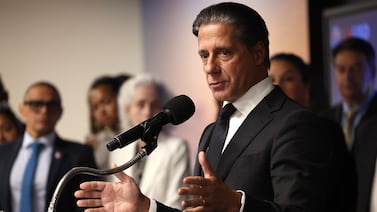
The district is considering building on existing financial incentives for attendance, Superintendent Nikolai Vitti said during the meeting.
Instead of an across-the-board incentive, like its perfect attendance payouts for high schoolers, the district could offer gift cards to families of early-grade students living in neighborhoods with the highest concentrations of poverty, Vitti said. The district could even target the incentive to neighborhoods and grade levels with the highest rates of chronic absenteeism, he added.
The chronic absenteeism rates in kindergarten, first grade, and second grade were higher than the district average last year, according to the district’s data. The kindergarten rate, for instance, was 68.3%.
The district may also give more gas cards to parents who carpool, bringing students from the same neighborhoods to school together. Attendance agents would organize this strategy at schools, Vitti said.
The district will also recommend updating school policy to curb the frequency of early pick-ups, said Vitti. Caregivers would still be allowed to pick up students early, but the new policy would set a standard about how often is acceptable.
“This has been a big problem for a lot of schools where we have parents consistently removing children from school before the end of the day,” he said. “It disrupts the learning process.”
This spring, the district will give some students at Cody and Osborn high schools bicycles to get to school, Deputy Superintendent Alycia Meriweather said during the meeting.
Students told the district in a recent survey that bikes would help them get to school. They are already being used at Davis Aerospace Technical High School, where the chronic absenteeism rate dropped by more than 14 percentage points last school year compared to the year before.
The bikes will be given to a targeted group of students to create data around whether the move can improve their attendance, she added.
DPSCD will continue to explore the idea of adding more yellow or shuttle bus services. Vitti said specific student data will be needed in order for those efforts to pay off.
“You will hear, ‘Why don’t we do more transportation?’” he said. “We can add a bus, but if we don’t have any assurance that there’s actually kids that are going to go from point A to B, then we’re just going to have an empty bus.”
The district does not currently provide yellow bus service to most high school students. Exceptions are made in some cases, including for those with disabilities or experiencing homelessness.
Although the district’s yellow bus pilot at Henry Ford High School and East English Village Preparatory Academy at Finney served few students last year, the district said it may have helped improve attendance at one campus.
Chronic absenteeism declined by 8.5 percentage points last semester at Ford compared to the 2024-25 school year, according to the district. In the same time frame, the district’s nine other neighborhood high schools’ rate decreased by 0.1 percentage point.
Ford went from having the highest chronic absenteeism rate of all 10 neighborhood high schools to the third lowest, according to the district.
The same was not true at East English – the chronic absenteeism rate there went up by roughly 1 percentage point in the fall compared to last year, the district said.
Board members want to see more parent, community investment
At an October board meeting, some members asked what could be done to hold parents more accountable when their kids miss too much school.
This year, the district began more coordination with its police department in issuing “parental responsibility” citations for egregious truancy cases, according to the district. The citations require parents to improve their child’s attendance or enter the court system.
The citations are a “last resort,” said Meriweather, the deputy superintendent.
Board members asked whether the district could expand attendance contracts to students at risk of severe absenteeism in neighborhood schools.
Currently, the contracts are used for students who attend a school outside of their attendance boundary who are at risk of missing 45 days. They are asked to sign contracts, with their parents, agreeing to improve their attendance or risk being transferred to their neighborhood schools.
The policy was adopted for the 2024-25 school year. More than 2,900 students were identified under the policy and 434 were transferred, according to the district. The average chronic absenteeism rate went down by 7 percentage points for the group who signed contracts. Chronic absenteeism reduced even more for the group of students who were forced to transfer back to their neighborhood schools, with the average rate dropping by 10.1 percentage points.
Board members asked if the at-risk threshold could be reduced from 45 days.
“We can definitely look at bringing that number down,” said Vitti.
McClendon suggested the district partner with community organizations, parent-teacher associations, volunteers, and block clubs to help get kids to school. The groups could help walk kids to school, monitor bus stops for safety, make phone calls to parents, drive carpools, and more, she said.
The district spends around $14 million a year on improving attendance, said Vitti, and most of the funding pays for attendance agents.
The district has hired more attendance agents and concentrated them in neighborhood schools with the most absenteeism in recent years. The agents have a number of duties, including home visits, data collection, dropping off resources to families, making connections to wraparound services, and more.
Board members said they would like to discuss whether it would be possible to hire more agents in future budgets.
“We need to talk about capacity to help, whether it’s on an office level, whether it’s on the school level, to ensure that we’re able to touch every student,” said McClendon.
Hannah Dellinger covers Detroit schools for Chalkbeat Detroit. You can reach her at hdellinger@chalkbeat.org.