Sign up for Chalkbeat Indiana’s free daily newsletter to keep up with Indianapolis Public Schools, Marion County’s township districts, and statewide education news.
Should the mayor hold more power over Indianapolis Public Schools and charter schools?
Control over public education in the city is fractured now. An elected board governs Indianapolis Public Schools, where enrollment has been falling and the financial outlook is grim. Oversight of the city’s 50-plus charter schools is spread across multiple authorizers, including the mayor’s office, resulting in a patchwork of accountability. And as school choice has expanded, tensions over money and political power have been rising too.
All that makes the role of the mayor a notable one that could be addressed by the Indianapolis Local Education Alliance, which has been tasked by lawmakers with recommending systemic changes for IPS and charters.
The state-mandated group must submit recommendations by the end of 2025 on two narrow issues – changing transportation and building use. But it could also make suggestions on other topics like calling for some enhanced form of mayoral control, which would dramatically reshape the hierarchy running schools.
Some groups support this change, which would follow in the mold ofNew York City, where the mayor appoints the schools chancellor, and Washington, D.C., where the mayor appoints the schools chancellor and nominates members of the charter school board.
In its recommendations to the ILEA, Stand for Children Indiana, a nonprofit that mobilizes parents who support school choice, said that school board members appointed by the mayor could bring “experience as educators, or understanding facilities management or accountability systems — so they can add to the elected board’s experience.”
Yet the city-county structure of Indianapolis would create unique challenges. The mayor, a charter authorizer who governs a county featuring 11 school districts, would have sweeping influence over just one.
And consolidating power under one elected office could tie control of schools to the election of just one official every four years who oversees much more than just education.
This month, New York City voters elected a new mayor, Zohran Mamdani, intent on ending mayoral control. And in Indianapolis, some potential Democratic candidates for the 2027 mayoral election support elected school boards and are skeptical of charter schools and support limiting charter school authorizing.
Research into mayoral control over schools has found mixed results when it comes to academic performance and other factors.
A spokesperson for Mayor Joe Hogsett declined to share his thoughts on mayoral control, saying it would be unfair to the “ongoing and important work” of the ILEA. Hogsett is the ILEA’s chairperson.
An executive-driven school system can streamline governance under someone the public clearly recognizes as in charge, said Kenneth Wong, a professor emeritus of education policy at Brown University who has studied mayoral control for over 20 years. Given that IPS is the largest district in Marion County, he said, there could be a case for having mayoral control exclusively over one district facing a “dramatic educational crisis.”
“One could make the argument that because of the complexity and the amount of money involved in IPS, that needs coherence and accountability,” he said in an interview.
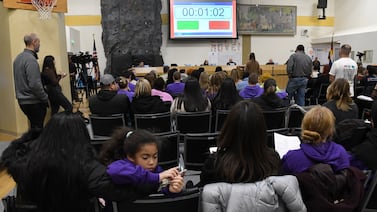
But some school board members, parents, and community members have called strongly for IPS to maintain a fully elected school board. They view the idea of having one person pick people to oversee the district as a blow to transparency and democratic control.
“Choosing our own representation is reflective of the community. Appointments would be a step backwards,” said Samantha Douglas, a Far Eastside resident, during a district-hosted town hall earlier this month. “We never hear from folks who are appointed.”
Unigov could complicate Indianapolis school governance changes
Mayoral control doesn’t mean the mayor runs schools like a superintendent. And it isn’t necessarily an all-or-nothing proposition.
A school board partially elected and partially appointed by the mayor could control IPS schools. The mayor’s office could serve as the sole charter authorizer — or as one of a maximum of two, as some groups have suggested. Stand for Children has also suggested a hybrid appointed and elected IPS board that would also act as the sole charter authorizer.
But the 1970 state legislation known as Unigov complicates matters.
Unigov consolidated nearly all city and county services for Indianapolis and Marion County. But school districts were not part of the merger and continued to operate independently.
Today, the mayor represents the city of Indianapolis and a county with 11 school districts: IPS, eight township school districts, and the school districts for Beech Grove and Speedway, two municipalities within the county with their own mayors that were excluded from Unigov consolidation.
Under mayoral control, the mayor would oversee only one out of the 11 school districts. But voters in other school districts — the majority of Marion County — would still cast votes for a mayor.
Through the Office of Education Innovation, the mayor’s office also already authorizes most charters within IPS borders.
In his 2007 book “The Education Mayor,” Wong found that mayor-controlled systems performed better academically than those without mayoral control — particularly in elementary school English language arts.
“While the data is dated, the basic premise remains relevant – mayors, when given accountability, will connect public schools to quality of life improvement,” Wong said in an email. “Mayors tend to focus resources to address the achievement gap.”
But he said one downside is the sentiment that community voices are not heard when mayors control schools.
Chicago highlights arguments from both supporters and detractors of mayoral control.
Mayoral control across three administrations from 1995 to 2020 coincided with increased academic performance in Chicago. Yet decisions to close schools also led to a public uproar and galvanized the teacher’s union to push for state legislation that would end it.
And in 2023, voters there picked an opponent of mayoral control when they elected former teacher and union organizer Brandon Johnson as mayor. Chicago began phasing out mayoral control this year, and it will end in 2027 when the board will be fully elected.
Several potential candidates skeptical of mayoral control
Mayoral control gained steam in the 1990s and garnered support from Democrats supportive of education reforms like charter schools. But it has drawn criticism from teachers unions and progressive groups.
If Hogsett, a Democrat supportive of charter schools, runs for reelection but loses to a candidate critical of charter schools’ growth, that could disrupt the smooth relationship the charter sector has enjoyed with both Republican and Democratic administrations.
The Mind Trust, an influential local nonprofit that has helped grow the city’s charter sector, called for an IPS board appointed by the mayor and city councilors in 2011. Today, though, it does not have a public stance on who should govern schools.
“We continue to think that that is a worthy conversation,” CEO Brandon Brown said of mayoral control. “We also think it’s one of many questions that need to be answered over the next few months, and we’ve not taken a formal position on it.”
Given the support that charter schools have from local Democrats and statehouse Republicans, Brown said, he does not see future administrations posing a significant risk to charter schools.
Of course, it’s not clear whether state lawmakers would move forward with expanding mayoral control in time to affect the 2026 school board elections or the 2027 mayoral election, even if they are interested.
Other potential candidates have differing views.
Democratic state senators Andrea Hunley and Fady Qaddoura — who are rumored to be mayoral candidates in 2027 but told Chalkbeat they have not yet decided whether to run — said they support an elected school board. Both are skeptical of charter schools and support restricting the number of charter authorizers.
Marion County prosecutor Ryan Mears, who’s also weighing a 2027 run, told Chalkbeat that the mayor could play a helpful role in setting an accountability standard for all schools.
“I’m certainly more partial to an elected board,” he said. “But I also think there’s room for what role mayor appointees can [do].”
Pike Township Trustee Annette Johnson, who objected to the opening of a charter school in Pike Township and confirmed she plans to run, said she favors elections instead of mayoral control.
“It just seems like it would be a lot of responsibility for mayor, with everything else that we have to contend with within our day-to-day duties as mayor of this city,” she said.
Former IPS school board member Will Pritchard, a charter school supporter who is also considering a run, said mayoral control might be feasible — if the county only had one school district.
“To have the mayor control one district but not the other 10 does not make sense,” he said. “And to have a large portion of the city voting for the mayor while a smaller portion of the city has their school district controlled by the mayor presents an awkward division.”
If you are having trouble viewing this form, go here.
Amelia Pak-Harvey covers Indianapolis and Lawrence Township schools for Chalkbeat Indiana. Contact Amelia at apak-harvey@chalkbeat.org.