Sign up for Chalkbeat Indiana’s free daily newsletter to keep up with Indianapolis Public Schools, Marion County’s township districts, and statewide education news.
An attempt to unify operations for traditional public and charter schools in Indianapolis is proving to be a complex task that could ultimately favor charters over district schools in critical ways.
At the heart of the matter: ownership and control of school buildings, some of which are privately owned or leased by charter schools and some of which are publicly owned by Indianapolis Public Schools. The future landscape for the roughly 42,000 students in IPS and charter schools could be shaped by how easily schools can access or control these buildings.
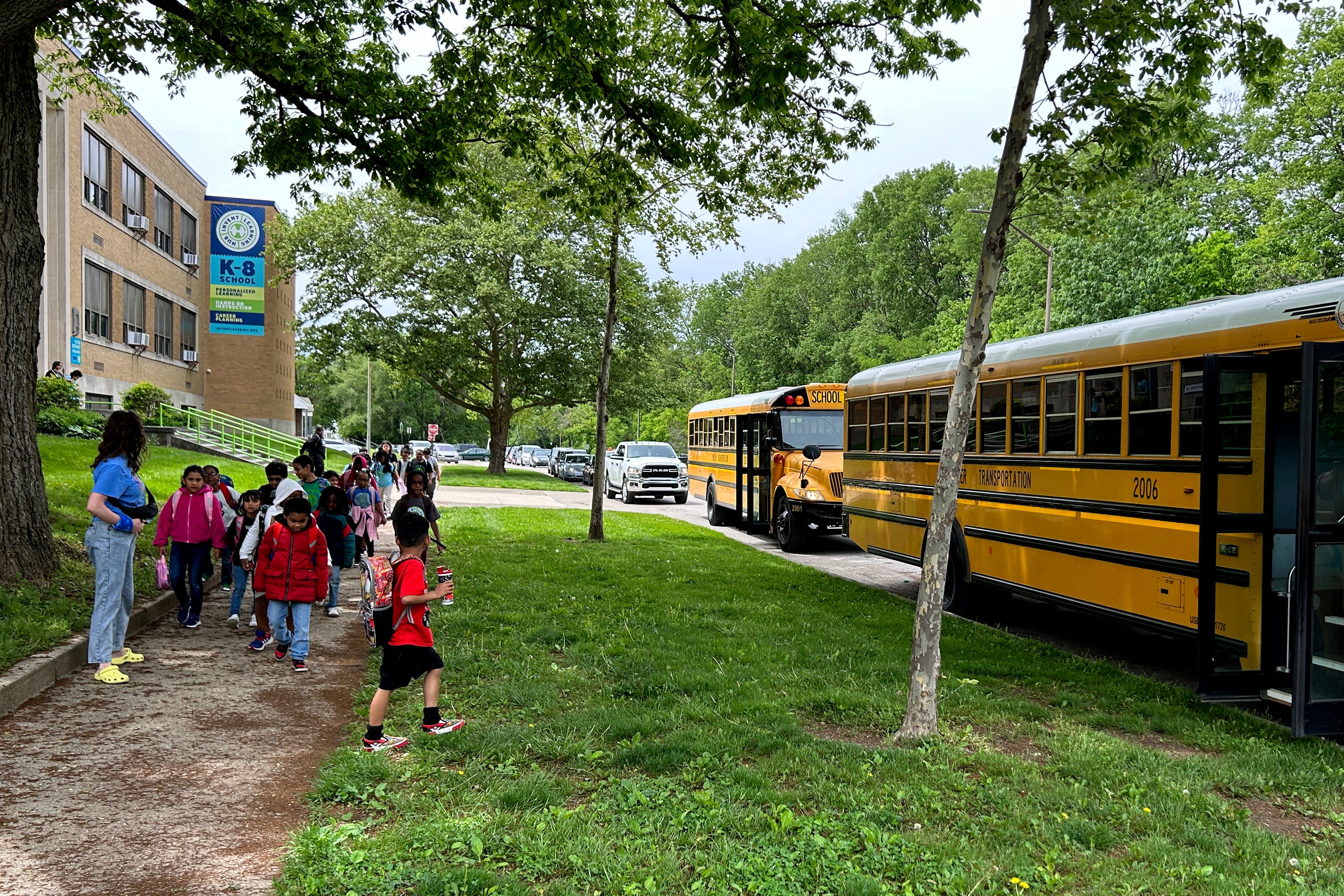
The move to centralize control over buildings comes as Indianapolis has grappled with a fractured education system of two different school sectors— traditional and charter — operating with different access to buildings and different transportation systems using different funds.
That divide is what a state-established task force known as the Indianapolis Local Education Alliance, or ILEA, sought to bridge through recommendations in December that have formed the basis for legislation advancing in the Indiana Statehouse.
But in the broader attempt at efficiency, at least some charter schools appear to be gaining what could be key advantages. Whether charters maintain that edge will depend heavily on the actions of a mayor-appointed board over the next two years.
Lawmakers last month made key changes to legislation that would create the Indianapolis Public Education Corporation, or IPEC, to manage transportation and facilities for district schools as well as charters within IPS boundaries. The revision would allow charters to opt into or out of the bill’s mandate that schools turn over control of their buildings to the proposed corporation.
Another addition to the legislation directs the corporation to create a process to close “inefficient” school buildings based on underutilized capacity.
The opt-out provision could favor the nearly two-dozen charters that already own their buildings by making it easier for them to maintain control of those facilities even after IPEC launches. In addition, due to enrollment trends, the process focused on shuttering underutilized schools could ultimately create a net benefit for charters by closing several IPS-run school buildings that the corporation could give to charters.
The legislation is based on recommendations from the ILEA. The debate over the bill mirrors recent and at times bitter political disputes between IPS and charters. IPS supporters have argued that the new corporation will not solve problems facing the city’s schools. Charter advocates, meanwhile, say charters should not be forced to give control of privately owned buildings to a public entity such as IPEC.
Republican Rep. Bob Behning, the bill author, said his goal is to create a facilities plan that every school would want to participate in so that school leaders can focus on academics.
IPS Superintendent Aleesia Johnson said other parts of the bill could streamline operations across both district and charter schools. But it depends on how the bill is actually implemented.
The bill gives the corporation until 2028 — the same year charters will start receiving property taxes — to enact a transportation and facilities plan across all school types.
“[The] devil’s in the details in terms of how the execution works, in terms of how there’s collaboration across different entities, in terms of how we all think about the trade-offs that might be necessary to actually make this work,” Johnson told Chalkbeat. “And that we don’t know yet.”
Charters schools want to keep control over buildings
Behning has said his intent is for the corporation to own all school buildings. But his legislation, HB 1423, only says that IPEC would “control” buildings through the facilities plan.
Schools that opt out of that plan would not receive property tax dollars reserved for building needs. But the nearly two-dozen charters that already own their buildings might prefer to opt out and prioritize maintaining control over their facilities over gaining access to that revenue starting in 2028. Their need for that revenue to acquire or lease buildings could be minimal or non-existent.
Meanwhile, charter schools operating in IPS buildings and charter applicants aiming to start a school could benefit by allowing IPEC to control their buildings, because they could still gain access to new or different buildings for their schools.
The legislation includes the same opt-out provision for IPS. But that flexibility is “almost symbolic,” Behning admitted. That’s because if the district opted out, it would lose the very property tax funding it currently relies on to pay for buildings.
In addition, forcing charters to relinquish control of their buildings — which might be a privately held asset — to a public entity could create legal problems, some charter advocates say.
As of 2024-25, over 20 charter schools owned their buildings, while another 19 leased space and 12 operated in IPS buildings as part of the school’s Innovation Network, according to a report from the mayor’s Office of Education Innovation.
At Circle City Prep, owning its school building on the Far Eastside allows the charter to pursue quick improvements and modifications, executive director Megan Murphy said in an email. The school would want to preserve that flexibility and autonomy, she said.
“It is in the best interest of our scholars and the community we serve to be able to be adaptive to the needs of our school and student population,” Murphy said.
Meanwhile, closing underutilized buildings would likely hit IPS particularly hard and also could affect charter schools struggling with enrollment.
At least eight schools run by IPS, which recently experienced its biggest drop in enrollment since the pandemic, are operating at a building capacity of 50% or lower, according state enrollment data for this year and a previous IPS study. Previously, lawmakers have used that 50% threshold to determine when certain traditional school districts would have to offer underenrolled buildings to charter schools for $1.
Building usage across charter schools is less clear. But at least four charter schools were operating at below 50% of their stated capacity in 2024-25 — a figure based on the number or students the school intends to serve rather than on the dimensions of a physical building, according to a mayor’s office report.
IPS supporters fear what lawmakers are planning
Lawmakers have stressed the district’s impending financial cliff as reasons for the drastic changes in HB 1423. The district anticipates ending the school year with a $40 million cash flow deficit.
While charters will gain access to property tax revenue in two years, IPS is projected to lose significant funding from property taxes due to various changes at the state level. In addition, IPS funding from a property tax hike that voters approved several years ago expires in 2026.
But the district’s supporters say traditional IPS schools need adequate education funding from the state, not the looming overhaul to key aspects of how the district works. They worry that recent events like the evolution of Behning’s bill point to the gradual demolition of IPS in favor of charters.
“Let me be clear what compromise looks like when you’re negotiating with people who want to dismantle you,” IPS parent Courtney Hawk, part of the Fully Funded, Fully Public campaign that wants an elected school board to maintain control of IPS assets, said at a district board meeting last month. “It looks like surrender in slow motion.”
The bill doesn’t match the charter sector’s priorities in some respects, however. Some charter advocates have pushed back on a requirement that all schools offer transportation, for example. Charters have struggled to offer transportation without property tax funding.
Behning’s legislation says all traditional public and charter schools inside district boundaries must provide for transportation for all students, a service that IPEC would manage. The requirement reflects a recommendation from the ILEA, and supports an argument from some school choice advocates and many parents that true choice is not possible without a way to get to school.
But Scott Bess of the Indiana Charter Innovation Center, a charter advocacy group, pointed out that state law doesn’t require school districts to offer transportation, and it should therefore not be required for any schools within IPS boundaries.
There’s some truth to the different concerns from both IPS and charters, said Barato Britt, who served on the ILEA. But if lawmakers follow the task force’s intent as closely as possible, he said, “we will have made progress to transform an already evolved educational landscape in a more connected fashion.”
“We can’t act like our trajectory without it was promising, whether it was the traditional space or the charter space,” said Britt, who serves on the board of the KIPP Indy Public Schools charter network. “Something had to be done.”
Ultimately, the pressure will be on IPEC’s board to address the big challenges lawmakers are poised to ask it to solve.
Indiana’s legislative session is due to end Friday.
Amelia Pak-Harvey covers Indianapolis and Lawrence Township schools for Chalkbeat Indiana. Contact Amelia at apak-harvey@chalkbeat.org.