Sign up for Chalkbeat Indiana’s free daily newsletter to keep up with Indianapolis Public Schools, Marion County’s township districts, and statewide education news.
Sixth grader Jocelyn Montiel had her phone stolen. She said her friend, Esteban Gonzalez, was to blame.
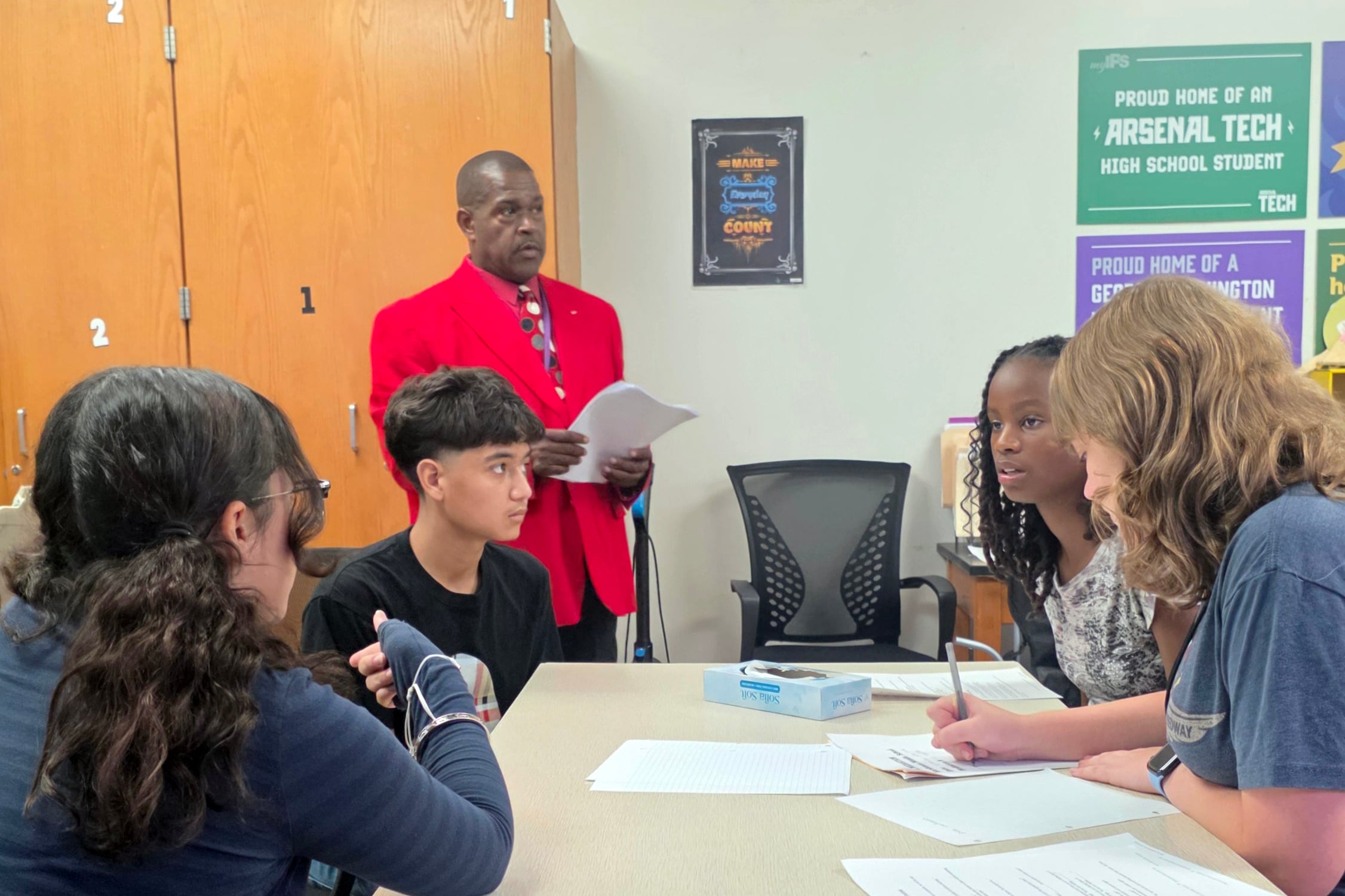
Gathered around a table in educator Grover Edwards’ classroom, the two students discussed the situation with two of their peers who were serving as mediators.
Jocelyn shared her sense of betrayal when she turned around to find her phone gone. Esteban described the injustice of being falsely accused.
The two mediators restated the issue and asked Esteban directly if he stole the phone.
They redirected the students when they started raising their voices and helped each reflect on what they could have done differently.
The fight over the phone was only a simulation — in fact, Jocelyn and Esteban serve as mediators too. The conflict resolution methods the students were practicing are part of a decade-old peer mediation program at H.L. Harshman Middle School, which enrolls about 500 students on the near eastside of Indianapolis. Through the program, students learn how to help their classmates settle disputes before they escalate, leading to a better school climate. School leaders say it has contributed to fewer fights and suspensions, even as statewide out-of-school suspension rates hover above pre-pandemic levels.
Student mediators say friends and classmates seek out mediation as an alternative to fighting. In mediation, students put their feelings into words in a supportive environment.
“Talking to an adult, you may be getting in trouble,” said Isabell Gonzales, an eighth grader who has been part of the program since sixth grade. “When you’re talking to your peers there’s less pressure.”
What issues does middle school peer mediation tackle?
The program is supported by a $1.2 million grant from Indiana University Health that places Peace Learning Center trainers in IPS and Lawrence Township classrooms to teach mediators how to resolve middle school conflicts. Similar approaches have been used in New York City schools and elsewhere.
Harshman leaders contacted the Peace Learning Center about starting a peer mediation program in 2016, but the program took off after the IU Health donation and when the school hired Edwards, said Tim Nation, executive director of the Peace Learning Center. Edwards has been leading the program for six years.
Peer mediation is meant to address conflicts before they turn into physical confrontations that require adult intervention. Students most commonly seek mediation for fights between friends or conflicts over relationships, the mediators said. Those kinds of conflicts can be trickier to resolve than determining who took a phone, they added.
“When it comes to relationships, it’s harder for people to take accountability for what they did or said,” said seventh grader Camille Hynes.
One of the hardest parts of learning how to mediate is helping their peers find the words to express how they feel, said Jocelyn, whose older sister also served as a peer mediator.
“Sometimes people will agree with what we’re saying just to get it over with,” Camille said.
Still, it can be easier to express feelings to a peer than a teacher or administrator, Jocelyn said.
More than 100 students applied to be mediators this year, but only about 25 to 30 were selected after an interview process, said Edwards. They train for three weeks after school before stepping in to mediate conflicts.
“They want to be a part of something, building something stronger,” he said.
Harshman students can seek mediation by filling out a form in Edwards’ classroom, where posters about peace line the walls and cloth drapes dim the fluorescent lighting.
Edwards said he has seen a significant drop in the number of fights breaking out in Harshman hallways, as well as subsequent suspensions.
Discipline data from the Richard M. Fairbanks Foundation shows that Harshman’s out-of-school suspension rate began declining in 2016 before spiking shortly after the pandemic.
Since 2023, the share of students with out-of-school suspensions has declined from a peak of 26% to 8% in 2024-25.
Across IPS, the out-of-school suspension rate has remained around 10% since 2022, lower than before the pandemic. About 6.5% of students statewide had an out-of-school suspension last year, slightly higher than before the pandemic.
Over the last school year, peer mediators handled about 25 peer conflicts, Edwards said.
Edwards also facilitated conferences with students focused on restorative practices, which are alternatives to traditional discipline focused on repairing harm.
Students and teachers must trust the process
When a conflict is resolved, both parties sign an agreement not to discuss their argument further outside the room. That helps build trust in the mediation process and mitigates feelings of embarrassment, the mediators said.
“Talking about it after can become a further issue,” Camille said. “The situation may be small but that can make it bigger.”
The program also requires buy-in from adults at the school, Principal Amy Moore said. Administrators have to trust that the peer mediators can resolve a conflict using the skills they’ve learned.
The principles of peer mediation have had an effect beyond Edwards’ classroom, she said.
Moore said she sees students in the hallways using conflict resolution language with each other. They say in jest: “That’s not the Harshman way,” she said.
“They’ve internalized it,” Moore said. “It’s become woven into the fabric of the school.”
Aleksandra Appleton covers Indiana education policy and writes about K-12 schools across the state. Contact her at aappleton@chalkbeat.org.