Newark Public Schools would get nearly $1.2 billion in state aid in 2024 under Gov. Phil Murphy’s proposed budget, an 11% boost, according to a state aid summary the administration released Thursday.
The school aid increase for New Jersey’s largest school district is part of the governor’s $53.1 billion proposed budget for the next fiscal year, which he presented two days earlier at a joint session of the Legislature in Trenton.
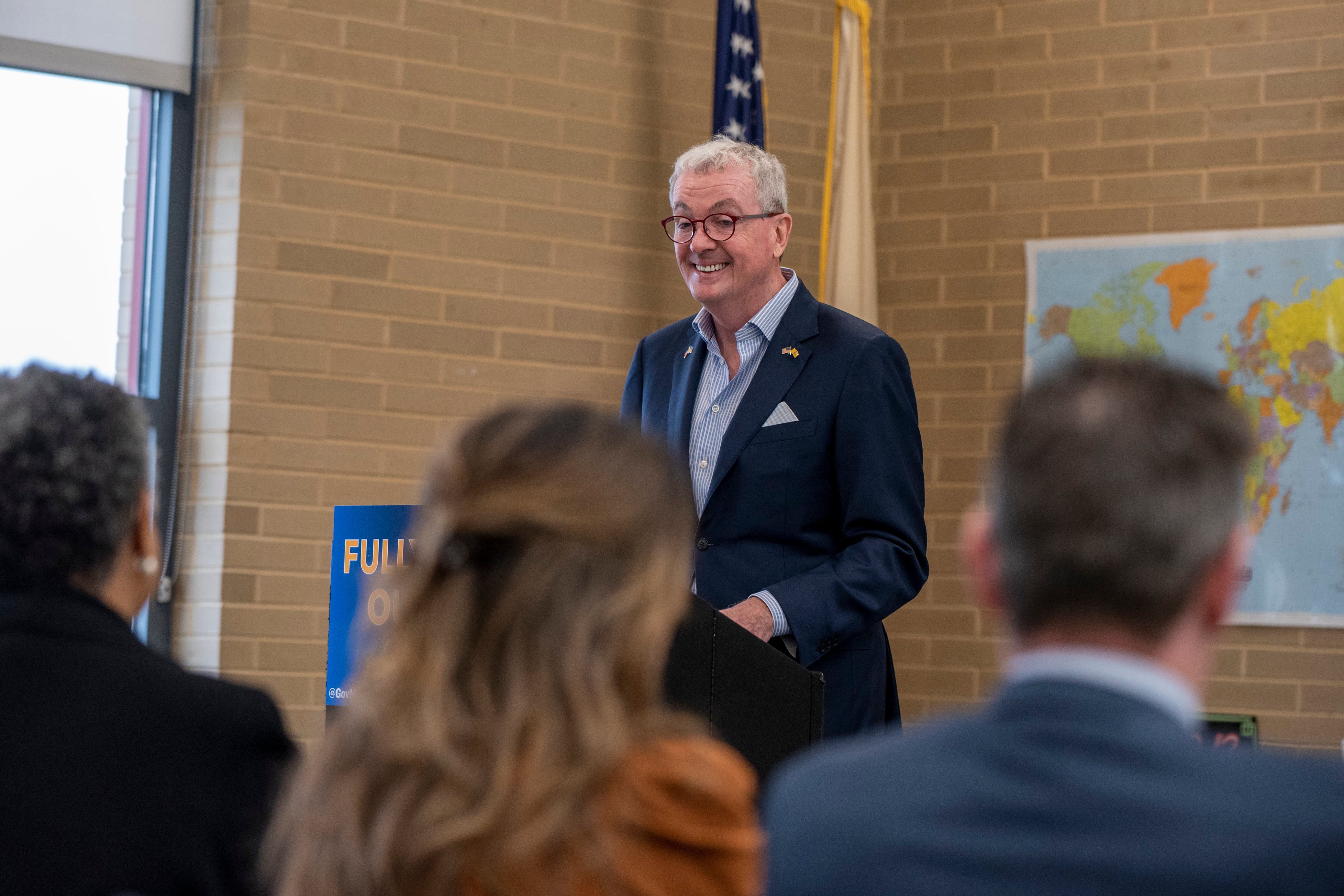
Murphy appeared Thursday with Acting Education Commissioner Angelica Allen-McMillan, Senate Majority Leader M. Teresa Ruiz, and other education leaders at a news conference in a Somerset County middle school to announce what would be a historic increase in aid for districts if the Legislature approves his proposed budget.
About $20.5 billion of the total plan is earmarked for pre-K-12 education, which would be an increase of $1 billion over the current year. Nearly $10.8 billion is carved out to fund the state’s school aid formula, up $832 million from the current year. This would be the state’s sixth payment into a seven-year plan to fully fund the school aid formula, which has left poor districts, including Newark, underfunded for years.
“I am incredibly proud that our administration’s fiscal stewardship has made it possible for us to create a six-year streak of increasing aid for our public schools,” Murphy said at the news conference at Montgomery Township Upper Middle School.
Last year, Newark Public Schools received $1 billion in state aid, which was an increase from the previous year, though still about $140 million short of being fully funded. Poorer districts, such as Newark, rely heavily on state aid to fund their schools because of a lower revenue stream from local property taxes compared with wealthier districts with high property values.
Murphy’s proposed budget also includes $109 million in new spending for universal pre-K, which would fully fund programs that started in 2023. About $40 million of that would go toward expanding preschool programs into new districts and other needs, such as workforce development.
The administration also aims to help districts address the staffing shortage crisis seen statewide by committing $10 million in stipends for student teachers, $5 million to waive teacher certification fees, $1 million to develop local partnerships for paraprofessional training, and other initiatives.
The New Jersey Education Association, the state’s teachers union, said that it supports the education investments Murphy proposed in his budget but that more funding should go toward initiatives to alleviate the school staffing shortage crisis.
The state must adopt a budget for next year by June 30. State lawmakers will hold public hearings on the budget over the next few months.
The Newark Board of Education will present its budget at a special meeting at 6 p.m. on March 29 at Science Park High School, 260 Norfolk St.
Catherine Carrera is the bureau chief for Chalkbeat Newark, covering the city’s K-12 schools with a focus on English language learners. Contact Catherine at ccarrera@chalkbeat.org.