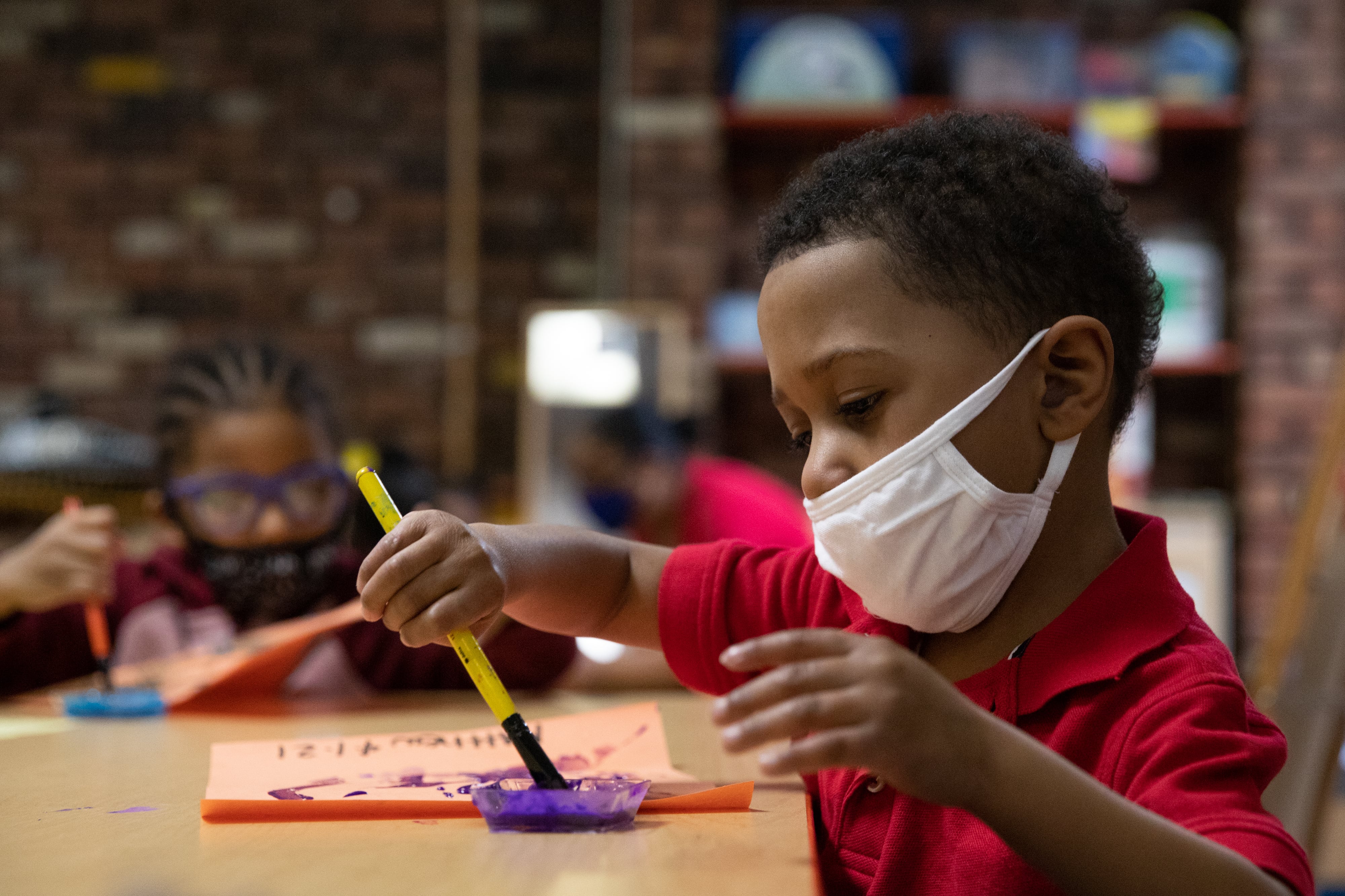
New York City plans to drop its mask mandate for its youngest students on April 4, Mayor Eric Adams announced Tuesday, as long as COVID cases remain low.
With children under the age of 5 the only age group still required to mask in school, many of their parents have relentlessly pressed Adams on the issue as he has traveled around the city in recent days.
“We want to see our babies’ faces,” Adams said at a press conference at City Hall insisting that “science,” not parent pressure, guided his decision. “Now it’s time to peel back another layer.”
In the meantime, health officials will keep an eye on COVID cases as concern mounts over the more contagious subvariant known as BA.2.
Gov. Kathy Hochul on Monday said the state was “closely monitoring” the subvariant, and pledged to “remain vigilant” as positivity ticks slightly upwards.
New York City’s health commissioner Dr. Ashwin Vasan said that cases are “just one data point we’re looking at,” while noting that hospitalizations remain low and healthcare capacity is, so far, not strained as with the previous omicron variant this winter.
“With BA.2, we’re not seeing any signs that it causes more severe illness in any age group, as yet,” he said. “Right now, overall risk remains low. Overall cases in children remain low. Hospitalizations in children remain low, which is giving us comfort to make this decision at this point.”
Mask-wearing became optional for most students in New York City public schools about two weeks ago, prompting a range of emotions from shrugs, to excitement, and fear. But Adams left the requirement in place for the youngest students, who are not yet eligible for vaccines. At the time, he pointed to data that those children had higher hospitalization rates than other children.
Vasan said that is still the case, but that overall, cases of hospitalization for young children “remain extremely low.”
The new rule would apply to children in pre-K and day care settings, according to officials.
While parent pushback over mask mandates has received intense media attention, polling has shown widespread support for requiring children to cover their nose and mouth while in school.
Sharon Stapel, a Brooklyn parent of pre-K child and a third grader at P.S. 20 on the Lower East Side, said she was “very concerned” about what she called a “rush to ‘return to normal,’” and the possibility of making masks optional for the city’s youngest students.
“Those of us with young children have not returned to normal since March 2020 - and we won’t be able to until our kids can be vaccinated,” she said.
Amy Zimmer contributed.