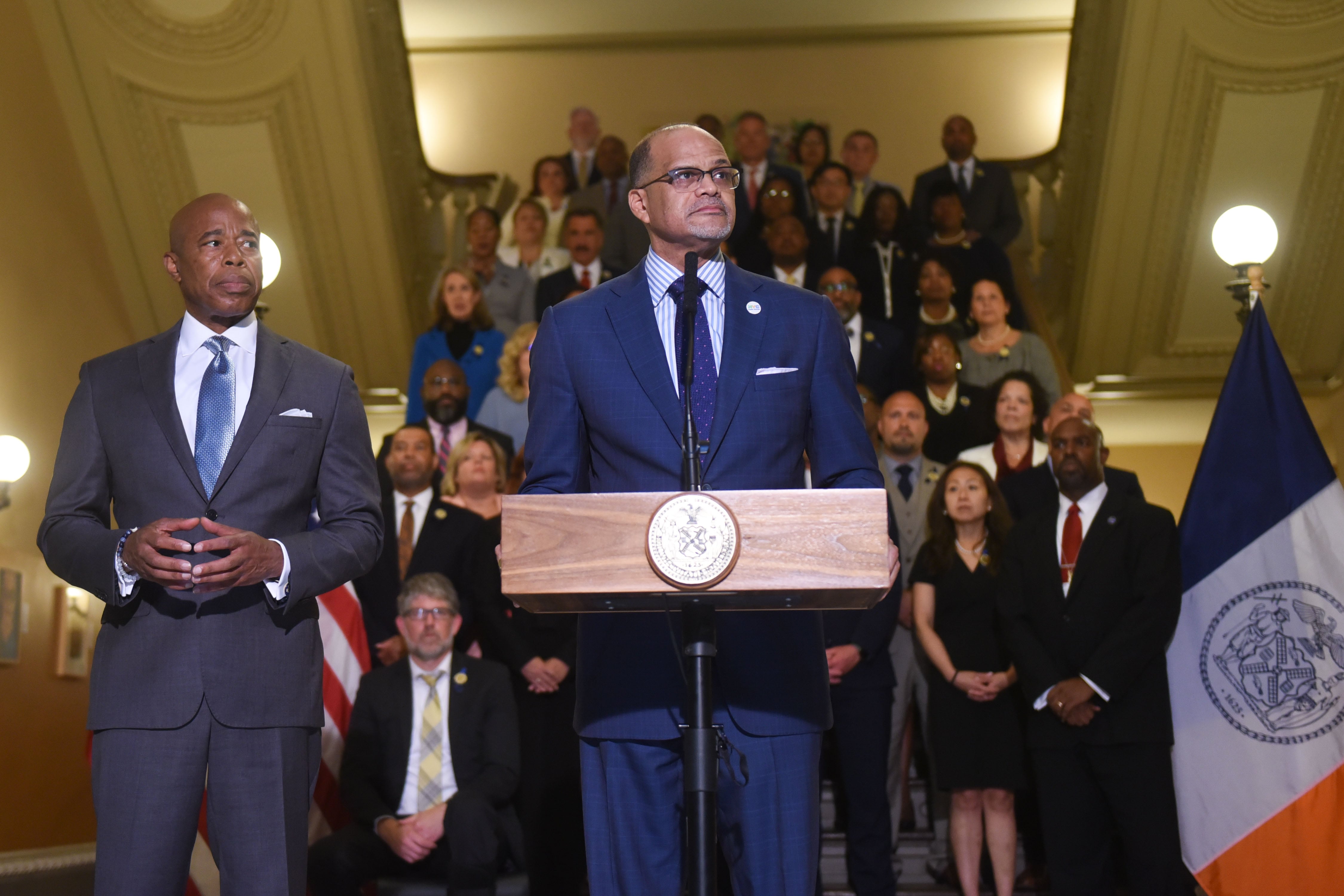
As the education department faces intense pressure to reconsider school budget cuts, Chancellor David Banks indicated that there’s another pot of money he wants to slash: hundreds of millions worth of tuition payments for students with disabilities.
“All this money that is meant for the kids in our public schools are going to private schools,” Banks said during a regularly scheduled meeting of his parent advisory council. “Folks have figured out how to game this system.”
If that money were plowed into traditional public schools, “We wouldn’t be having this fight about budget cuts,” Banks said. “We’d be able to pay for all that after-school programming, all of those kinds of things. This is money that’s going out the back door every single day.”
Banks’ comments struck a nerve with some parents and advocates who argue the growing cost of private school tuition payments is due to the city’s inability to provide adequate options for students with disabilities rather than an effort to take advantage of the city. Under federal law, families have the right to seek private placements if the city isn’t able to provide a free and appropriate education in a public setting.
“It sounds a little bit like shifting the blame to the families, but the reality is there isn’t somewhere in the public school system for many of those families to turn,” said Maggie Moroff, a disability policy expert at Advocates for Children, which offers free legal help to families seeking private placements.
Several hours after Banks’ comments, education department spokesperson Nicole Brownstein wrote, “We know that families want to do what is best for their children, and all children are entitled to attend a school that best meets their needs and allows them to reach their highest potential.”
Private school tuition payments have long been a contentious policy issue in New York City. Many families and advocates say they are a lifeline for students who would otherwise languish in public school settings, ranging from those with relatively common reading challenges like dyslexia to those with more serious intellectual delays.
But securing the tuition payments often requires significant time and resources, creating barriers for low-income families. Some argue the money could be better spent creating quality programs that are more accessible within the public system.
Banks seems to favor creating more in-house programs and his administration has begun launching programs specifically for students with dyslexia, though those efforts remain quite small. The chancellor did not say exactly how he thought families were gaming the system or whether the education department is considering any specific policy changes to make it harder for families to secure private school tuition payments from the city. A spokesperson declined to elaborate.
Under Mayor Bill de Blasio, city officials sought to make it easier to navigate the reimbursement process, a break from his predecessor, Michael Bloomberg, who hired additional lawyers to fight families’ attempts to enroll in private schools.
Banks indicated that the city now spends $1.2 billion on special education payments, including tuition for private schools. There are thousands of students with disabilities who attend private schools paid for with public dollars, but their paths to securing that funding can differ significantly.
Some students are placed directly there by the education department in cases where the city does not dispute that the student can’t be properly served in a public program. Other families must sue the city to win tuition payments. Payments to private schools have been rising dramatically in recent years, according to a 2021 report from the city’s Independent Budget Office.
It took a lengthy battle — and pro-bono legal help — for Manhattan mom Yolanda Rodriguez to secure a private school placement for her son who was struggling to learn how to read at a traditional public school.
But she ultimately won her son a placement at The Community School in Teaneck, New Jersey, which has offered more specialized instruction and one-on-one help. Her 12-year-old son, Landon, has thrived there.
“In the beginning he wasn’t reading at all,” Rodriguez said. “Once we switched him to the Community School, he was able the next year to start reading and pick up books and read signs.”
Rodriguez bristled at the chancellor’s suggestion that she was taking advantage of the system. “It was not easy at all,” she said. “Maybe for the rich parents it’s easier, but not for us.”
Alex Zimmerman is a reporter for Chalkbeat New York, covering NYC public schools. Contact Alex at azimmerman@chalkbeat.org.