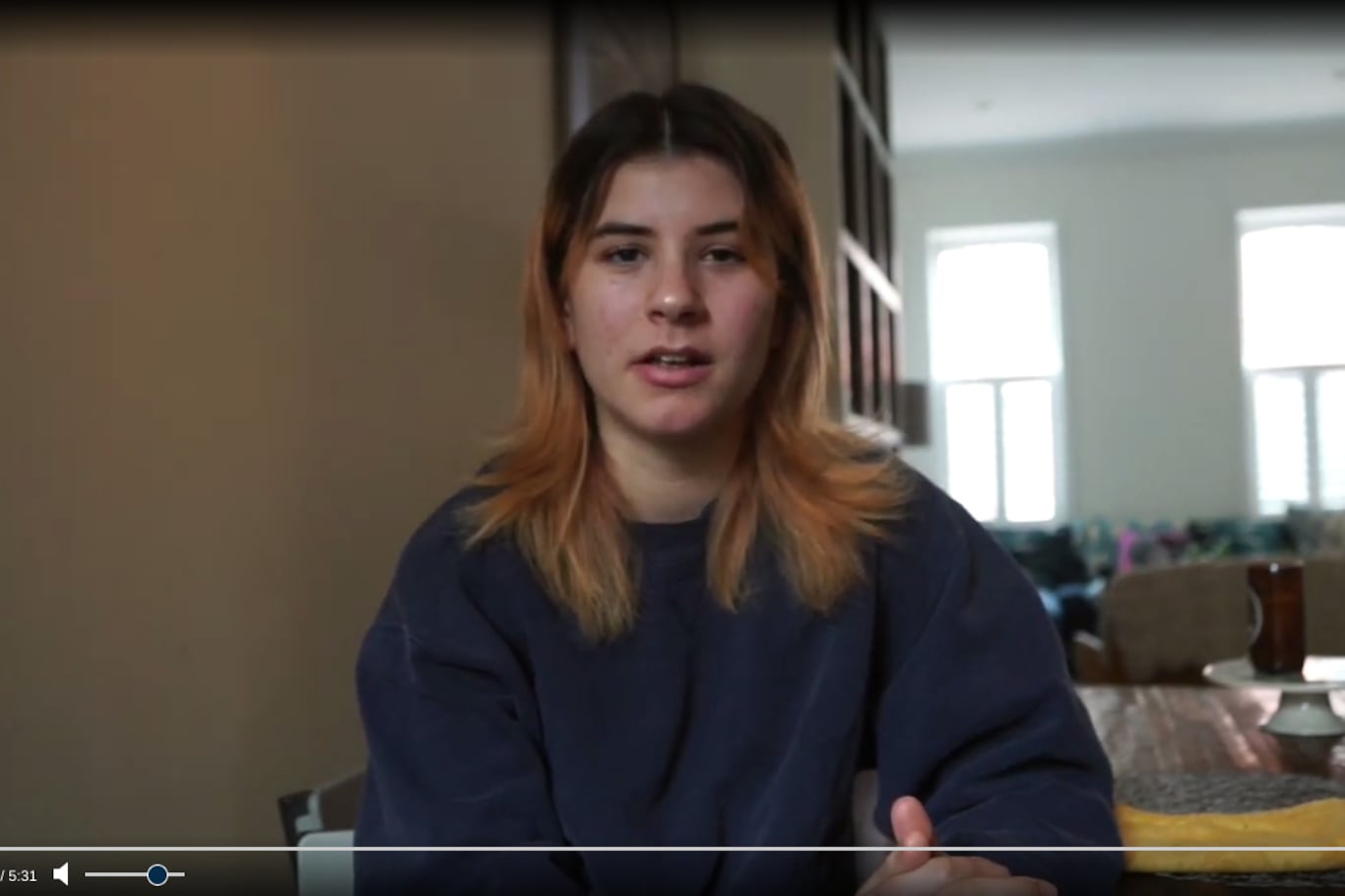
A Philadelphia student’s documentary about pollution in the Schuylkill River won her $250 and an honorable mention award from C-SPAN television network.
Hanna Roemer-Block’s piece, “Bridge Over Dirty Water,” was one of more than 1,400 videos from the U.S., Morocco, and South Korea to enter the network’s StudentCam contest, which asked students to explore a federal policy or program and report on its relevance to their lives and communities.
Roemer-Block, an 11th grade student at Science Leadership Academy, said she hadn’t expected to win. “It was a big surprise,” she told Chalkbeat.
“Bridge Over Dirty Water” makes the point that government policy, not individual action, is most important for the environment.
“A lot of people think it’s up to the community to do something about this,” she told Chalkbeat in an interview. “This is too big a problem for an individual to take on.”
Roemer-Block works with the Bartram’s Garden boating program, which teaches people to row and kayak on the Schuylkill. The river, she notes in the video, supplies drinking water for more than half of Philadelphia’s residents. Yet, as experts told her, it still bears marks of its industrial past. While water quality in the Schuylkill has improved since the Clean Water Act was passed in 1972, there’s still the problem of sewage overflow — something that may get worse as climate change brings more frequent and more severe storms.
Part of Roemer-Block’s job at Bartram’s Garden is testing the river water for E. coli bacteria — the boats don’t go out if the levels are too high — so she went into the project aware of how water pollution affects daily life. Once she had the idea of making a video about the Schuylkill, she said, “It came to life really quickly,” she said.
Roemer-Block interviewed Josef Kardos, an engineer from Toronto, who pointed out the difference between the European and American approaches to potential new toxins. He said that in Europe, new chemical substances are tested pre-manufacture to see if they’re harmful, while in the U.S., companies “just kind of dump the chemicals in the water and deal with the effects afterwards,” Roemer-Block said. “That cycle needs to be changed,” she said.
Roemer-Block made the video as part of Michael Clapper’s American history class. Clapper said the class looks at “big questions” about government policy and the individual’s role. “She took those big themes from the class and said, why do these things matter to me, and how do I make a film that answers these questions in a real-world fashion?” he said in an interview.
As if that wasn’t a challenging enough task, Clapper said, he tested positive for COVID partway through the project and had to conduct classes over Zoom. Still, many students “really embraced this project and created a number of terrific films,” he said.
“It definitely wasn’t easy,” Roemer-Block said. “There was a part toward the end of trying to edit down all my interviews, and I thought, ‘If I make it through these next two days, then I can make it through the rest of the school year,’” she said.
Videos about the environment and pollution accounted for 10 percent of the entries in this year’s contest, making it the most popular topic, C-SPAN said. “Environmental issues are becoming more drastic,” Roemer-Block said. “When people think of problems that need to be solved, they are thinking of environmental issues more and more.”
Clapper said he’s proud of the way Roemer-Block tracked down sources to interview and edited the footage to “get those perfect kernels that really move the piece along.”
“When an 11th grader can do that so well, during COVID, when their teacher’s at home, it’s a really terrific accomplishment,” he said.
Roemer-Block said she hasn’t firmed up plans for after high school, but will probably study English or some other “writing-based” subject in college. The subject of her video notwithstanding, “I’m not a very science-y person,” she said.
A panel of educators and C-SPAN representatives evaluated the videos for the competition, which is sponsored by the C-SPAN Education Foundation. Awards were based on “thoughtful examination of the competition’s theme, quality of expression, inclusion of varying sides of the documentary’s topic, and effective incorporation of C-SPAN programming,” C-SPAN said. In all, there were 150 winners.