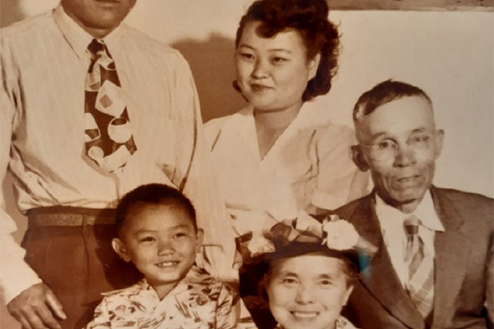
In a small Colorado town in the late 1930s, Mary Okugawa earned the right to be called valedictorian. The child of Japanese immigrants, my grandmother worked hard in school — two schools, in fact, since she also attended nihongo gakko (Japanese language school).
But when local school board members discussed who would publicly receive the academic honor, they declared that no “Jap” would get to call herself the valedictorian. Nor would a “Jap” speak at “our” graduation.
No recourse was forthcoming. There was no newspaper or viral cascade of social media to turn the tide. So that was that.
Roughly two decades later, when she lived in a Wyoming farm town about 90 miles from the site of a World War II Japanese-American internment camp, a nearby pool refused to serve people of Japanese descent. Mary Ujifusa’s moral indignation in response to this bigotry burned too hot to cool off. She shamed the resort into serving her and people like her. She also fought to repeal the state’s anti-miscegenation law. During these fights, Grandma Mary must have thought: Oh no, not any more.
My grandmother’s struggles, far from making her cynical, made it only more important to her that her children would succeed in spite of such obstacles. She passed her passion for education on to my father, to me, and other family members.
I can’t pinpoint the moment when I knew I wanted to be an education journalist. But a big part of what’s driven my work covering schools comes from my grandmother, her belief in nurturing children, and her determination to do the right thing and do right by her family.
Reporters and editors discuss their duty to hold power to account. In a different world, perhaps a reporter would have heard about the high school and written a story that would have changed the outcome. I have an obligation to remember that at Chalkbeat.
Perhaps you’ve assumed that I learned about my grandmother’s experiences with racism and discrimination directly from her, in emotional conversations. Not so. I learned of them by reading about them in an oral history project involving my dad.
Self-restraint, modesty, and a desire not to relive the experience might explain why my grandmother never shared those stories with me. They underscore why journalists must be patient and careful when talking with those students, families, educators, and others who might fear telling their stories and how the world will respond.
But that aside, I’ve highlighted the detail of reading about a family experience to underscore that even as 15-second videos, podcasts, and cable news define much of the media landscape, the written word maintains a unique power to educate and sway us.
Just as people in the news business have an obligation to readers and the general public, as an editor, I have an obligation to reporters and the words they use (and don’t use).
I’ve had an eclectic career involving education. My first job after college was teaching conversational English at two high schools in rural Japan. From this work, I learned respect for what educators do, observed comical classroom moments, and realized what students bring to school often escapes notice or action.
My work covering education has taken me to small towns in Mississippi, Washington, D.C., and the aftermath of a hurricane in Puerto Rico. The diversity of these experiences enhances the ways in which I can turn that sense of obligation into helping our newsroom craft meaningful and captivating stories.
In a similar way, Chalkbeat recognizes that the story of education in America is not a monolith best told from a static perch. The story must be told from Chicago, Detroit, Denver, Nashville, New York, Newark, and all sorts of places in between. That’s Chalkbeat’s mission. I’m excited to be a part of it.
I hope Grandma Mary would be proud.
Andrew Ujifusa is a story editor at Chalkbeat.